
How to Evaluate a VOC Emissions Control Manufacturer for Coating Line Compliance
Selecting the right VOC emissions control manufacturer is a critical procurement decision for coating lines facing stricter permits, production targets, and operating-cost pressure.
Buyers must assess more than advertised removal efficiency. System compatibility, compliance expertise, energy consumption, service responsiveness, and proven application experience determine whether a project succeeds.
A suitable supplier should provide a technically defensible solution, predictable lifecycle costs, reliable operating data, and support through permitting, commissioning, and future production changes.
Start With Your Compliance and Process Requirements
Procurement teams should begin with their own operating conditions rather than requesting generic proposals from every VOC emissions control manufacturer in the market.
The first question is which regulations apply to the site. Requirements may come from national laws, local air permits, industry standards, customer expectations, or export-market rules.
Ask environmental managers to clarify the required destruction efficiency, allowable outlet concentration, total annual VOC limit, monitoring obligations, and reporting frequency before issuing requests for quotation.
Coating line emissions are rarely constant. VOC concentration changes with coating formulation, solvent content, flash-off time, booth airflow, oven conditions, production volume, and cleaning activities.
A manufacturer cannot size equipment accurately without representative operating data. Buyers should provide minimum, normal, and maximum exhaust flow, VOC concentration, temperature, humidity, and contaminant composition.
It is also important to identify hazardous air pollutants, silicone compounds, particulate matter, halogenated solvents, or catalyst-poisoning chemicals that may affect treatment technology selection.
For example, a regenerative thermal oxidizer may suit high-volume solvent emissions, while a carbon adsorption system may offer better economics for intermittent or lower-concentration exhaust streams.
Do not assume the existing ventilation design is appropriate. Excessive booth airflow can significantly increase treatment-system size, fuel demand, electricity use, and long-term compliance costs.
A capable manufacturer should review the complete coating process, including spray booths, flash zones, curing ovens, mixing rooms, solvent storage, and purge-air sources.
This wider process view matters because untreated side streams can undermine permit compliance even when the primary VOC control system performs as specified.
Assess Technology Fit Instead of Comparing Removal Efficiency Alone
Removal efficiency is an essential specification, but it does not prove that a system will operate reliably with the coating line’s real exhaust profile.
Buyers should ask each supplier to explain why its proposed technology matches the site’s airflow, VOC loading, production schedule, coating chemistry, and utility availability.
Thermal oxidizers destroy VOCs through combustion and are commonly selected for stable, high-volume industrial coating applications with meaningful solvent loading.
Regenerative thermal oxidizers can recover heat from treated exhaust, reducing supplemental fuel consumption when inlet VOC levels and operating hours justify the investment.
Regenerative catalytic oxidizers operate at lower temperatures, but catalyst performance can be affected by contaminants such as phosphorus, sulfur, silicone, heavy metals, or chlorinated compounds.
Carbon adsorption captures VOCs rather than immediately destroying them. It can be useful for lower concentrations, intermittent emissions, solvent recovery, or polishing applications.
Concentrator systems may combine zeolite adsorption with a thermal oxidizer. They reduce the volume of air requiring oxidation and can lower fuel demand in high-airflow coating operations.
Biofiltration, condensation, and hybrid systems may also be relevant, particularly where emissions contain recoverable solvents or where thermal treatment faces operating constraints.
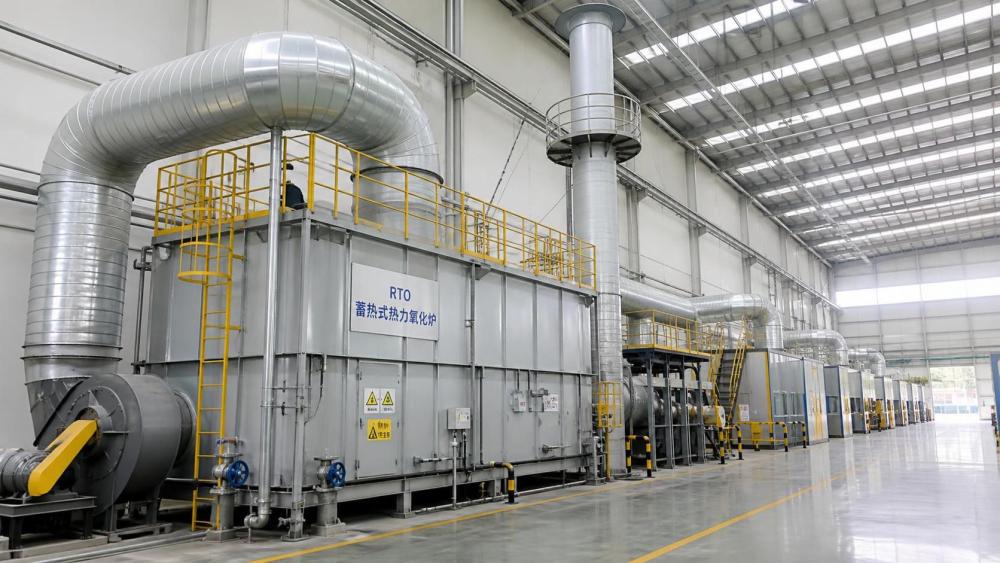
A credible VOC emissions control manufacturer should state the conditions under which its solution performs well and identify limitations before contract award.
Be cautious when proposals use identical destruction-efficiency claims but provide little detail about residence time, combustion temperature, catalyst condition, pressure drop, or operating turndown.
Ask suppliers to model expected emissions at different production rates. Compliance should be demonstrated during startup, normal production, line cleaning, and low-load operating periods.
The proposed design should also account for future coating changes. A system selected only for today’s solvent formulation may become unsuitable after reformulation or capacity expansion.
Verify Compliance Capability With Evidence, Not Marketing Claims
Procurement decisions should be based on documented evidence that the supplier can help similar facilities meet applicable VOC permit conditions over time.
Request project references for coating lines with comparable substrates, coating chemistry, airflow range, production hours, and regulatory requirements. Generic industrial references are less valuable.
Ask whether the referenced systems have passed third-party stack testing, regulatory inspections, performance guarantees, and emissions reporting requirements after commissioning.
A strong supplier should explain how it calculates guaranteed outlet concentrations and destruction efficiency, including the assumptions used for inlet concentration and exhaust flow.
Review whether guarantees cover the complete system or only the oxidizer chamber. Duct leakage, bypass events, capture inefficiency, and auxiliary exhaust streams can affect actual compliance.
Manufacturers should also provide recommended continuous monitoring instruments, alarm logic, calibration procedures, and data-recording methods required by site permits.
For thermal systems, typical compliance records may include combustion temperature, fan status, burner operation, pressure readings, airflow, and control-system alarm history.
For adsorption systems, monitoring may include bed temperature, differential pressure, breakthrough indicators, regeneration sequence data, solvent concentration, and carbon replacement records.
Evaluate whether the manufacturer can support local permitting documentation. This may include process-flow diagrams, equipment specifications, mass-balance calculations, emissions estimates, and control narratives.
Environmental compliance specialists should review supplier documentation before purchase orders are issued. A technically attractive proposal can create delays if permit information is incomplete or inconsistent.
Buyers should also confirm who is responsible for acceptance testing. Define test methods, sampling locations, operating conditions, pass criteria, retest procedures, and corrective-action responsibilities contractually.
Calculate Total Cost of Ownership Across the Equipment Lifecycle
Lowest capital cost is often a poor indicator of the best commercial outcome. VOC treatment systems create ongoing utility, maintenance, labor, testing, and downtime costs.
Request a lifecycle cost model covering at least five years, preferably ten years for larger coating lines with significant fuel and electricity consumption.
The model should include natural gas, electricity, compressed air, cooling water, replacement media, catalyst replacement, spare parts, preventive maintenance, stack testing, and operator training.
For thermal oxidizers, fuel use depends heavily on heat recovery, inlet VOC concentration, exhaust temperature, airflow stability, insulation quality, and operating hours.
Suppliers should distinguish between normal fuel use and worst-case operation. Low-VOC production periods may require substantially more supplemental fuel than average calculations suggest.
Electricity costs can also become material. Large induced-draft fans, recirculation blowers, rotary concentrators, pumps, and control equipment may operate continuously throughout production shifts.
Ask for fan curves, motor ratings, variable-frequency-drive assumptions, pressure-drop estimates, and annual operating-hour calculations used in the proposal.
Maintenance planning deserves equal attention. Rotary valves, dampers, burner components, heat-exchanger media, adsorption beds, sensors, and refractory materials require scheduled inspection and replacement.
Compare recommended maintenance intervals with local staffing capabilities. A sophisticated system is less valuable when site personnel cannot maintain it without frequent emergency service visits.
Downtime costs should be quantified. If the VOC control system stops, the coating line may be forced to reduce output, suspend spraying, or risk non-compliant operation.
Procurement teams should request estimated availability, critical spare-parts lists, lead times, and a clear definition of components that can shut down the line.
Evaluate Engineering Quality and Integration With the Coating Line
VOC control equipment does not operate independently. Its performance depends on proper integration with exhaust collection, coating application equipment, ovens, controls, utilities, and safety systems.
Review the manufacturer’s engineering scope carefully. Some suppliers provide a treatment unit only, while others take responsibility for ductwork, fans, controls, installation support, and commissioning.
Ambiguous boundaries create project risk. The contract should clearly identify responsibility for capture hoods, exhaust balancing, structural supports, electrical connections, gas piping, and stack design.
Ask for preliminary layout drawings that show equipment footprint, maintenance access, lifting clearance, duct routes, stack location, control panels, and utility tie-in points.
Space constraints often affect final cost. A compact system may require more complex ducting, special foundations, rooftop installation, crane access, or additional noise-control equipment.
Confirm that the proposed design accommodates process upset conditions. Examples include coating booth fan failures, sudden concentration changes, high-temperature exhaust, power interruption, and emergency shutdown.
Safety interlocks should prevent coating application when the control system is unavailable, unless a documented alternative compliance strategy has been approved by environmental authorities.
For combustible solvents, suppliers must demonstrate how the design addresses lower explosive limit conditions, dilution air, purge sequences, explosion relief, and fire detection.
Control-system integration is another procurement checkpoint. Determine whether the VOC unit will communicate with the coating line through PLC signals, plant SCADA, remote monitoring, or alarm systems.
Reliable data exchange supports safe sequencing. It can prevent spraying before treatment equipment reaches operating temperature and provide auditable records for compliance investigations.
Check Manufacturing Quality, Service Capacity, and Global Support
Equipment quality matters, but service capability often determines the ownership experience after installation. Buyers should examine the manufacturer’s support model with the same rigor.
Ask where equipment is fabricated, whether critical components are made in-house, and how the manufacturer controls welding, refractory installation, electrical assembly, and factory testing.
Quality documentation may include material certificates, inspection records, pressure tests, electrical test reports, control-panel checks, and factory acceptance test procedures.
For international projects, verify whether the supplier can provide local electrical standards, regional certification, multilingual documentation, export packaging, and field support in the destination country.
Service response is especially important for production-critical coating lines. Request documented response times, remote diagnostic capabilities, local service coverage, and escalation contacts.
Buyers should determine whether spare parts are stocked regionally. Long lead times for burners, sensors, drives, control modules, or specialized media can create expensive production interruptions.
Review training provisions in detail. Operators need practical instruction on startup, shutdown, alarms, abnormal conditions, daily inspections, recordkeeping, and basic troubleshooting.
Maintenance teams should receive separate training on preventive maintenance, calibration, combustion systems, mechanical inspections, replacement procedures, and safe lockout practices.
A good VOC emissions control manufacturer will provide manuals that match the supplied configuration rather than delivering generic documentation that lacks site-specific operating guidance.
Consider financial and organizational stability as well. Long-lived emissions equipment requires a supplier likely to remain available for upgrades, replacement components, compliance support, and service.
Use a Structured Supplier Comparison and Contract Review
Procurement teams can reduce subjective decisions by using a weighted supplier scorecard rather than relying primarily on initial price or sales presentations.
Typical evaluation categories include compliance capability, technology fit, lifecycle cost, project engineering, reference quality, service coverage, delivery certainty, safety design, and contract terms.
Assign greater weight to compliance and operating cost than to minor differences in purchase price. Permit failure or excessive fuel use can erase initial savings quickly.
Require each bidder to submit comparable data in a standardized format. This makes it easier to identify omitted costs, different assumptions, and unsupported performance claims.
Key commercial terms should include performance guarantees, utility-consumption assumptions, installation scope, commissioning obligations, operator training, warranty length, and liquidated damages where appropriate.
Guarantees should define the measurement method precisely. A guaranteed result is only meaningful when testing conditions reflect actual coating-line operation and approved compliance requirements.
Review exclusions carefully. Suppliers may exclude variable coating formulations, upstream capture performance, external utility failures, contaminants, or production conditions that occur regularly in practice.
Do not treat exclusions as routine legal language. Each exclusion should be assessed against the facility’s known operating risks and the organization responsible for controlling them.
A pre-award technical meeting can resolve major uncertainties. Include procurement, environmental compliance, plant engineering, maintenance, production, safety, and the proposed manufacturer.
This review should confirm the final design basis, schedule, interfaces, acceptance test plan, startup sequence, documentation deliverables, and ongoing service responsibilities.
Conclusion: Choose the Manufacturer That Can Defend Long-Term Compliance
The best VOC emissions control manufacturer is not simply the supplier offering the highest stated destruction efficiency or the lowest quoted equipment price.
For coating-line buyers, the right partner understands the actual emission profile, supports permit compliance, integrates safely with production, and provides transparent lifecycle cost assumptions.
Strong evaluation combines environmental requirements, process data, technology suitability, engineering scope, reference validation, service readiness, and carefully written performance guarantees.
When procurement teams compare suppliers through this framework, they can select a VOC control solution that protects production continuity, reduces compliance risk, and supports predictable long-term operating costs.