
Meeting VOC Limits Starts With the Compliance Boundary
Electrostatic coating engineers can meet tighter VOC limits without accepting a visibly weaker finish, but only when compliance and finish quality are treated as one process-control problem. A low-VOC material alone does not guarantee a compliant line. Equally, a high-transfer-efficiency electrostatic gun does not automatically protect gloss, color consistency, adhesion, or corrosion performance.
The first engineering question is therefore not simply, “Which coating has the lowest VOC content?” It is: “What is the regulated emission point, and which variables determine the mass of solvent that actually leaves the process?” Depending on the facility and jurisdiction, the applicable obligation may concern coating VOC content, VOC applied per unit of production, total facility emissions, capture efficiency, destruction efficiency, or a combination of these measures. A finish can meet a supplier's technical data sheet target and still create a compliance problem if solvent additions, cleaning materials, flash-off losses, booth exhaust, or production volume are not included in the operating picture.
For technical evaluators, the practical conclusion is clear: protect finish quality by reducing unnecessary solvent use and coating waste first. End-of-pipe controls may still be necessary, but they should not be used to compensate for unstable application conditions or an unsuitable coating system.
Separate Material VOC From Line-Level VOC Performance
Coating formulations are often compared through a single VOC value. That figure is useful, but it is not enough for an engineering decision. The relevant material state is the ready-to-spray mixture, including reducers, catalysts, thinners, and any permitted adjustment solvent. A coating that is compliant in its supplied form can move outside the intended operating range when viscosity is corrected on the shop floor without disciplined mix control.
Waterborne, high-solids, powder, UV-curable, and lower-solvent liquid systems can all reduce solvent emissions under the right conditions. Their finish behavior, however, differs substantially. Higher-solids liquid coatings may require more careful atomization and film-build control. Waterborne materials can be sensitive to humidity, substrate condition, grounding, and flash-off management. Powder coatings eliminate many liquid-coating solvent concerns, yet they introduce their own requirements around charging, reclaim quality, film thickness, cure profile, and appearance on complex geometries.
A low-VOC transition should therefore begin with a material-and-process qualification plan, not a purchasing substitution. The plan should establish:
- VOC content of the ready-to-spray material and all associated solvents;
- the allowable viscosity, temperature, pot-life, and conductivity window;
- target dry-film thickness by part geometry and exposure requirement;
- required color, gloss, distinctness of image, texture, adhesion, and corrosion criteria;
- flash-off and cure conditions needed to achieve those properties;
- the cleaning and changeover materials that contribute to solvent use.
That approach prevents a common failure mode: selecting a compliant formulation, then restoring familiar spray behavior through excessive reduction. The coating may appear easier to apply, but the VOC benefit narrows and film build becomes less predictable.
Transfer Efficiency Is a Finish-Control Variable
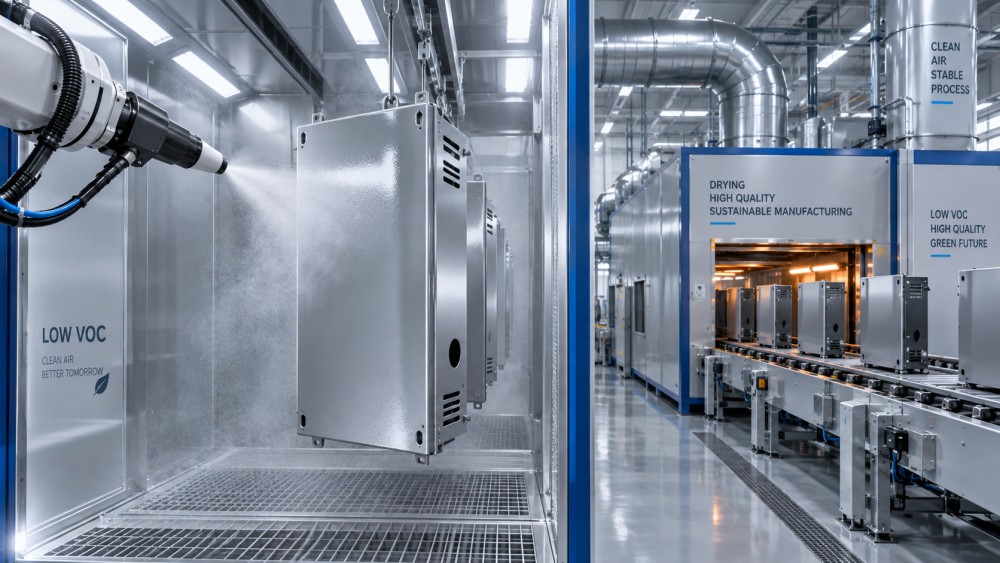
Electrostatic application is valuable because it can improve the proportion of coating deposited on the part rather than lost to booth exhaust, overspray, or recovery systems. Yet transfer efficiency should not be pursued as an isolated maximum. An overly aggressive electrostatic field can produce back ionization, uneven deposition, edge build-up, Faraday-cage effects in recessed areas, or wrap that looks efficient from one viewing angle while leaving hidden surfaces undercoated.
Finish quality depends on the interaction of voltage, current limit, gun-to-part distance, spray pattern, atomization, fluid delivery, part orientation, conveyor speed, and grounding. The appropriate settings vary with coating chemistry, target thickness, part geometry, and line speed. For a broad flat panel, higher electrostatic attraction may support good coverage with low waste. For a fabricated enclosure with deep corners, welded seams, and internal channels, the same setting can create visible build on external edges while starving recesses.
Engineers should evaluate transfer efficiency alongside coverage uniformity. A useful review looks at coating deposited per part, dry-film thickness distribution, reclaim or waste volume, booth loading, and visual defects over a representative production run. This is more informative than a single transfer-efficiency claim made under ideal test conditions.
Grounding deserves particular attention. Poor or inconsistent grounding reduces electrostatic attraction and often leads operators to compensate by increasing voltage, fluid flow, or repeat passes. Those responses can increase overspray and distort film build without solving the underlying issue. Fixtures, hooks, contacts, conveyor interfaces, and part-to-ground continuity need routine verification, especially where paint buildup, corrosion, oxide layers, or frequent tooling changes are present.
Reduce Solvent Demand Before Adding Abatement Capacity
When a line approaches an emissions limit, installing capture and abatement equipment may appear to be the fastest answer. It can be necessary where permitted emissions cannot otherwise be achieved. But abatement capacity is expensive to operate, and its effectiveness depends on stable collection conditions. If the coating process is generating avoidable overspray or excessive solvent vapor, the facility carries both a compliance burden and a finish-quality burden.
Source reduction usually begins with the parts of the process that receive less attention than the spray booth itself. Closed or controlled mixing, calibrated dispensing, temperature management, and documented viscosity adjustment can materially reduce variation. So can reducing the number of color changes, minimizing open containers, and replacing broad manual flushing practices with controlled cleaning procedures where compatible with the coating system.
For liquid electrostatic coating, material temperature is particularly important. A stable temperature can improve viscosity consistency and support atomization with less reliance on added reducer. The target is not to heat material indiscriminately. Excessive temperature can shorten pot life, alter application behavior, affect safety controls, or create a finish that behaves differently after cure. The correct setting must be qualified with the coating supplier's process recommendations and the actual equipment configuration.
Booth air balance also affects the result. Too little airflow can allow airborne coating to recirculate, increasing dirt and deposition defects. Excessive airflow can pull atomized material away from the part, reduce effective wrap, raise material consumption, and increase the load presented to the exhaust system. A compliant booth is not simply one with high exhaust volume; it is one that maintains containment and capture while allowing the electrostatic process to deposit coating consistently.
Do Not Treat Cure as a Separate Quality Issue
VOC control efforts frequently shift formulation and film-build behavior, which makes curing more consequential. A coating that looks acceptable as it enters the oven may develop gloss variation, solvent popping, pinholes, poor adhesion, or incomplete crosslinking if flash-off and cure conditions are not aligned with the applied film thickness. Increasing solids content or reducing solvent may change how readily volatiles escape before the film skins over.
Cure validation should reflect the part, not only the oven setpoint. Heavy and light substrates, complex assemblies, and densely loaded racks can experience different metal temperatures even when the oven display remains constant. For critical finishes, the engineering record should connect oven conditions to verified part temperature, dwell time, film thickness, and final performance tests.
This matters for compliance as well as appearance. Rework adds coating, solvent, cleaning activity, energy use, and emissions. A line that meets its nominal VOC calculation but produces frequent cosmetic rejects may be much less robust than the calculation suggests. First-pass yield belongs in the same operating review as emission performance.
Use Recovery Systems With a Clear Quality Strategy
Recovery can lower material consumption and reduce the amount of coating directed to waste, especially in powder coating and in selected liquid applications. It also creates a quality-control question: whether recovered material remains consistent enough for the required finish.
For powder systems, reclaimed powder can differ from virgin material in particle-size distribution, contamination level, charge behavior, and pigment balance. These changes may become visible in color, texture, gloss, or film uniformity. Reclaim ratios should be determined by finish tolerance and verified through controlled quality checks, rather than set solely around material-saving targets.
In liquid systems, recovered overspray is generally more difficult to reuse because solvent loss, contamination, and changes in composition can affect application and cure. Where recovery is technically feasible, it requires defined segregation, conditioning, testing, and traceability. For premium cosmetic surfaces or tightly controlled corrosion systems, disposal reduction may need to be achieved through better transfer efficiency and recipe discipline rather than aggressive reuse.
Build a Compliance Record That Can Explain Process Changes
VOC compliance is difficult to defend when production records show only the final emissions figure. Technical evaluators should be able to trace material consumption, mix ratios, solvent additions, production throughput, booth operating state, and abatement status to the same production period. The level of detail should match the regulatory obligation and the risk of the process, but the record must be sufficient to explain why emissions changed.
A practical control plan normally links compliance information to quality information. If solvent use rises, the review should ask whether viscosity drifted, material temperature changed, atomization quality declined, a new part geometry was introduced, first-pass yield fell, or cleanup activity increased. If gloss or adhesion shifts, the review should examine whether the corrective action could also affect VOC emissions.
Evaluate the Line Under Its Hardest Normal Conditions
The most convincing demonstration of electrostatic coating engineering VOC compliance is not a successful run on a simple, clean, flat part at moderate throughput. It is stable performance across the operating conditions that normally challenge the line: difficult geometries, maximum planned throughput, color changeovers, humid or dry ambient conditions, variable substrate mass, and realistic maintenance intervals.
Before approving a process change, technical teams should define the conditions that represent normal production risk and qualify both emissions performance and finish acceptance within that range. This avoids a narrow compliance solution that fails once production volume rises or part mix changes.
VOC limits do constrain coating choices and line design, but they do not require a lower-grade finish. The strongest results come from controlling the whole deposition system: material preparation, electrostatic application, grounding, airflow, flash-off, cure, recovery, and rework. When those elements are measured together, lower solvent use often improves process repeatability as well as regulatory performance.