
Eco-Spray Booths Cost Breakdown: What Drives Capex, VOC Control, and Operating Expense
Understanding eco-spray booths cost is essential when capital approval depends on both compliance and long-term efficiency.
The purchase price is only the visible layer. Real cost sits in airflow, VOC treatment, utilities, maintenance, and throughput stability.
That is why a useful eco-spray booths cost review must separate initial capex from operating expense and compliance risk.
In practical terms, two systems with similar booth prices can create very different five-year ownership costs.
The breakdown below focuses on what usually moves budget decisions fastest, especially in regulated coating operations.
Why Eco-Spray Booths Cost Varies So Much
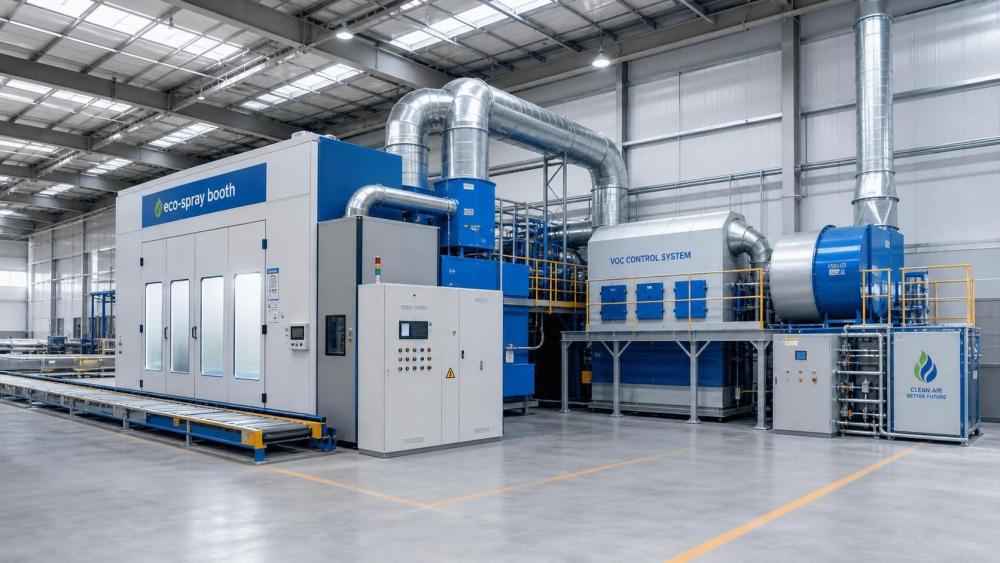
Eco-spray booths cost can vary widely because the booth is only one part of the coating system.
A basic open-face setup may handle light production. A sealed automated line with VOC abatement serves a very different factory profile.
The main cost drivers usually include booth size, air volume, exhaust treatment, automation, controls, and local permitting requirements.
Material choice matters too. Powder coating, water-based paint, and solvent-heavy finishes create different design and compliance needs.
From a finance view, the key question is not whether the system is advanced. It is whether each added feature protects cost or output.
Capex Drivers in an Eco-Spray Booth Project
Initial eco-spray booths cost usually starts with the booth enclosure, fan package, ducting, lighting, and control panel.
After that, capex rises through a series of practical additions rather than one dramatic item.
1. Airflow Design and Booth Configuration
Crossdraft booths cost less upfront, but they may deliver less uniform capture in demanding finishing environments.
Downdraft and side-draft designs often require more structure, more fan power, and tighter balancing.
That raises eco-spray booths cost, yet it can reduce rework, overspray escape, and operator exposure.
2. Filtration Stages and Media Type
Single-stage filters keep capex lower. Multi-stage systems improve particle capture and prepare exhaust for VOC control equipment.
HEPA-grade or specialty media adds cost quickly, especially where finish quality or environmental rules are strict.
3. Automation and Material Handling
Manual booths can look attractive on a capex sheet. However, robotic guns, conveyors, and recipe controls may lower labor variance.
For high-volume lines, automation can improve transfer efficiency and reduce paint waste enough to justify higher eco-spray booths cost.
4. Explosion Protection and Safety Integration
Fire suppression, interlocks, spark-resistant components, and hazardous area compliance are not optional in many facilities.
These features may not raise output directly, but they reduce shutdown risk and support insurance and audit readiness.
How VOC Control Changes the Cost Structure
VOC control is often the point where eco-spray booths cost moves from equipment pricing into environmental system design.
A booth that handles overspray well still may fail budget expectations if VOC treatment is added late.
Common options include activated carbon adsorption, thermal oxidizers, catalytic oxidizers, and hybrid recovery systems.
Each option changes both capex and energy demand. It also affects maintenance schedules, media replacement, and permit complexity.
When Carbon Systems Make Sense
Carbon adsorption can fit lower flow rates or variable production patterns. Initial investment may be moderate.
But ongoing media replacement can raise operating expense if solvent loading is high or process control is inconsistent.
When Oxidizers Become Necessary
Thermal and catalytic oxidizers increase eco-spray booths cost sharply at purchase. They also add fuel, heat recovery, and service needs.
Still, they can be the more economical path where VOC concentrations are steady and compliance margins are tight.
Operating Expense Often Decides the Real Payback
Many approvals focus too heavily on purchase price. In reality, operating expense often determines whether eco-spray booths cost stays manageable.
The biggest recurring costs usually come from four areas.
- Electricity for fans, pumps, conveyors, and controls.
- Gas or thermal energy for make-up air and VOC destruction.
- Filter media, carbon replacement, and waste disposal.
- Labor for cleaning, tuning, and unscheduled repairs.
Air recirculation design can reduce utility bills, but only when local codes and contamination risks allow it.
Variable frequency drives can also lower energy use during low-load periods. That matters more than many buyers expect.
In actual operations, small efficiency gains repeated across shifts can outweigh a modest discount on initial eco-spray booths cost.
A Practical Cost Comparison Framework
A clear side-by-side model helps separate supplier claims from decision-grade numbers.
This framework works best when suppliers provide duty-cycle assumptions, not just nameplate specifications.
Without that detail, eco-spray booths cost estimates can look precise while hiding major operating uncertainty.
Questions That Expose Hidden Cost
The fastest way to improve a purchase review is to ask sharper questions early.
- What VOC load and airflow basis was used for sizing?
- Which utility costs were assumed in the operating model?
- How often do filters or carbon beds need replacement?
- What output loss occurs during cleaning or changeover?
- What compliance margin remains if production volume increases later?
- Which maintenance tasks require outside service support?
These questions usually reveal whether low eco-spray booths cost is genuine or simply shifted into future operating burden.
How to Approve the Right System
A strong approval decision balances three outcomes: compliant emissions, stable production, and controllable lifetime cost.
That means the best option is rarely the cheapest quote and not always the most advanced system.
The more reliable path is to compare eco-spray booths cost across five years using real production hours, local energy rates, and maintenance intervals.
When that model includes VOC control, downtime exposure, and consumables, weak proposals usually become obvious.
For industrial buyers evaluating auxiliary process systems, this discipline matters because support equipment quietly shapes yield, compliance, and profitability.
Eco-spray booths cost should therefore be treated as a full-process investment, not a standalone equipment line item.
Start with the operating profile, stress-test the VOC strategy, and approve only the system whose total cost logic remains credible under real factory conditions.