
Why does eco-friendly coating compliance now sit at the center of quality control?
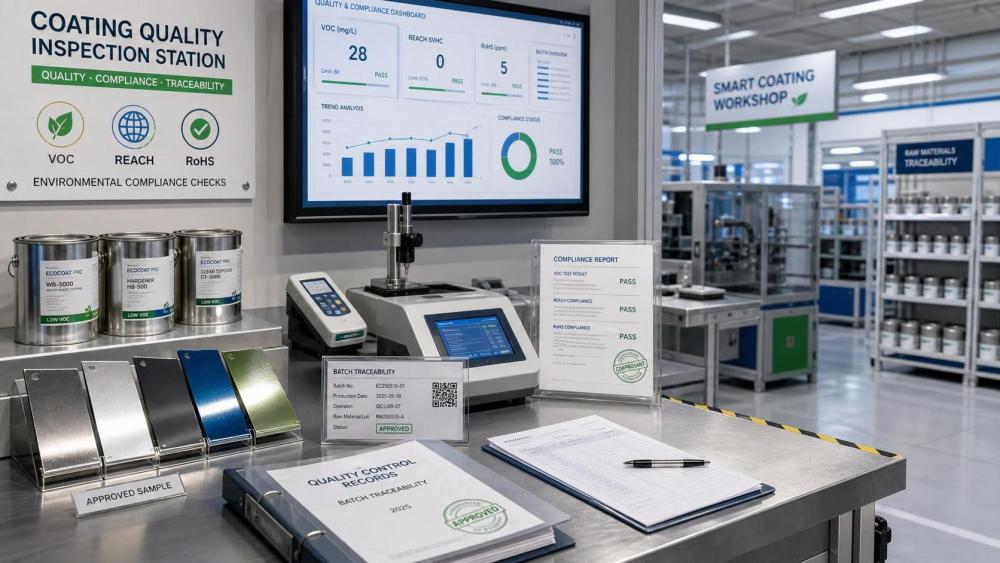
Eco-friendly coating compliance has moved beyond branding language. It now affects shipment approval, worker exposure control, recall risk, and cross-border product acceptance.
In practical terms, coatings are no longer judged only by gloss, adhesion, or corrosion resistance. They are also judged by the chemical profile behind that performance.
That is why VOC, REACH, and RoHS checks matter so much. They touch air emissions, substance restrictions, and material declarations at the same time.
For industrial lines using electrostatic coating, surface treatment, vacuum-assisted processes, precision cleaning, or coded traceability, one weak compliance link can disrupt the whole release process.
A coating may still pass appearance inspection and fail market access. That gap is where most compliance surprises begin.
A more useful question is not whether a coating is marketed as green. It is whether the formulation, process, and records support real eco-friendly coating compliance.
When people ask about VOC, REACH, and RoHS, what are they really checking?
The three checks sound similar, but they answer different risks. Mixing them together often leads to incomplete verification.
VOC checks focus on emissions and process exposure
VOC compliance usually asks how much volatile organic content is present during storage, spraying, curing, or drying.
This matters for workplace safety, local environmental permits, and coating shop design. It also affects fire load, ventilation demand, and solvent recovery planning.
REACH checks focus on substance risk inside the formulation
REACH is not just a document request. It is a substance management issue, especially for SVHCs, restricted chemicals, and evolving supplier declarations.
In coatings, the concern may involve resins, pigments, additives, catalysts, or pretreatment residues. A small additive can trigger a large documentation burden.
RoHS checks focus on restricted hazardous substances in finished articles
RoHS is commonly linked with electronics, but coated components for electrical, control, or connected equipment often fall into its orbit.
The coating itself may contribute lead, cadmium, chromium VI, or certain flame-related substances, depending on the formulation and application system.
Simply put, VOC asks what may evaporate, REACH asks what substances create legal concern, and RoHS asks what restricted chemicals remain in the finished product.
Which checks matter most before approving a coating for production use?
The most important checks are the ones that can block production, shipment, or customer acceptance first. That priority is usually more practical than checking everything equally.
A fast screening table helps separate paperwork comfort from real eco-friendly coating compliance risk.
Before release, the strongest practice is to combine document review with process review. One without the other leaves blind spots.
In advanced manufacturing, that often means connecting coating data with cleaning records, laser or inkjet traceability, weighing accuracy, and curing stability.
This is also where platforms such as GIAS become useful. They frame coating compliance as part of a wider auxiliary process chain, not as an isolated chemical checkbox.
Are supplier certificates enough, or do you still need in-house verification?
Certificates are necessary, but they are rarely sufficient on their own. Most failures happen in the space between supplier data and factory reality.
For example, a coating can be compliant in its delivered state but perform differently after dilution, mixing, line contamination, or incorrect bake profiles.
That is why eco-friendly coating compliance should be checked at three levels:
- Supplier level: SDS, technical data sheet, declaration of conformity, and latest regulatory statement.
- Incoming level: batch identity, shelf life, packaging integrity, and consistency with approved formulation.
- Process level: actual application parameters, oven profile, transfer efficiency, emissions behavior, and final part traceability.
A useful in-house question is simple: if an auditor asks which finished lots used a specific coating batch, can that answer be produced quickly?
If the answer depends on emails or manual guesswork, the compliance system is weaker than it looks.
Where do coating teams usually misjudge eco-friendly coating compliance?
The biggest mistake is treating compliance as a purchasing document instead of a process control topic. That creates late surprises during audit, export, or customer review.
Mistake 1: Assuming low VOC means fully compliant
Low VOC helps, but it does not clear REACH or RoHS risks. A water-based coating can still contain restricted substances.
Mistake 2: Ignoring pretreatment and cleaning chemistry
In real production, coating performance depends on upstream cleaning and surface preparation. Residues from ultrasonic cleaning, degreasing, or pretreatment can complicate compliance claims.
Mistake 3: Forgetting the role of equipment stability
Electrostatic coating settings, pump behavior, batching accuracy, and vacuum-assisted steps can all change film build and cure behavior.
When process drift changes coating consumption or emissions, eco-friendly coating compliance can shift without any formula change.
Mistake 4: Using static declarations in a dynamic regulatory environment
REACH candidate lists evolve. Internal approvals should therefore include review dates, not just archived certificates.
How should you compare coating options when performance and compliance seem to conflict?
This is one of the most common real-world questions. A lower-risk chemistry may appear weaker until the full process is adjusted around it.
Rather than comparing coatings on a single lab panel, compare them through the production route that will actually use them.
- Check substrate condition after cleaning and pretreatment.
- Measure transfer efficiency in the intended electrostatic setup.
- Review cure window, energy demand, and ventilation impact.
- Confirm whether coding, marking, sealing, or assembly steps affect the coated surface.
- Verify customer specification language against actual regulation scope.
More often than expected, the best option is not the coating with the boldest environmental label. It is the one with stable evidence, process fit, and fewer downstream exceptions.
That broader view matches the way GIAS approaches auxiliary systems. Coating quality is tied to cleaning precision, traceability, weighing control, and equipment consistency across the line.
What should be on the next-step checklist before final approval?
A short, disciplined checklist is usually more effective than a thick approval file that nobody reviews after launch.
The point is not to slow approval. The point is to make eco-friendly coating compliance predictable, auditable, and repeatable.
A sound next step is to map every approved coating against its VOC evidence, REACH status, RoHS scope, and traceability path.
Then review where auxiliary equipment influences the result, especially cleaning, batching, vacuum stability, and coating application control.
That kind of structured review reduces regulatory surprises and usually improves coating consistency at the same time.