
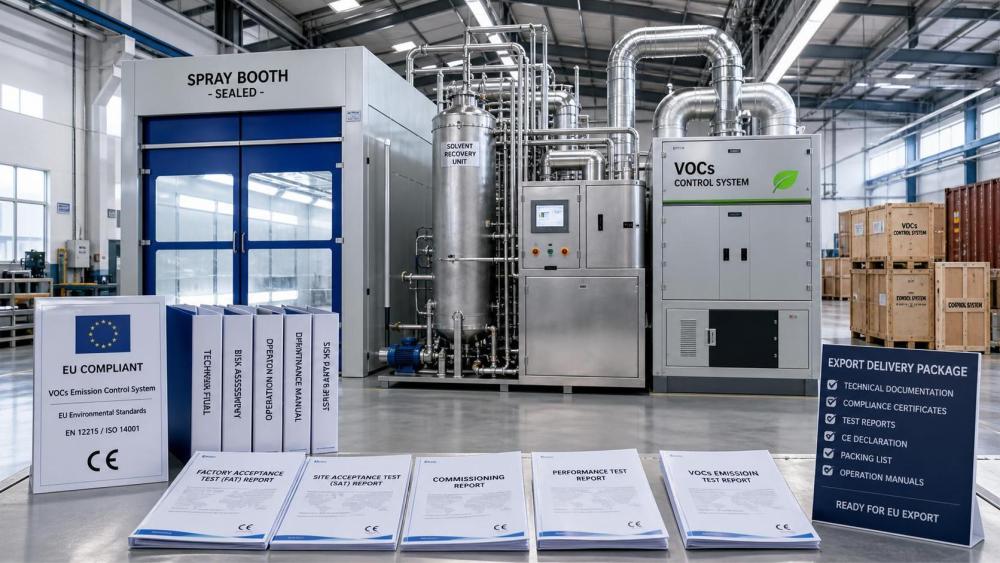
On August 1, 2026, a new compliance threshold took effect for exports of Eco-spray Booths & VOCs equipment to the EU under the detailed implementation rules for extended producer responsibility (EPR) covering packaging and printing coating equipment. The immediate point of attention is that certified VOCs reduction data, solvent recovery rate documentation, and verification reports for closed-loop cleaning systems must be submitted before customs clearance, making this not only a regulatory change but also a practical issue for exporters, certification workflows, shipment timing, and delivery planning across powder coating lines, electrostatic coating systems, and environmental spray booth supply.
What Has Formally Changed at the Border
The confirmed change is straightforward. From August 1, 2026, the EU detailed implementation rules for EPR in packaging and printing coating equipment came into force. Under this requirement, manufacturers exporting Eco-spray Booths & VOCs equipment to the EU must provide certified VOCs emissions reduction data, solvent recovery rate information, and a verification report covering the closed-loop cleaning system before customs clearance.
The requirement directly affects the export compliance path and delivery cycle for powder coating lines, electrostatic coating systems, and environmental spray booth suppliers. No additional confirmed implementation details were provided in the source input beyond these points.
Where the Pressure Will Likely Appear First
Export transactions move from product shipment to document readiness
From an industry perspective, exporters are the first group likely to feel the change because the new requirement is tied to pre-clearance documentation. The practical effect is that shipment scheduling may depend not only on production completion, but also on whether certified emissions, recovery, and system verification materials are complete and acceptable for use in customs-related processes.
Equipment manufacturers face a tighter link between technical design and compliance files
Manufacturers of powder coating lines, electrostatic coating systems, and environmental spray booths may need to pay closer attention to whether product configuration, solvent recovery performance, and cleaning-system design can be matched with compliant supporting records. Analysis shows that the impact is not limited to engineering; it also reaches technical file preparation, internal review, and handoff between production and export teams.
Certification and testing service providers may become a key part of delivery timing
Observably, where certified VOCs reduction data and verification reports are required before clearance, service providers involved in testing, validation, or certification may become more closely tied to shipment readiness. The main point here is procedural: when required documentation becomes a clearance prerequisite, delays in validation can affect downstream delivery commitments even if manufacturing is already complete.
Buyers and procurement teams may need earlier document checks
For buyers, import-facing procurement teams, and project sourcing functions, the issue is likely to shift toward earlier verification of supplier documentation. What deserves closer attention is whether tenders, purchase specifications, and pre-shipment checklists start to request the required VOCs, solvent recovery, and closed-loop cleaning verification materials in advance, rather than leaving them to the final export stage.
What Companies Should Watch in the Near Term
Check whether compliance files are complete before shipment planning
Analysis shows that companies involved in EU-bound deliveries should review whether the required certified data and verification documents exist, are current, and can be submitted before customs clearance. Where the input provides no further execution detail, it is more appropriate to treat this as a documentation readiness issue that needs active checking rather than assume a uniform market practice has already formed.
Review technical documents used in bidding and customer approval
Because the rule specifically refers to VOCs reduction data, solvent recovery rate, and closed-loop cleaning system verification, companies may need to examine whether these elements are adequately reflected in technical submissions, product dossiers, and customer-facing compliance materials. This is especially relevant where delivery depends on prior approval of technical documentation.
Reassess delivery lead times and handover points in the supply chain
From an operational perspective, firms should watch whether internal schedules still assume that compliance documentation can be finalized late in the shipping process. Observably, once a document package becomes a pre-clearance condition, lead times may depend more heavily on coordination between manufacturing, compliance review, and external validation.
Continue tracking how execution language is applied in practice
The source information confirms the rule has taken effect, but it does not provide additional detail on review standards, document format expectations, or broader enforcement practice. For that reason, companies should continue monitoring how the requirement is referenced in trade documentation, customer requests, and compliance checks tied to EU-bound orders.
Why This Reads as an Execution Signal
As an editorial observation, this update is better understood as a live execution signal than as a distant policy discussion. The key reason is timing: the requirement is already effective from August 1, 2026, and it is tied to customs clearance rather than a general sustainability statement. Analysis shows that the market relevance lies in how compliance evidence is being positioned as a condition for export movement.
At the same time, this should not be overstated. The input does not confirm broader market outcomes, enforcement intensity across cases, or the exact pace at which all participants will adjust. It is more appropriate to interpret the development as a rule now in force, with further observation still needed on implementation wording, verification practice, and commercial response.
How the Market Should Read This Update
The industry significance of this development lies in the shift from general environmental positioning to document-backed export compliance for affected VOCs-related spray equipment. For manufacturers, exporters, and buyers linked to EU shipments, the main issue is not abstract policy change but whether certified emissions, recovery, and system-verification records are ready at the point they are needed.
Current observation suggests this is best read as an already effective compliance requirement with practical consequences for export preparation and delivery sequencing, while the finer points of execution still deserve continued attention.
Source Basis and What Still Needs Verification
This article is based on the user-provided news title, event date, and event summary. For developments of this kind, commonly relevant source types may include official notices, regulatory authority releases, customs or trade administration information, industry association updates, standard-setting documents, and reporting from authoritative trade media.
No specific official source link was provided in the input, so the underlying official publication path still needs to be verified on an ongoing basis. Further observation is also needed on detailed implementation language, certification interpretation, tender document changes, market feedback, and how affected companies are applying the requirement in actual export workflows.