
Why coating facilities need a broader compliance view
China’s industrial VOC regulations have moved coating operations beyond a simple “use lower-VOC paint” approach. For factories that spray, dip coat, roll coat, print, laminate, or cure coated products, the compliance question now reaches into material approval, booth design, transfer efficiency, exhaust collection, treatment equipment, maintenance records, and site-level environmental management.
That matters because coating quality and VOC control are tightly connected. A poorly balanced spray booth may create overspray, uneven film build, dust defects, and fugitive emissions at the same time. An overloaded activated-carbon unit can create odour complaints and compliance exposure while also disrupting airflow and coating consistency. A switch to a waterborne formulation may reduce solvent content, but can introduce drying, corrosion, adhesion, or viscosity-control issues if the line was designed around solventborne materials.
For quality control and safety managers, the practical task is therefore not to interpret every regulatory document in isolation. It is to build an operating system that can demonstrate control: which materials enter the site, where VOCs are generated, how exhaust is collected, whether treatment equipment is functioning, and whether the plant can provide credible records during an inspection, customer audit, incident investigation, or permit review.
China’s national legal framework includes the Law of the People’s Republic of China on the Prevention and Control of Atmospheric Pollution, while more detailed obligations are often defined through national emission standards, provincial requirements, local implementation rules, environmental permits, and sector-specific policies. Requirements may differ by location, coating process, facility scale, and pollutant category. A facility should confirm its applicable limits and documentation duties with the local ecological and environment authority or a qualified compliance adviser rather than assuming one national checklist applies unchanged everywhere.
The first decision: identify the real emissions profile
Many compliance gaps start with an incomplete inventory. The coating room is obvious, but VOC emissions can also arise from paint mixing, thinner dispensing, manual wipe-down, gun flushing, line cleaning, adhesive use, ink application, temporary storage of opened containers, and waste handling. In some factories, the largest uncontrolled source is not the spray gun itself but the cleaning and transfer activity around it.
A useful starting point is to map the process from receiving dock to waste collection. Quality teams should link each material to a product family, batch, consumption point, safety data sheet, technical data sheet, and approved operating window. Safety and environmental teams should identify where vapours can escape before reaching an exhaust hood or treatment unit.
At minimum, the material inventory should distinguish between:
- Coatings, primers, clear coats, thinners, hardeners, inks, adhesives, and cleaning agents.
- Waterborne, solventborne, powder, high-solids, UV-curable, and other process-relevant technologies.
- Declared VOC content, hazardous components, flash point, storage requirements, and supplier documentation.
- Materials used during normal production versus maintenance, rework, laboratory testing, and emergency cleaning.
- Approved substitutes and the technical approval process for unplanned material changes.
This exercise is more than paperwork. If production substitutes a thinner to resolve atomisation problems, the VOC profile, drying curve, fire risk, and exhaust-treatment loading may all change. If quality staff only assess colour, gloss, adhesion, and film thickness, the plant may overlook a change that creates an environmental nonconformance.
Material declarations should be checked for completeness and internal consistency. A supplier’s marketing claim such as “eco-friendly” or “low odour” is not sufficient evidence of compliance. The useful documents are the current technical data sheet, safety data sheet, VOC-content information where applicable, and records showing that the formulation is suitable for the intended process. Where reporting units, testing methods, or exemptions are unclear, the issue should be marked for verification rather than converted into a presumed compliant value.
Check the applicable standards before setting internal targets
Searches for industrial VOC regulations China often produce a confusing mix of national standards, municipal notices, industry guidance, and equipment supplier claims. The key distinction is between a general policy direction and a binding requirement applicable to a particular installation.
Coating facilities may need to assess several layers of obligation: pollutant emission limits, fugitive-emission controls, workplace safety requirements, hazardous-waste controls, environmental impact assessment commitments, discharge-permit conditions, and local rules governing monitoring or reporting. A facility that complies with its coating-material specification may still face risk if it cannot meet stack-emission requirements, control leaks from open containers, or operate according to permit conditions.
Standards and local implementation practices can change, and certain requirements depend on the location and industrial category. The following matrix is a practical review tool, not a substitute for a legal applicability assessment.
An internal compliance register should name a responsible owner for each requirement and record the reason it applies. This is especially important for sites that have expanded over time. New booths, curing ovens, repair areas, or outsourced surface-treatment activities may have been added without a full review of their environmental implications.
Low-VOC material is not automatically a low-risk process
The most common oversimplification is that switching to a lower-VOC coating resolves the compliance problem. In practice, low-VOC materials can reduce source emissions, but they do not eliminate the need for proper application and containment. They may also introduce operating changes that affect product quality and energy consumption.
Waterborne coatings, for example, can require more careful control of temperature, humidity, substrate condition, flash-off time, and drying capacity. A line that lacks sufficient air movement or curing capacity may experience poor levelling, pinholes, reduced corrosion protection, or incomplete cure. Operators may then compensate by increasing coating thickness, adding unapproved additives, extending drying time, or changing application pressure. Those actions can undermine both quality and compliance.
High-solids systems can reduce solvent use but may demand different spray equipment, pump configuration, tip selection, temperature conditioning, or atomisation control. Powder coating avoids many solvent-related VOC concerns during application, yet it creates separate issues around powder recovery, dust control, grounding, housekeeping, oven performance, and colour-change waste. UV-curable technologies may provide fast cure and lower solvent usage in some applications, but they require control of lamp performance, substrate geometry, shadow areas, photoinitiator-related hazards, and worker exposure.
The correct decision is not to select a technology based on a single declared VOC figure. Assess whether the full process can sustain the required finish, throughput, defect rate, safety controls, and emissions performance. A trial should include more than lab panels. It should test normal production variation: high-volume days, operator changes, humid conditions, maintenance intervals, and the most demanding product geometries.
Capture efficiency is often the weakest link
VOC treatment equipment only treats the air that reaches it. This sounds obvious, but many facilities concentrate on the end-of-pipe unit while overlooking open mixing tanks, containers left uncapped, manual cleaning benches, leaking ducts, poorly positioned hoods, or spray booth doors kept open for production convenience.
Fugitive emissions can be difficult to quantify and easy to dismiss, particularly when stack test results appear acceptable. Yet they can trigger odour complaints, increase employee exposure, create fire hazards, and weaken the credibility of an environmental management system. For quality teams, fugitive emissions also often signal weak process discipline: uncontrolled solvent wiping, inconsistent gun-cleaning practices, or informal rework procedures.
Inspection routines should therefore cover physical operating conditions, not only instruments. Check whether containers are closed when not in use, whether transfer hoses and pumps are intact, whether cleaning solvents are managed in closed equipment where feasible, whether booth seals are serviceable, and whether negative pressure is maintained in the intended capture zone. Observe the process during shift changes and maintenance periods, when standard practices are most likely to be bypassed.
Airflow verification should be linked to the actual process. A spray booth may pass a simple airflow check yet still fail to capture emissions from a worker spraying inside a complex enclosure, coating a large part, or conducting touch-up work outside the designed zone. Process engineers, EHS personnel, and line supervisors should review capture performance together, using smoke visualization or other suitable methods where permitted and technically appropriate.
Select treatment equipment around real operating conditions
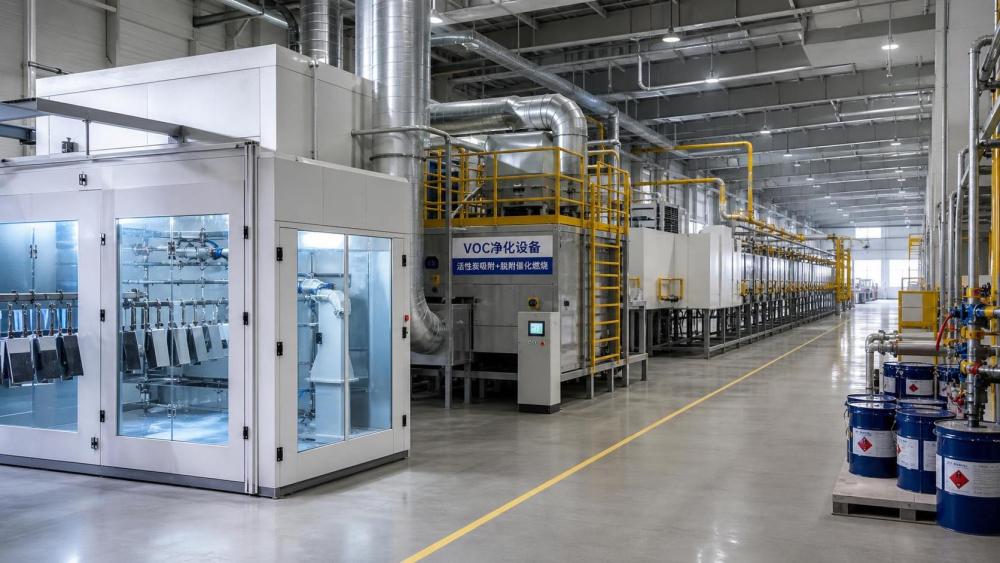
Activated-carbon adsorption, thermal oxidation, regenerative thermal oxidation, catalytic oxidation, condensation, and combined systems may each be used in industrial VOC control. No technology is universally suitable. Selection depends on airflow volume, VOC concentration and composition, humidity, particulate loading, temperature, exhaust variability, fire and explosion characteristics, available utilities, operating hours, footprint, and maintenance capability.
For example, carbon adsorption can be effective in certain lower-concentration applications, but breakthrough risk, humidity effects, fire considerations, and spent-carbon management need active control. Thermal or regenerative oxidation systems may offer strong destruction performance for suitable exhaust streams, but their energy demand, inlet concentration range, safety interlocks, and maintenance requirements must be understood. Catalytic systems can be sensitive to catalyst poisoning or particulate contamination. A system that performs well during commissioning may deteriorate quickly if upstream filters, booth housekeeping, or operating controls are neglected.
Quality and safety managers do not need to perform all engineering calculations themselves, but they should challenge incomplete equipment proposals. Ask suppliers and internal engineering teams to document the design assumptions: expected air volume, maximum and minimum concentration range, pollutant composition, target removal efficiency, pressure drop, utility demand, safety protections, expected consumables, and what happens during a line stop or abnormal concentration event. Claims of “high efficiency” without a defined operating envelope are not enough for an investment decision.
Where equipment is already installed, compare its original design basis with current production. Changes in coating type, output, booth configuration, product mix, or shifts can make an apparently compliant system undersized or unsuitable. This review is particularly important after capacity expansions that were treated as production projects rather than environmental-control projects.
Build records that can withstand inspection
Compliance records should help the site operate better, not merely fill a cabinet. The strongest systems connect production data, maintenance activity, material usage, emissions controls, and corrective actions. If an inspector, customer, or corporate auditor asks why solvent use increased in a given month, the plant should be able to link the change to production volume, a product mix shift, rework, an approved formulation change, or an identified abnormal event.
A practical record set may include approved coating specifications; purchase and consumption records; batch and production data; booth and treatment-unit operating logs; temperature, pressure, airflow, or other relevant operating parameters; maintenance work orders; filter and carbon replacement records; calibration certificates where applicable; emissions test reports; waste-transfer documentation; training records; and deviation investigations.
Records should be reviewed for contradictions. A treatment unit recorded as operating continuously while a production line was shut down may reflect poor logging discipline. Conversely, high coating consumption with no corresponding treatment-equipment runtime deserves investigation. Digital logs can reduce manual errors, but only if responsibilities, alarm escalation, and data review are defined. Automated data that nobody reviews is not a control system.
Integrate VOC management with quality and workplace safety
VOC compliance is frequently assigned to an EHS function, while quality teams focus on finished-part acceptance. This division creates blind spots. The same variables that affect emissions can affect coating defects: viscosity, solvent ratio, atomisation pressure, booth air balance, temperature, humidity, flash-off time, oven profile, filter condition, and operator cleaning practices.
An integrated review should consider whether nonconforming parts are driving additional VOC use. Rework, stripping, extra wipe-down, repeated spraying, and rejected batches can significantly increase material consumption and emissions. A recurring surface-defect problem may therefore be both a quality issue and an environmental indicator. Tracking rework solvent use separately from planned production use gives management a clearer view of where improvement efforts should go.
Safety controls also need to reflect actual chemical use. Ventilation, ignition-source control, grounding and bonding, chemical storage, spill response, personal protective equipment, and emergency procedures should be consistent with the substances on site. A formulation change should trigger an EHS and process-quality review, not simply a procurement update.
Prepare for the next round of scrutiny
China’s policy direction has consistently favoured source reduction, more effective collection, better treatment performance, and stronger control of unorganized emissions. Facilities should expect increasing attention to whether controls work in daily operation, not only whether equipment exists on a layout drawing. Local enforcement priorities and reporting arrangements can vary, but the trend is clear: undocumented assumptions and poorly maintained control systems carry more risk than they did a few years ago.
The most useful next step is a line-by-line gap assessment. Start with one representative coating process and follow the material, air, and records through the full cycle: receipt, storage, mixing, application, curing, cleaning, exhaust treatment, waste handling, and data review. The resulting gaps will usually be specific and manageable: an unapproved cleaning solvent, an uncapped transfer point, missing airflow verification, an overdue maintenance action, or a material change that was never evaluated against the treatment system.
A coating facility does not become compliant because it owns a VOC-control device or purchases a lower-VOC coating. It becomes more defensible when its people can show that material selection, process settings, capture, treatment, maintenance, quality control, and records all describe the same controlled operation.