
The short answer to “Which coating is best for corrosion protection?” is that there is no single winner. A zinc-rich primer may be the sensible choice for structural steel exposed to weather, while an epoxy system is often preferred where chemicals, moisture, and immersion are involved. Powder coating can be highly effective on well-prepared fabricated parts, but it is not a universal substitute for a multi-layer liquid system. The best coating is the one that matches the metal, corrosion mechanism, service conditions, preparation quality, and realistic maintenance plan.
This matters because coating failures are rarely caused by the paint or powder alone. In factories, corrosion often begins at a sharp edge that was not properly covered, beneath a washer that traps water, around a weld contaminated by spatter, or under a coating applied to a surface carrying oil, salts, or residual blasting dust. Buyers sometimes compare products only by price per kilogram or claimed film thickness. That approach can be expensive once rework, warranty exposure, shutdown time, or export quality disputes enter the picture.
Start with the environment, not the coating catalogue
Corrosion protection should be specified from the actual exposure conditions backward. “Outdoor use” is not detailed enough. A painted enclosure in a dry inland industrial park faces a different risk from a conveyor frame near a coast, a pump skid in a fertilizer plant, or a battery-production component exposed to washdown and process residues. Temperature cycling, ultraviolet exposure, chloride contamination, abrasion, standing water, chemical splashes, and electrical contact points can all change the right answer.
The substrate matters just as much. Carbon steel, galvanized steel, aluminum, stainless steel, cast iron, and zinc die-cast parts do not behave the same way beneath a coating. For example, aluminum often needs carefully controlled pretreatment to support adhesion, while galvanized surfaces can present adhesion issues if they are weathered, contaminated, or treated incorrectly. Stainless steel is not immune to corrosion; in chloride-rich conditions or at damaged weld areas, surface condition remains important.
A practical specification therefore begins with a few questions: What is the base metal? Will the part be indoors, outdoors, immersed, buried, or intermittently wet? Is appearance important after years of exposure? Can the item be recoated in service? Is there a risk of impact, abrasion, or forklift contact? And is the coating process controlled well enough to reproduce the intended result across production batches?
How the main corrosion-protection coatings compare
Different coating families protect metal through different mechanisms. Barrier coatings aim to keep water, oxygen, and contaminants away from the substrate. Zinc-containing coatings provide a degree of sacrificial protection to steel. Topcoats may add UV stability, chemical resistance, color retention, cleanability, or appearance. In demanding service, the system is often more important than any individual layer.
For many fabricated-steel products, a zinc-rich primer followed by an epoxy intermediate layer and a polyurethane finish remains a well-understood architecture where long outdoor service and visual durability are both required. It is not automatically necessary for every bracket, cabinet, or indoor frame. But when failure would be difficult to repair, the cost of a robust system can be easier to justify than repeated touch-up work.
Epoxy is frequently described as the best anti-corrosion coating because it adheres well and forms an effective barrier. That reputation is deserved in many industrial settings, especially for protected equipment, process areas, and parts exposed to moisture or chemicals. Yet a standalone epoxy finish is not always the ideal exposed outdoor surface because sunlight can affect its appearance over time. In that situation, a UV-stable topcoat is commonly used above the epoxy layer.
Where powder coating is the right answer—and where it is not
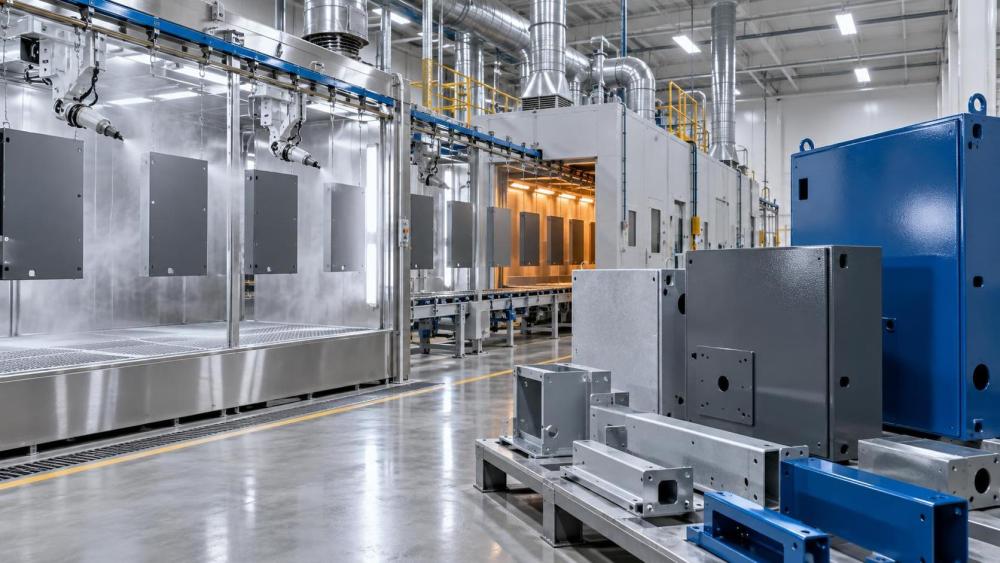
Powder coating is often the strongest option for high-volume industrial components that can be cleaned, pretreated, electrostatically coated, and cured in a controlled production line. It produces a uniform, durable film without relying on conventional solvent evaporation. For electrical cabinets, equipment housings, shelving, machine guards, agricultural components, and many metal fabrications, powder can offer an attractive balance of corrosion resistance, appearance, throughput, and environmental considerations.
However, saying “powder coating is better than paint” oversimplifies the decision. A powder-coated part with weak pretreatment can corrode prematurely, especially around cut edges, seams, welds, and mechanical damage. Complex assemblies also create Faraday-cage areas where electrostatic powder deposition can be difficult. Deep recesses, narrow corners, and internal cavities deserve attention before a line is selected. If a component cannot be heated to the required cure schedule, conventional powder coating may not be practical at all.
Pretreatment is where many corrosion-protection programs quietly succeed or fail. Cleaning removes oil and soil; conversion treatment supports adhesion and corrosion resistance; rinsing and drying must be controlled to avoid carrying contaminants into the coating stage. For precision or high-value parts, upstream cleaning processes deserve the same scrutiny as the coating booth. Ultrasonic cleaning, where appropriate for part geometry and contamination type, can help remove fine residues that ordinary washing may miss. The correct method still depends on material compatibility, soil load, process chemistry, and production volume.
Surface preparation is not a minor detail
If there is one recurring lesson from industrial coating work, it is that a premium coating cannot reliably compensate for poor surface preparation. Rust, mill scale, oil, salts, welding residues, and hand marks interfere with adhesion. Even a surface that looks clean can carry invisible contamination capable of causing blistering or underfilm corrosion later.
The suitable preparation route depends on the coating and substrate. Abrasive blasting may be used for steel where an appropriate profile is needed. Chemical cleaning and conversion coatings are common in automated powder-coating lines. Mechanical finishing can be necessary around welds and sharp edges. Coating engineers also pay close attention to edge radiusing: liquid and powder films tend to pull away from sharp edges, leaving lower thickness exactly where corrosion is likely to start.
This is why coating thickness alone is a misleading procurement metric. A high average film build does not guarantee protection at corners, bolt holes, threads, and seams. Quality checks should reflect the part’s actual risk areas, not only the broad flat panels that are easiest to measure.
Choose a system based on failure consequences
A sensible coating choice also reflects what happens if the coating fails. For a low-cost indoor trolley, a single-layer powder finish may be entirely reasonable. For an outdoor control enclosure, corrosion can compromise sealing, cable entries, labels, and electrical reliability. For a vacuum-system skid, a deteriorated coating may make cleaning harder and weaken the perception of process control, even before structural performance is affected. For equipment exported into coastal or humid regions, the same design may need a more conservative coating system than it would in a dry domestic market.
Maintenance access changes the calculation. Large installed structures may be difficult to blast and repaint after commissioning, so initial preparation and system selection carry more weight. Smaller removable covers or guards can sometimes be designed for replacement or refurbishment. In other words, “best” should include lifecycle practicality, not simply maximum laboratory resistance.
Questions worth asking before approving a coating process
- What substrate and surface condition will arrive at the coating line?
- Is the intended exposure dry indoor service, weathering, humidity, chemical splash, immersion, abrasion, or a combination?
- Which areas are most vulnerable: edges, welded joints, fastener zones, drainage points, cavities, or contact surfaces?
- Does the selected coating system have a compatible pretreatment, primer, and topcoat sequence?
- Can the chosen application method coat the part geometry consistently?
- How will curing, film thickness, adhesion, visual finish, and traceability be verified in normal production?
- Are local environmental, worker-safety, customer, or export requirements relevant to the materials and process?
The final question is often overlooked: can the supplier demonstrate process consistency rather than only provide a coating data sheet? In an industrial setting, reliable protection depends on batching accuracy for pretreatment chemistry, stable oven conditions, clean air and water management, disciplined handling, and inspection records. These supporting systems are not glamorous, but they are closely tied to coating quality.
A more useful answer than “the best coating”
For general industrial steel, epoxy-based systems and zinc-rich primer systems are often strong candidates where corrosion resistance is the priority. For visible outdoor equipment, an epoxy layer protected by a polyurethane topcoat is frequently worth considering. For repeatable production of fabricated parts, properly pretreated electrostatic powder coating can be an excellent solution. For unusually aggressive chemicals, elevated temperatures, immersion, or critical infrastructure, a specialized system should be evaluated against the actual service conditions rather than selected by name alone.
The useful decision is not “powder versus paint” or “epoxy versus zinc.” It is whether the complete surface-treatment process gives the part a realistic chance of surviving its real working environment. That includes cleaning, pretreatment, coating application, curing, inspection, handling, and repair strategy. For manufacturers comparing auxiliary equipment and process-support technologies, those upstream details often determine whether corrosion protection remains a specification on paper or becomes dependable performance in the field.