
Where precision process engineering services become a practical necessity
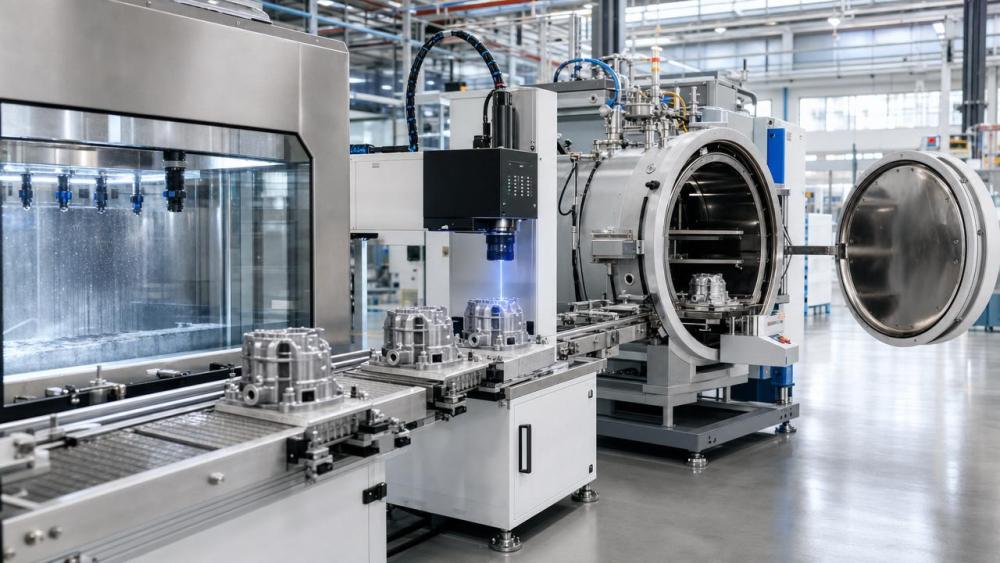
High-tolerance manufacturing rarely fails because of one dramatic mistake.
More often, losses begin with tiny shifts in cleaning quality, vacuum stability, coating thickness, marking clarity, or batching accuracy.
That is the point where precision process engineering services stop being optional support and become part of process control itself.
The need is especially clear when auxiliary systems influence final yield as much as primary machines.
In advanced manufacturing, microscopic residue can disrupt sealing, poor coding can weaken traceability, and unstable weighing can change product behavior.
Precision process engineering services help translate those hidden risks into measurable control points.
This matters across the broad industrial landscape covered by GIAS, where ultrasonic cleaning, laser marking, vacuum systems, electrostatic coating, and batching systems all affect downstream performance.
The real question is not whether precision matters.
The better question is when precision process engineering services create enough operational value to justify deeper process design, validation, and monitoring.
Actual demand changes with the production environment
Different sites can produce similar parts while needing very different levels of engineering support.
The difference usually comes from tolerance windows, contamination sensitivity, regulatory pressure, and process interaction between machines.
A line that handles decorative metal parts may care most about coating uniformity and appearance retention.
A line producing medical, electronic, or battery-related components will often focus on residue control, identification integrity, and repeatable vacuum conditions.
That is why precision process engineering services should be judged by site conditions, not by equipment labels alone.
In practical evaluation, the first signs include recurring rework, unstable test results, unexplained scrap, frequent parameter adjustments, and inconsistent results between shifts.
When those patterns appear, process variation is usually embedded in the system rather than in isolated operator behavior.
A useful way to judge the need
- Tolerance failure creates safety, compliance, or warranty exposure.
- Auxiliary equipment directly affects surface quality, cleanliness, or product identity.
- Multiple process steps interact, making root cause analysis difficult.
- Production scaling amplifies small deviations into recurring loss.
When cleanliness and joining quality drive the decision
One common trigger for precision process engineering services appears in ultrasonic cleaning and ultrasonic welding applications.
These steps look secondary on paper, yet they often determine whether later assembly remains stable.
For precision metal parts, residue left after machining can interfere with coating adhesion, laser marking contrast, or vacuum compatibility.
In plastic assemblies, weld energy that is only slightly off target can create internal weakness without obvious visual defects.
Here, precision process engineering services are valuable because they connect part geometry, contamination type, cycle design, fixture layout, and inspection criteria.
The key is not simply choosing a more advanced machine.
The key is confirming whether cavitation intensity, bath chemistry, weld amplitude, and part handling remain stable under real throughput conditions.
In actual applications, the strongest signal is often variation after scale-up.
A pilot line may perform well, while full-volume production introduces fixture wear, loading inconsistency, and contamination carryover.
Traceability-focused lines need more than readable marks
Laser marking and inkjet coding present another situation where precision process engineering services make sense.
Many operations assume traceability is solved once a code can be printed or scanned.
That assumption becomes risky in high-tolerance environments.
A mark must survive cleaning, coating, abrasion, packaging, export handling, and long storage without losing legibility or data integrity.
Precision process engineering services help define the full identification window, including substrate response, line speed, contrast stability, code placement, and verification standards.
This is especially important where anti-counterfeiting, regulatory labeling, or serialized product history matters.
More often than expected, coding problems come from upstream process variation.
Surface oil, oxidation, coating inconsistency, or unstable part positioning can make a marking system look unreliable when the deeper issue is process interaction.
Different scenarios, different engineering priorities
Batching, vacuum, and coating lines show the highest payoff
The strongest return from precision process engineering services often appears where material behavior changes with very small process shifts.
Industrial weighing and batching are a clear example.
In food, chemicals, pharmaceuticals, and lithium battery production, minor recipe drift can affect viscosity, reactivity, shelf life, or electrochemical performance.
The challenge is not only weighing accuracy.
Feed behavior, humidity, transfer loss, cleaning intervals, and software logic all influence repeatability.
Precision process engineering services are useful here because they examine the whole dosing path, not just scale specifications.
Vacuum systems require a similar view.
In degassing, coating, freeze-drying, semiconductor-related processes, or vacuum packaging, pressure stability is rarely the only issue.
Pump selection, chamber design, leak behavior, gas load, maintenance intervals, and contamination control all interact.
When process windows are tight, precision process engineering services help prevent underperformance that standard pump sizing cannot explain.
Surface treatment and electrostatic coating add another layer.
Thickness consistency, edge coverage, curing behavior, and corrosion resistance depend on pretreatment quality, environmental stability, and part orientation.
That is why high-tolerance finishing lines often need engineering support long before visible defects appear.
Misjudgments that often delay the right intervention
A frequent mistake is treating similar products as identical process cases.
Two parts with matching dimensions can respond very differently because of material grade, surface history, or cleanliness requirements.
Another misjudgment is focusing only on equipment capability sheets.
Precision process engineering services are usually justified by real operating conditions, including utilities, part mix, maintenance discipline, ambient humidity, and operator variation.
Cost is also easy to misread.
A lower initial investment may look attractive, yet unstable cleaning chemistry, frequent revalidation, coating rework, or traceability failures can produce a higher lifetime burden.
In practice, the need for precision process engineering services often becomes obvious only after repeated troubleshooting.
By then, process drift may already be affecting delivery performance and quality reputation.
What should be confirmed before moving forward
- Map which auxiliary step has the strongest effect on final defects.
- Separate equipment limitations from material or environmental causes.
- Check whether current inspection methods catch early process drift.
- Compare short-term savings with rework, scrap, and compliance exposure.
A practical way to decide the next step
The best use of precision process engineering services is usually selective rather than broad.
Start where process variation is small in appearance but large in consequence.
That may be an ultrasonic cleaning stage before assembly, a vacuum process affecting material stability, a coating line tied to corrosion claims, or a coding step supporting export traceability.
GIAS is useful in this context because it frames auxiliary systems as process-critical infrastructure rather than background equipment.
That perspective helps when comparing technologies, reviewing compliance requirements, or identifying where deeper engineering support may remove hidden variability.
A practical next move is to document one unstable process, define its tolerance-sensitive output, and review upstream conditions that influence it.
Then compare whether precision process engineering services can reduce variation through process redesign, tighter validation, better monitoring, or more realistic operating parameters.
When that review is grounded in the actual application, decisions become clearer and process upgrades become easier to justify.