
Process support systems manufacturing sits behind many of the quality outcomes that production teams measure every day. It covers the auxiliary technologies that keep parts clean, formulas accurate, surfaces protected, products identifiable, and process conditions stable. These systems are rarely the headline equipment on a factory floor, yet they often decide whether production stays consistent, compliant, and commercially reliable.
That is why the topic now draws broader attention across advanced manufacturing. When tolerances tighten, traceability rules expand, and export standards become harder to ignore, support processes stop being secondary details. They become part of the real production strategy.
What falls under process support systems manufacturing
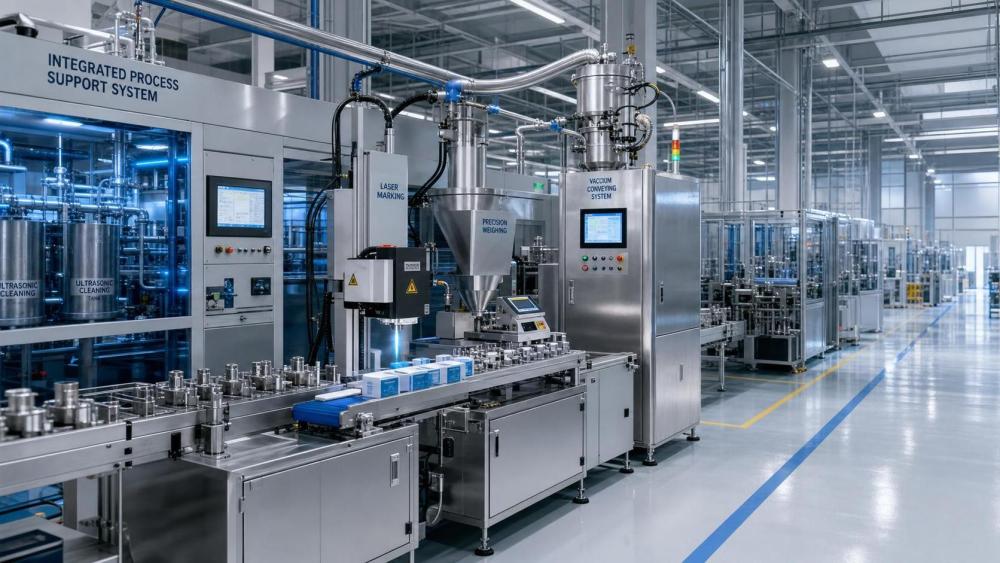
A useful way to understand process support systems manufacturing is to look at what it controls. It does not usually shape the main product alone. Instead, it protects the conditions that make the main process dependable.
In practical terms, this category often includes ultrasonic cleaning and welding, laser marking, inkjet coding, industrial weighing and batching, vacuum pumps and vacuum systems, surface treatment, and electrostatic coating.
Each of these technologies solves a different production problem. Together, they create a support layer around quality, repeatability, and downstream control.
Core functions across the production chain
This broad scope explains why process support systems manufacturing appears across many industries rather than one narrow equipment segment. The systems differ in design, but they share the same purpose: controlling variables that can quietly damage final product quality.
Why production performance depends on these systems
The value of process support systems manufacturing becomes clearer when production problems are traced back to their source. Many failures do not begin at the main machine. They begin in contamination, unstable dosing, weak identification, poor surface adhesion, or vacuum inconsistency.
A part that looks acceptable can still carry microscopic residue. A package can pass visual inspection but fail traceability requirements. A coating line can run on schedule yet produce poor long-term corrosion resistance.
In other words, support systems influence outcomes that are often measured later, sometimes after shipping. That delayed impact is exactly why they matter so much.
The pressure points driving demand
- Higher traceability expectations in regulated and export-oriented supply chains
- Tighter process windows in electronics, medical, battery, and precision manufacturing
- Greater emphasis on contamination control and repeatable cleanliness
- More scrutiny on coating durability, emissions, and environmental compliance
- Need for stable recipe control in multi-material and high-value production
These pressures have made process support systems manufacturing more visible in sourcing decisions, plant upgrades, and supplier evaluations. It is no longer enough for a line to run fast. It has to run cleanly, consistently, and with evidence.
Where these systems create the most business value
The business case is rarely limited to one benefit. Process support systems manufacturing affects quality yield, rework rates, audit readiness, product identity, maintenance planning, and long-term brand risk.
Take ultrasonic cleaning as an example. Its value is not only in removing visible dirt. It can eliminate microscopic particles and oils that interfere with bonding, plating, coating, or sensitive assembly steps.
Laser marking and industrial coding show a similar pattern. They add more than a label. They create durable information links between production batches, quality events, warranty claims, and anti-counterfeiting programs.
Weighing and batching systems also carry strategic weight. In industries built around formulations, a small dosing error can affect taste, reaction stability, energy density, cure performance, or shelf life.
Vacuum systems are equally important where atmosphere control defines the process itself. Freeze-drying, semiconductor fabrication, degassing, vacuum packaging, and coating all depend on stable pressure conditions rather than nominal equipment capacity alone.
Surface treatment and electrostatic coating add another layer of value. They help products meet durability expectations while aligning with appearance standards and environmental requirements that increasingly shape market access.
Typical production scenarios behind the category
One reason process support systems manufacturing can feel fragmented is that the use cases vary widely. Yet the underlying logic stays consistent: a specific support process protects a specific risk.
Examples across sectors
In electronics, ultrasonic cleaning and vacuum systems help control particulate contamination and process stability. Small residues can compromise adhesion, conductivity, or packaging reliability.
In food and pharmaceuticals, weighing and batching systems protect recipe accuracy, while coding systems support lot tracking, expiry management, and compliance documentation.
In automotive and industrial components, surface treatment and electrostatic coating influence corrosion performance, finish consistency, and field durability.
In packaging and export manufacturing, vacuum and coding technologies often shape shelf life, product integrity, and supply-chain traceability.
In lithium battery production and chemical processing, batching precision and controlled vacuum conditions can directly affect safety, consistency, and process repeatability.
This is where specialized intelligence platforms such as GIAS become useful. They bring together technology analysis, application insight, compliance context, and supplier visibility in one place, making comparison more practical and less assumption-driven.
How to evaluate process support systems manufacturing in practice
A common mistake is to evaluate auxiliary systems only by purchase price or headline speed. In practice, the better questions focus on fit, verification, and failure consequences.
Useful evaluation points
- What exact process variable needs control: contamination, identity, pressure, dosing, or surface condition?
- Which defects or compliance risks appear when that variable drifts?
- How is performance measured: cleanliness level, marking permanence, batch accuracy, vacuum stability, or coating thickness?
- Can the system integrate with line data, quality records, and maintenance workflows?
- What standards, certifications, or validation documents are necessary for the application?
- How easy is supplier support across installation, calibration, and long-term service?
Process support systems manufacturing should also be judged over time. A cheaper system that introduces drift, cleaning gaps, unstable coding, or frequent recalibration may cost more through scrap, audits, and downtime.
That longer view matters especially when supplier comparisons look similar on paper. The real difference often appears in process validation, spare parts support, data visibility, and consistency under production load.
What to watch next
The future of process support systems manufacturing is moving toward tighter integration with quality systems, digital traceability, and application-specific process control. Equipment is becoming easier to monitor, but the decision process is becoming more technical.
That makes structured research more valuable than broad product browsing. A useful next step is to map the support processes around a current production line, identify where hidden variation enters, and compare technologies against those exact risks.
From there, it becomes easier to narrow priorities: better cleaning validation, stronger coding permanence, more accurate batching, improved vacuum stability, or a more durable surface finish. That is usually where better sourcing decisions begin.