
A coating quotation can look attractive until the steel equipment reaches service and early rust appears at edges, bolted joints, welds, or areas damaged during transport. In that situation, the original purchase price is no longer the real cost. Rework, shutdown planning, access equipment, lost production time, and replacement parts can quickly outweigh the saving made on the initial order.
The main answer is that corrosion protection coating price is determined less by the paint container and more by the required corrosion performance. Surface preparation, steel condition, coating system, dry film thickness, geometry, application method, inspection scope, and expected service environment all influence the quotation. A buyer should therefore compare bids by the complete coating specification and lifecycle risk, not by price per square metre alone.
Start with the service environment, not the coating name
Steel equipment exposed to a dry indoor utility room faces a very different corrosion risk from a skid installed outdoors near salt air, a chemical washdown area, a humid process line, or a facility with frequent condensation. Two suppliers may both quote an “epoxy system,” yet the actual protection level can be very different because the intended exposure conditions were never defined with enough precision.
Before requesting prices, identify where and how the equipment will operate. The useful questions are practical:
- Will the steel remain indoors, outdoors, underground, or near coastal air?
- Is it exposed to rain, standing water, humidity cycles, washdown, chemicals, abrasion, or elevated temperatures?
- Will insulation, cladding, fasteners, or process piping create crevices where moisture can remain trapped?
- Must the finish preserve appearance, or is functional corrosion resistance the only priority?
- What service interval is expected before major maintenance can realistically be performed?
These details influence resin selection, primer requirements, film build, stripe coating at difficult locations, and the need for a UV-resistant topcoat. A system designed for sheltered interior use may be materially cheaper than one built to survive wet outdoor exposure, but substituting the former in the wrong location is not a true saving.
Surface preparation is often the largest hidden variable
Coatings adhere to prepared steel, not simply to steel that looks clean. Oil, weld spatter, soluble salts, old coating residues, mill scale, oxidation, and sharp edges can all reduce coating performance. As a result, preparation work often accounts for a substantial portion of the final coating cost, particularly on fabricated equipment with welds, corners, complex assemblies, and restricted access.
A low quotation may assume only basic cleaning and minimal mechanical preparation. A higher quotation may include abrasive blasting, dust removal, edge treatment, surface-profile control, and preparation of weld seams. Those quotations should not be treated as equivalent.
Steel condition matters as well. New structural steel with accessible surfaces can be prepared more efficiently than aged equipment carrying degraded paint or corrosion products. Refurbishment work is particularly difficult to price without a close inspection because the extent of pitting, adhesion failure, contamination, and inaccessible areas may only become clear after cleaning starts.
Ask every bidder to state the preparation method and the condition assumed for the substrate. The quotation should clarify whether it includes removal of existing coating, degreasing, abrasive media, masking, local repair of damaged steel, treatment of weld spatter, and edge rounding or grinding. Without this information, a low initial figure may become a variation once work begins.
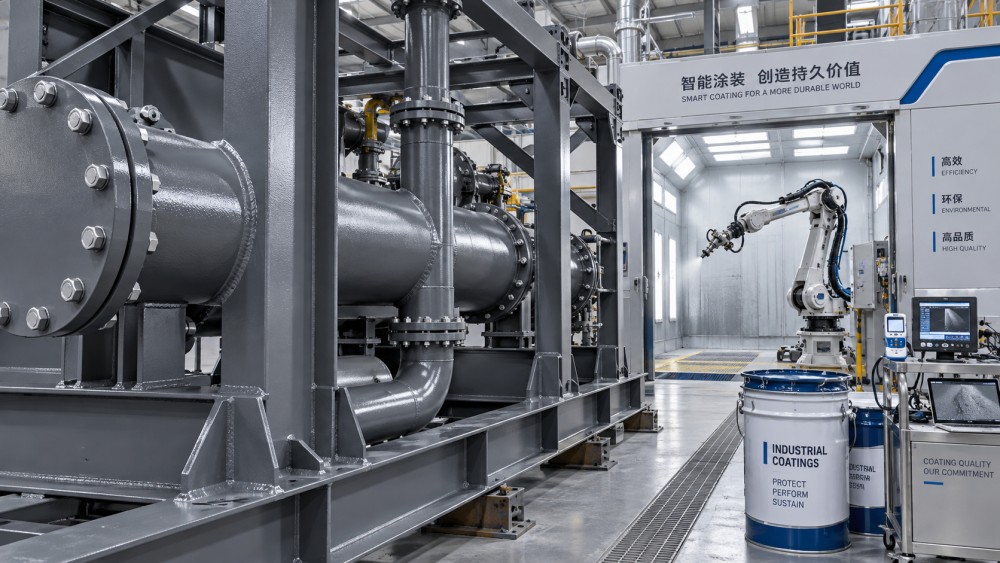
Coating chemistry changes both material cost and application cost
There is no single “best” protective coating for steel equipment. The selected system must match the exposure, temperature, substrate, application location, cure conditions, and maintenance plan. Material prices can differ, but application requirements can create equally important cost differences.
Buyers should avoid specifying coating chemistry by habit. For example, a topcoat selected primarily for appearance may not solve underfilm corrosion caused by poor preparation. Conversely, an expensive high-build system may be unnecessary on equipment that remains in a controlled, dry interior environment and can be maintained easily. The right specification is one that addresses the actual failure mechanism.
Film thickness is not just a number on a data sheet
Dry film thickness has a direct effect on material consumption, application time, inspection effort, and price. A thicker coating system generally requires more product and may require multiple application passes. It can also introduce risks when applied poorly: solvent entrapment, sagging, incomplete curing, cracking, or adhesion problems between coats.
A quotation should distinguish between nominal thickness, minimum acceptable thickness, and the number of coats included. A bid that states only “two coats” gives little procurement value because two thin coats and two properly built coats may provide very different protection. Likewise, a contractor may price a target thickness based on smooth, open panels while the equipment actually contains brackets, flanges, handrails, nozzles, lifting lugs, and dense weldments that require additional stripe coating.
Stripe coating is often omitted from simple comparisons. It is the localized application of coating to edges, welds, corners, bolts, and other areas where sprayed film tends to be thinner. It adds labour, but these locations are also where corrosion commonly begins. For outdoor skids, tanks, frames, and process-support assemblies, confirming how such areas will be handled is more useful than demanding a blanket reduction in unit price.
Equipment geometry can make identical surface area far more expensive
Price-per-area calculations are useful for budget planning, but they can be misleading for fabricated equipment. A large flat steel enclosure may be relatively straightforward to blast and spray. A smaller frame with channels, gussets, internal corners, ladders, pipe supports, and mounted components can require more masking, manual work, repositioning, and touch-up despite having less total area.
Access is another factor. Coating performed in a controlled workshop may be less costly and more consistent than work completed after installation. Site work can require containment, ventilation, weather protection, scaffolding, local safety controls, and coordination with other trades. If equipment is to be coated after assembly, procurement should determine whether the price includes all access and protection measures or only the coating labour itself.
Transport and assembly arrangements also matter. A fully coated skid can be damaged by lifting points, bolted connections, field welding, or handling. The quotation should define responsibility for touch-up materials, field repairs, and coating restoration after installation. Leaving this undefined can create disputes between fabricator, coating contractor, installer, and equipment owner.
Application method affects consistency and cost
Brush and roller application can be appropriate for small repairs, complex locations, and site touch-up. Spray application is normally more efficient for larger production volumes and can provide better uniformity when conducted under controlled conditions. However, spraying may require masking, overspray management, ventilation, specialized equipment, and trained operators.
The cheapest application method is not automatically the lowest-risk method. A contractor using brush application on a complex assembly may spend more time but achieve reliable coverage around welds and internal angles. A spray-based process may offer lower labour cost on broad surfaces but still require manual stripe coating at edges. Procurement comparisons should therefore ask for the planned application method by component type rather than treating “spray applied” as a universal quality indicator.
Cure conditions deserve the same attention. Temperature, humidity, ventilation, and minimum time between coats affect whether a coating reaches its intended properties. Shop-applied systems may benefit from more controlled conditions, while field work may need scheduling around weather and process availability. A quotation that assumes ideal conditions can become unrealistic when the actual work window is cold, humid, or operationally restricted.
Inspection requirements create cost, but they also make bids comparable
Coating inspection is sometimes viewed as an optional extra, especially when budget pressure is high. Yet inspection is what confirms whether the purchased system was actually delivered. A coating specification without measurable acceptance criteria leaves room for inconsistent interpretation.
For many steel equipment purchases, the relevant quality controls include visual inspection, surface cleanliness checks, dry film thickness measurements, confirmation of coat sequence, cure verification where appropriate, and repair of visible defects. More demanding service may justify additional testing such as adhesion assessment, holiday detection for suitable linings, or environmental-condition records during application.
The goal is not to add every possible test to every order. It is to align inspection with failure consequences. Equipment in a low-risk indoor setting may only require straightforward visual and thickness checks. A vessel, enclosure, support structure, or process unit exposed to aggressive conditions may need more documented control because a coating failure would be difficult or costly to repair.
When reviewing bids, determine whether inspection tools, reporting, hold points, and rework are included. Also ask who approves deviations. A supplier may offer a low price by excluding inspection documentation, while another includes the labour needed to measure, record, and correct the work. Those are different procurement packages.
Compare quotations on an equal technical basis
A practical bid comparison should convert each proposal into the same set of questions. This prevents an apparently low corrosion protection coating price from masking a thinner system, weaker preparation level, excluded repairs, or a shorter expected service life.
- Confirm the substrate: new steel, weathered steel, galvanized steel, previously coated steel, or repaired equipment all require different preparation assumptions.
- Define the exposure: state moisture, chemicals, sunlight, temperature, abrasion, immersion, and access constraints clearly.
- Require the full coating build-up: identify primer, intermediate coat, topcoat, intended dry film thickness, and treatment of edges and welds.
- Separate shop and site work: list what will be coated before delivery, what must be completed after installation, and how damage will be repaired.
- Identify exclusions: masking, disassembly, scaffolding, containment, old-coating removal, welding repairs, and inspection documentation should not be left ambiguous.
- Evaluate maintenance implications: compare the expected access difficulty and likely repair scope if the coating system fails earlier than planned.
It is also sensible to ask bidders to provide pricing in separable elements where possible: surface preparation, coating materials, application labour, inspection, repairs, and site-related work. This does not mean purchasing each item separately. It allows the buyer to understand which assumptions create the difference between offers and to negotiate scope without degrading the essential protective system.
When a higher initial price is justified
A more expensive coating system can be justified when maintenance access is limited, equipment downtime is costly, corrosion could affect safety or product cleanliness, or future recoating would require major disassembly. The value is not simply in using a premium product; it is in reducing the chance that steel condition becomes an operational problem before maintenance is feasible.
On the other hand, over-specification also has a cost. Equipment that is protected from weather, kept clean, and regularly accessible may not need the same multi-layer system used for exposed outdoor structures or chemically aggressive areas. The buyer’s task is to distinguish between necessary durability and precautionary spending that does not match service conditions.
The most defensible purchasing decision links the coating specification to the operating environment, fabrication details, and maintenance reality. Once those are defined, the quoted price becomes easier to evaluate because it represents a known scope of protection rather than an uncertain promise attached to a paint label.