
Advanced manufacturing is often described through its flagship technologies: automation, robotics, semiconductor tools, EV battery lines, precision machining, smart factories. In practice, many of the quality and reliability gains that define modern production come from a different layer of equipment—the systems that support, stabilize, verify, clean, identify, dose, evacuate, coat, and protect the process.
These are advanced manufacturing support systems. They rarely become the headline investment in a factory expansion, yet they frequently determine whether production is repeatable, compliant, traceable, and scalable.
For anyone trying to understand where these systems matter most, the key is not to treat them as “secondary equipment.” Their value becomes clear when manufacturing depends on tight tolerances, contamination control, product identification, recipe accuracy, vacuum integrity, or durable surface performance. In those environments, support systems stop being optional infrastructure and become part of the product quality architecture itself.
What counts as an advanced manufacturing support system?
The term covers a broad group of industrial technologies that do not always perform the primary transformation of a product, but make that transformation consistent and commercially viable.
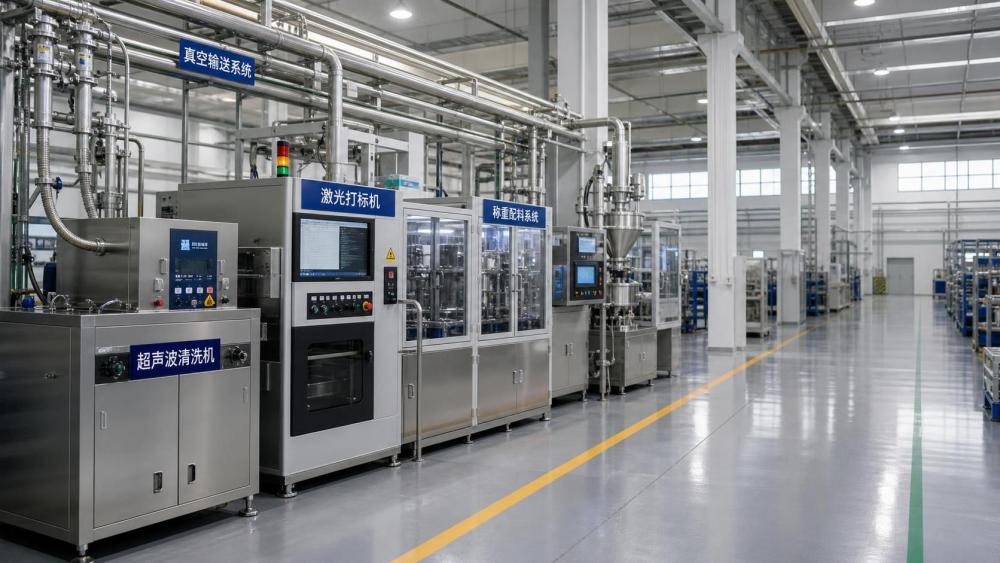
Typical examples include:
- Ultrasonic cleaning systems for removing fine contaminants from parts and assemblies
- Ultrasonic welding systems for joining plastics or delicate components without adhesives or fasteners
- Laser marking and industrial inkjet coding for identification, serialization, lot tracking, and anti-counterfeiting
- Industrial weighing and batching systems for controlled dosing, blending, and recipe management
- Vacuum pumps and integrated vacuum systems for packaging, drying, coating, degassing, and semiconductor processes
- Surface treatment technologies for adhesion improvement, cleaning activation, corrosion resistance, and finishing
- Electrostatic coating systems for efficient, uniform application of powder or liquid coatings
What these systems share is not a single technology base, but a common business function: they reduce process variation in places where variation is expensive.
That expense may show up as scrap, field failure, rework, compliance risk, weak traceability, unstable throughput, or customer rejection. In export manufacturing especially, support systems often carry more strategic weight than their share of capex suggests, because overseas buyers increasingly evaluate process capability, not just final unit price.
Why they matter more than their “support” label suggests
There is a common misconception that auxiliary systems can be upgraded later without much consequence because they sit outside the core production machine. That assumption is often wrong.
In many sectors, the primary machine can only perform to specification if upstream and downstream support conditions are controlled. A high-precision coating line cannot compensate for poor surface preparation. A medical component cannot be credibly validated if cleaning residues are inconsistent. A battery material formulation will not deliver repeatable performance if weighing and batching drift beyond acceptable limits. A premium branded product loses traceability value if its coding system produces unreadable or inconsistent marks.
In other words, advanced manufacturing support systems create the conditions under which mainline equipment can do its job reliably.
This is also why these systems are increasingly tied to broader manufacturing priorities:
- quality assurance and yield improvement
- regulatory compliance and audit readiness
- digital traceability and supply chain transparency
- resource efficiency and material control
- global customer qualification and export competitiveness
Where they deliver the most value
The strongest value cases appear in industries where failure is costly, contamination is critical, or repeatability is hard to maintain at scale.
Precision manufacturing and electronics
Electronics, semiconductors, connectors, sensors, and precision assemblies are highly sensitive to particles, residues, moisture, and dimensional inconsistency. In these environments, ultrasonic cleaning and vacuum systems often contribute directly to process stability.
Cleaning is not merely cosmetic. Micron-level contamination can interfere with bonding, plating, coating, conductivity, sealing, or optical performance. Vacuum systems, meanwhile, are fundamental in deposition, packaging, degassing, drying, and other controlled processes where atmospheric conditions affect material behavior.
The value here is usually measured through yield, defect reduction, and process repeatability rather than labor savings alone.
Medical devices and regulated production
In regulated sectors, support systems become part of quality documentation rather than just plant equipment. Marking, coding, cleaning, and process control all connect to traceability requirements, validation, and batch history.
Laser marking is especially relevant where permanence, readability, and resistance to sterilization or wear are important. Industrial weighing and batching are similarly critical when recipe accuracy affects safety, efficacy, or compliance.
The most important point is that the value is partly operational and partly evidentiary. A system that performs well but cannot support documentation, consistency, or audit requirements may fall short in real-world use.
Food, beverage, pharmaceuticals, and chemicals
These sectors rely heavily on dosing accuracy, hygienic process support, batch repeatability, and packaging integrity. Weighing and batching systems can have a direct impact on formulation quality, waste control, and regulatory confidence. Vacuum technology plays a major role in packaging, freeze-drying, evaporation, and product stability.
Here, support systems deliver value by controlling the hidden variables that affect shelf life, consistency, contamination risk, and material usage. In high-volume operations, even small dosing or packaging deviations can create substantial cumulative losses.
Automotive, battery, and new energy supply chains
The expansion of EVs, power electronics, and lithium battery manufacturing has raised the importance of process-support equipment. Material handling accuracy, contamination control, drying conditions, surface preparation, coding, and coating uniformity all influence product performance and safety.
Battery manufacturing is a useful example because it combines several support-system dependencies at once: precise batching of materials, vacuum support in drying or impregnation-related processes, cleaning of components or tooling, and durable identification for traceability across a global supply chain.
As qualification standards become tighter, these “non-core” systems often become part of supplier approval discussions.
Metal finishing and industrial coatings
Surface treatment and electrostatic coating technologies create value in a very visible way—appearance, corrosion resistance, adhesion, and environmental performance. But their deeper value is process consistency.
A coating failure is rarely just a coating problem. It often begins with poor pretreatment, contamination, humidity variation, uneven application, or inadequate curing control. Electrostatic coating systems help improve transfer efficiency and finish uniformity, but their actual performance depends on the broader process chain around them.
For manufacturers serving export markets, coating quality can affect warranty exposure, brand perception, and compliance with customer specifications.
The business case is often stronger than expected
One reason these systems are underappreciated is that their return on investment does not always show up as a new revenue line. It appears as avoided loss.
That can include:
- lower reject rates and rework
- more stable throughput
- fewer batch deviations
- better audit performance
- stronger product traceability
- reduced coating or material waste
- fewer customer complaints and field quality issues
In some facilities, the most important gain is not speed but confidence. A process that can be monitored, documented, and repeated is easier to scale, easier to certify, and easier to present to international buyers.
This matters in B2B manufacturing because procurement teams increasingly ask suppliers to demonstrate process control capability, not simply capacity. A factory with strong support systems may be better positioned to win demanding contracts even if those systems are largely invisible in a product catalog.
What people often misunderstand when researching this category
One common mistake is assuming all value comes from equipment sophistication. In reality, fit matters more than complexity. A highly advanced system that is poorly integrated, difficult to maintain, or mismatched to the material and throughput profile may underperform a simpler, well-configured alternative.
Another misunderstanding is to evaluate these systems only by initial purchase price. Lifecycle performance usually matters more. Consumables, calibration burden, maintenance intervals, operator skill requirements, utility consumption, spare parts access, and validation support can materially change total cost of ownership.
There is also a tendency to separate process equipment from compliance and data requirements. That separation is increasingly outdated. Marking systems affect traceability. Weighing systems affect batch records. Cleaning systems may affect validation. Vacuum stability may affect documented process consistency. In modern manufacturing, auxiliary equipment often sits at the intersection of engineering, quality, and compliance.
How to judge where the value is highest
For a reader trying to make sense of the category at a basic level, the most useful question is not “Which support system is most advanced?” but “Where does process variation create the most business risk?”
That is usually where these systems deliver the highest value.
Three indicators are especially useful:
- Defect sensitivity: If minor contamination, dosing drift, weak marking, or coating inconsistency can trigger product failure, support systems matter more.
- Traceability pressure: If customers, regulators, or internal quality systems require reliable identification and documented process control, marking, coding, and measurement systems carry strategic importance.
- Scale dependence: If a process works in pilot production but becomes unstable in volume manufacturing, support systems are often the missing control layer.
This is why their value is often highest in factories moving from basic production toward higher specification, export-oriented, or regulated manufacturing. The tighter the quality expectation, the more important the support infrastructure becomes.
Why this category is gaining visibility now
Several market shifts are bringing advanced manufacturing support systems into sharper focus.
One is the broader move toward traceability. Across many industries, product identification, lot control, and process records have become more important because of recalls, anti-counterfeiting concerns, quality audits, and supply chain transparency demands.
Another is the rising cost of inconsistency. Labor shortages, higher material costs, and pressure on margins mean manufacturers are less willing to accept rework and hidden process loss as normal.
A third driver is application complexity. Products in sectors such as electronics, healthcare, energy storage, and functional coatings are becoming more performance-sensitive, which increases reliance on precision support processes.
Environmental and efficiency pressures also play a role. Surface treatment choices, transfer efficiency in coating, and controlled use of chemicals or materials are no longer just engineering topics; they increasingly intersect with sustainability targets and compliance expectations. Exact regulatory treatment depends on market and jurisdiction, so specific standards should be reviewed case by case, especially where emissions, food contact, medical validation, or hazardous materials are involved.
What to watch going forward
The category is likely to become more data-driven and more integrated with production management systems. That does not mean every support machine becomes “smart” in a marketing sense. It means buyers will increasingly expect measurable process visibility: parameter logging, batch linkage, maintenance alerts, recipe control, and interoperability with quality systems.
There is also a shift in how these systems are evaluated. Instead of being purchased as isolated utilities, they are more often assessed as contributors to end-product performance and supplier credibility. That is a meaningful change for manufacturers competing internationally.
For researchers and first-time buyers, the practical conclusion is straightforward: advanced manufacturing support systems are best understood not as background equipment, but as leverage points. They create value where precision, cleanliness, identification, controlled dosing, vacuum stability, and surface integrity determine whether production is merely running—or truly under control.
That is where they deliver the most value, and why they increasingly deserve attention early in any serious manufacturing assessment.
- electrostatic coating
- ultrasonic welding
- digital traceability
- industrial inkjet coding
- industrial weighing and batching
- ultrasonic cleaning systems
- weighing and batching systems
- electrostatic coating systems
- advanced manufacturing support systems
- manufacturing support systems
- industrial weighing and batching systems