
In precision cleaning and micro-processing, small changes in jet behavior can decide whether a surface is cleaned accurately or damaged unnecessarily. That is why micro-jet impact force matters so much. It affects contaminant removal, feature definition, cycle stability, and the confidence behind equipment selection for advanced manufacturing environments.
Across sectors covered by GIAS, from surface treatment and ultrasonic cleaning to vacuum-supported processes and precision finishing, this topic sits at the intersection of quality control and process economics. Micro-scale force is not only a laboratory concept. It shapes real production outcomes, including yield, consistency, traceability, and downstream coating or bonding performance.
Why micro-jet impact force deserves closer attention
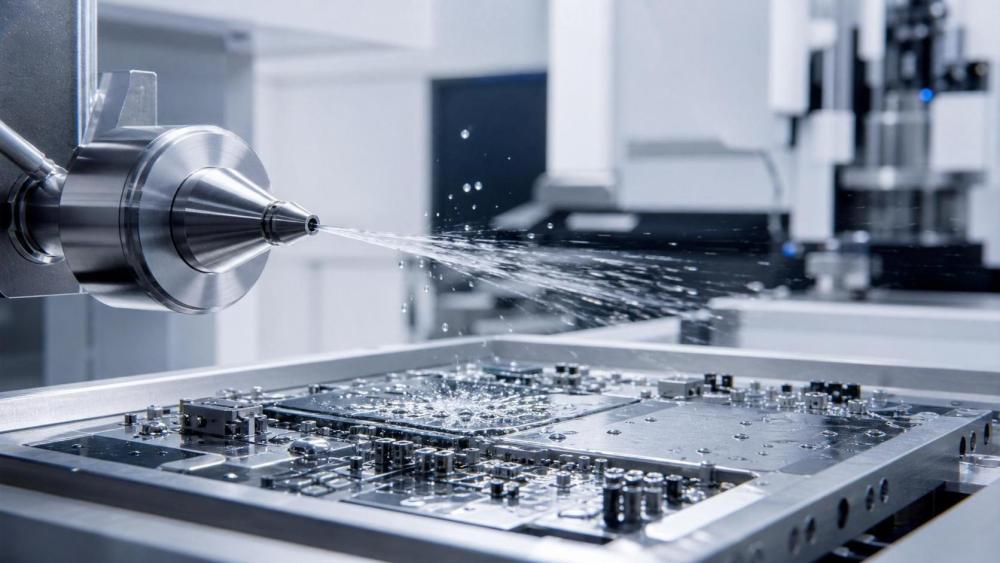
A micro-jet is a highly focused liquid stream, often used where larger spray methods are too aggressive or too imprecise. Its impact force describes how much mechanical energy reaches the target surface at the moment of contact.
That force influences more than cleaning speed. It also affects particle detachment, residue breakup, edge preservation, and the repeatability of fine process windows. In micro-processing, the useful range is often narrow.
When the force is too low, contaminants remain. When it is too high, coatings, soft substrates, or micro-features may erode. The challenge is not maximizing force. It is matching force to the material, geometry, and cleanliness target.
The main variables behind jet force
Micro-jet impact force depends on a group of linked parameters rather than a single setting. In practice, pressure alone never tells the whole story.
Pressure and flow stability
Supply pressure is the most visible variable. Higher pressure usually increases exit velocity and raises micro-jet impact force. But unstable pressure creates fluctuating force, which leads to uneven cleaning and uncertain validation results.
Pulse variation, pump wear, and regulator drift can all reduce control. For critical applications, force stability over time matters as much as peak value.
Nozzle diameter and geometry
Nozzle size determines how fluid energy is concentrated. A smaller opening can create a sharper jet and higher local force, even at moderate flow levels. Internal nozzle geometry also changes turbulence, coherence, and pressure loss.
This is why two systems running at the same nominal pressure may perform very differently. The nozzle is not just a delivery part. It is a force-shaping component.
Stand-off distance and impact angle
As the jet travels, it disperses and loses concentration. A short stand-off distance tends to preserve micro-jet impact force. A longer distance may soften the jet, which can help on delicate surfaces but reduce removal power.
Impact angle also matters. A normal angle often maximizes direct force. An inclined angle can improve sweeping action and contaminant transport, especially for particles lodged along edges or channels.
Fluid properties
Liquid density, viscosity, surface tension, and temperature all influence jet behavior. Lower viscosity can support smoother flow and finer jet formation. Temperature may reduce viscosity, but it can also change evaporation, chemistry, and material response.
If additives are used, wetting improves, yet the force profile may change slightly. In cleaning, chemistry and mechanics must be judged together.
Surface condition and target material
The same jet does not act the same way on polished metal, textured polymer, ceramic, glass, or coated battery foil. Surface roughness, adhesion strength of contaminants, and substrate hardness all affect the effective result.
In other words, micro-jet impact force is partly a system property and partly an interaction property. Performance emerges at the surface, not only at the nozzle.
Why industry is watching this more closely
Manufacturing trends are pushing tolerances lower and traceability expectations higher. That makes process-support technologies more visible in purchasing, qualification, and audit decisions.
A cleaning step that once looked secondary may now influence bonding strength, laser marking readability, coating adhesion, sealing reliability, or particle compliance. Micro-jet impact force becomes a controllable quality factor rather than a hidden operating detail.
This aligns with the broader GIAS perspective. Auxiliary systems are often judged by what they enable downstream: stable output, lower defect rates, and more defensible process documentation.
How to interpret performance in real operations
A useful evaluation starts by separating nominal machine settings from actual surface effect. A strong specification sheet does not guarantee the right micro-jet impact force at the workpiece.
It is better to assess three layers together: jet generation, delivery stability, and target response. This helps explain why pilot results sometimes fail to scale smoothly into production.
Look beyond pressure ratings
Rated pressure should be checked alongside flow uniformity, nozzle wear, filtration quality, and motion control. If contaminants clog the line or alter the orifice, micro-jet impact force drifts even though setpoints appear unchanged.
Connect cleaning force to downstream quality
The real question is not only whether debris disappears. It is whether the following operation becomes more stable. Better adhesion, more reliable coding, fewer coating defects, or cleaner inspection results usually indicate better force matching.
Use process windows, not single points
A robust line needs an acceptable range, not a perfect number. Define upper and lower force-related limits based on cleanliness, damage threshold, cycle time, and allowable variation between shifts or sites.
Common application scenarios
Micro-jet systems appear in different forms across manufacturing, but the force question remains similar: how much localized energy is needed, and how much is too much?
- Pre-bond cleaning for removing fine oils, particles, or residues before assembly
- Selective cleaning of channels, holes, edges, and micro-structured surfaces
- Surface preparation before coating, plating, marking, or sealing
- Delicate substrate processing where broad spray energy would be excessive
- Precision rework where only a limited area should be affected
In vacuum-related or contamination-sensitive environments, micro-jet impact force may also need to be balanced with drying performance, residue control, and particle capture strategy. The cleaning event cannot be isolated from the full process chain.
Practical checkpoints before selecting or adjusting a system
When comparing equipment or refining an existing process, a few checkpoints can prevent expensive misalignment between expected and actual performance.
- Define the contaminant type, adhesion level, and acceptable residual threshold
- Map sensitive materials, edges, coatings, and micro-features that limit force
- Verify nozzle life, maintenance intervals, and filtration requirements
- Check whether motion path and stand-off control are repeatable in production
- Measure outcomes with surface inspection, adhesion data, or downstream defect trends
- Request application evidence under conditions close to actual line requirements
These checkpoints are especially useful when multiple auxiliary systems interact. Cleaning force may affect coating quality, vacuum performance, marking legibility, or inspection repeatability later in the process.
Where to focus next
Understanding micro-jet impact force starts with physics, but good decisions come from process context. The most valuable comparison is rarely the highest force available. It is the most controllable force for the target surface and the required quality outcome.
A sensible next step is to build a simple evaluation matrix around pressure stability, nozzle design, stand-off distance, fluid condition, substrate sensitivity, and downstream quality effects. That creates a more reliable basis for trials, supplier comparison, and line-level risk control.
For operations reviewing advanced cleaning or micro-processing options, micro-jet impact force should be treated as a measurable process variable with direct business value. Once it is linked to yield, consistency, and surface integrity, equipment decisions become far easier to justify.