
Surface treatment technology Japan sits at the intersection of precision manufacturing, product durability, and regulatory discipline. In practice, it is not only about how a part looks after coating or plating. It is also about how reliably that surface performs under heat, friction, moisture, chemicals, and long production cycles.
That is why surface treatment decisions in Japan often receive close technical scrutiny. A finish that fails adhesion, corrodes early, or introduces contamination can affect yield, traceability, export readiness, and downstream assembly quality. Across advanced manufacturing, surface quality is tied directly to process control.
For companies comparing suppliers, production methods, or qualification standards, surface treatment technology Japan deserves attention as both a materials issue and a systems issue. Cleaning, pretreatment, coating application, curing, inspection, and compliance documentation all shape the final result.
Why the Japanese market treats surface performance as a process discipline
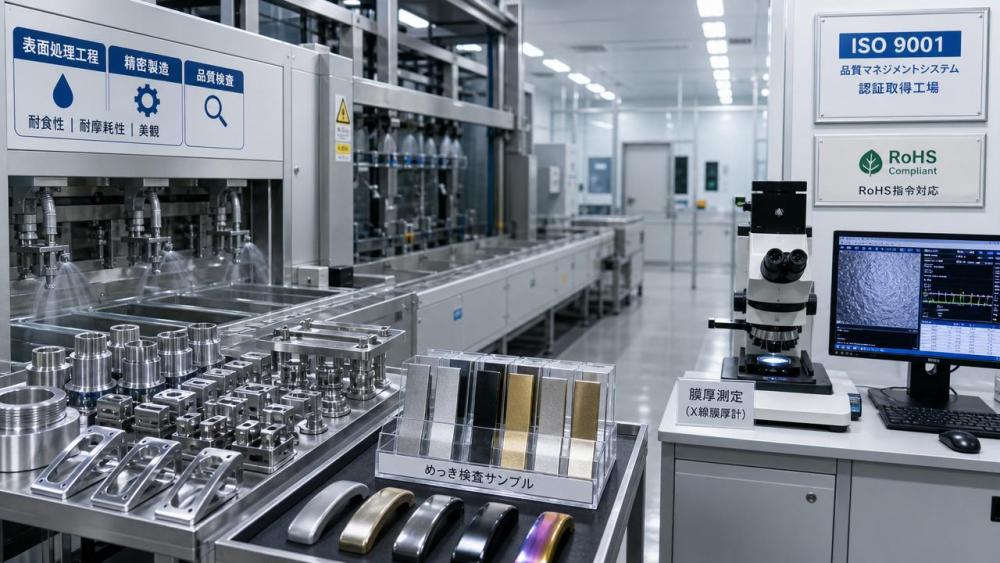
Japan’s manufacturing environment has long emphasized consistency at very small tolerances. That mindset extends to surface treatment. The coating line is rarely judged in isolation. It is evaluated by how well it supports assembly precision, appearance stability, and long service life.
This matters in electronics, automotive parts, industrial machinery, medical components, consumer goods, and export-oriented metal fabrication. In each case, the surface must do more than protect. It may need to insulate, conduct, reduce wear, improve solderability, resist fingerprints, or maintain cosmetic uniformity.
From the broader GIAS perspective, this fits a familiar pattern. Auxiliary processes such as ultrasonic cleaning, vacuum support, marking, coding, and weighing often determine whether a primary manufacturing step performs as intended. Surface treatment technology Japan reflects the same principle.
Core processes that define surface treatment technology Japan
The term covers several process families rather than a single technique. Each one serves different materials, product risks, and performance goals.
Electroplating and electroless plating
Nickel, zinc, chromium, copper, tin, silver, and gold plating remain important in Japanese production. They are used for corrosion resistance, conductivity, contact reliability, decorative finish, and dimensional control on precision parts.
Electroless nickel is especially relevant where uniform thickness is required on complex geometries. In high-value applications, phosphorus content, hardness, and post-heat treatment become important evaluation points.
Anodizing and conversion coatings
Aluminum components often use anodizing to improve corrosion resistance, wear behavior, and dye absorption. Conversion coatings are also common for aluminum, zinc, and magnesium where paint adhesion or temporary corrosion protection is needed.
In surface treatment technology Japan, these processes are frequently assessed by film thickness, pore sealing quality, color consistency, and compatibility with later bonding or printing steps.
Paint, powder coating, and electrostatic coating
Liquid coatings remain common for complex finish requirements, while powder coating is valued for efficiency and lower solvent emissions. Electrostatic coating improves transfer efficiency and helps produce uniform films on shaped metal parts.
For many industrial users, the technical question is not simply which coating is stronger. It is which process delivers stable film build, acceptable edge coverage, and repeatable curing under production conditions.
Chemical polishing, blasting, and functional treatments
Not every surface treatment is a coating. Some parts require roughness control, deburring, matte finishing, passivation, anti-fouling layers, or low-friction films. Functional surfaces are increasingly important in semiconductors, batteries, precision devices, and clean manufacturing environments.
Material compatibility is often the first technical filter
A strong evaluation starts with the substrate. Steel, stainless steel, aluminum, copper alloys, magnesium, engineering plastics, and hybrid assemblies do not respond the same way to pretreatment or coating chemistry.
For example, aluminum may need strict oxide management before coating. High-strength steel may raise hydrogen embrittlement concerns after certain plating steps. Plastics may require activation, etching, or plasma preparation before metallization.
Surface treatment technology Japan is therefore closely linked to upstream cleaning and surface preparation. Residual oil, particles, polishing compounds, or moisture can cause poor adhesion, blistering, uneven color, and early corrosion. This is where adjacent auxiliary systems matter.
Ultrasonic cleaning, controlled rinsing, filtration, drying, and vacuum-assisted process stability can significantly influence final coating quality. In many industrial lines, pretreatment quality explains more failures than the coating chemistry itself.
Where current industry attention is moving
Several trends are shaping how surface treatment technology Japan is specified and reviewed today.
- Lower environmental burden, including reduced VOC emissions and tighter chemical management.
- Higher traceability for export, automotive, electronics, and medical supply chains.
- Greater demand for cosmetic consistency on visible parts and branded products.
- Functional surfaces for conductivity, shielding, thermal control, and micro-scale cleanliness.
- Stable process windows for smaller, lighter, and more complex component geometries.
In other words, the market is moving away from basic coating selection alone. The focus is shifting toward total line capability, measurable repeatability, and documentation that supports audits and cross-border supply requirements.
Compliance points that cannot be treated as secondary
Compliance in Japan is shaped by domestic environmental controls, customer-specific requirements, and global market rules. That combination makes documentation almost as important as process output.
Typical review points include substance restrictions, wastewater treatment, worker safety controls, emissions management, and records for bath chemistry, film thickness, and inspection results. Depending on the industry, RoHS, REACH, ELV, and customer blacklists may affect material selection.
Hexavalent chromium is a well-known example. Even where legacy processes still exist, qualification pressure often favors alternatives with lower regulatory risk. The same logic applies to PFAS-related scrutiny, heavy metals, and solvent exposure.
The table below shows how compliance concerns connect to technical evaluation.
How to assess suppliers and process suitability
In practical terms, surface treatment technology Japan should be reviewed as a chain of controlled steps. A supplier with an impressive coating catalog may still struggle if pretreatment discipline, bath maintenance, or inspection traceability is weak.
A more useful assessment usually asks a narrower set of questions.
- What failure mode is the treatment supposed to prevent?
- Which substrate and geometry define the process window?
- How is cleanliness validated before coating or plating?
- Which tests reflect real operating stress, not only standard lab checks?
- How are restricted substances and revision changes controlled?
- Can the supplier show stable results across repeated lots?
This approach is especially useful when comparing Japanese suppliers with overseas alternatives. Price differences may appear clear at first. The harder question is whether process capability, compliance readiness, and defect prevention are equally visible.
Typical use cases across industrial sectors
The value of surface treatment technology Japan changes by application. On automotive brackets, corrosion resistance and paint adhesion may dominate. On electrical connectors, conductivity and contact durability matter more. On medical housings, cleanliness and biocompatibility concerns may shape treatment selection.
In electronics and precision assemblies, even a minor surface defect can interfere with bonding, shielding, thermal transfer, or visual acceptance. In branded export products, color variation or poor edge finish may become a market issue rather than a simple factory defect.
That is why many evaluations now connect surface treatment to broader auxiliary systems. Marking and coding affect traceability after finishing. Vacuum systems may support coating stability or drying quality. Cleaning technology defines whether the surface is ready for a high-value finish.
A practical next step for evaluation
A useful starting point is to build a comparison sheet around substrate, target performance, pretreatment method, coating chemistry, inspection plan, and compliance evidence. That structure quickly exposes whether two processes are truly comparable.
For organizations using GIAS as a reference point, the advantage is not limited to finding a surface treatment method by name. The stronger approach is to review the full support chain that protects coating quality, from cleaning precision to process traceability and environmental control.
Surface treatment technology Japan remains valuable because it combines materials science, disciplined manufacturing, and documentation that stands up to market scrutiny. The next decision is usually clearer when surface performance is evaluated as a controlled system, not just a finishing step.