
Precision Process Support Systems for Pharmaceuticals: Where They Matter Most in Production
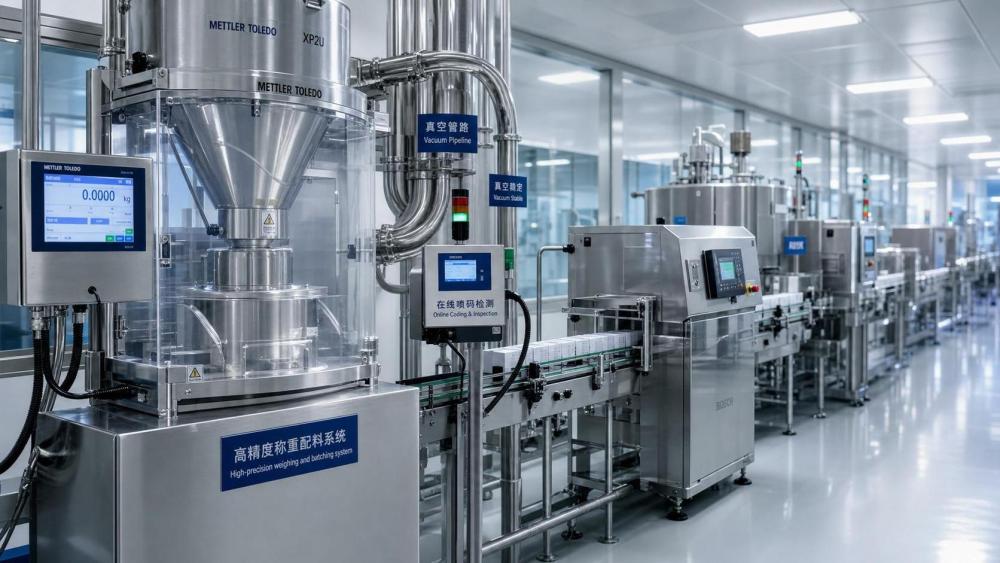
In pharmaceutical manufacturing, core machines get most of the attention. Yet product quality often depends on what happens around them.
That is where precision process support systems pharmaceuticals depend on become commercially and technically critical.
These systems control weighing accuracy, vacuum stability, contamination risk, product coding, and process repeatability.
When they perform well, batches stay consistent. When they drift, deviations spread quickly across production, quality, and compliance.
In real projects, this matters most during scale-up, validation, line upgrades, and multi-site transfer.
The practical question is not whether support systems matter. It is where they matter most, and how to prioritize them.
Why Precision Process Support Systems Pharmaceuticals Use Are Strategic
Pharmaceutical production runs under narrow tolerances. Small process errors can trigger scrap, rework, delayed release, or regulatory concern.
Precision process support systems pharmaceuticals facilities install help hold those tolerances every shift, every batch, and every product changeover.
More importantly, they support three outcomes that directly affect business performance:
- Reliable compliance with GMP and traceability requirements
- Stable product quality across commercial volumes
- Lower risk during expansion, validation, and technology transfer
This also means auxiliary systems should be specified early, not added late as utility items.
A late decision usually creates redesign pressure around layout, utilities, controls, and qualification scope.
Where They Matter Most on the Production Floor
Not every unit operation needs the same support intensity. Some points in production carry much higher process sensitivity.
1. Weighing and Batching at Material Entry
Errors at dispensing rarely stay isolated. They usually move downstream into blending, granulation, compression, and final release.
Precision process support systems pharmaceuticals plants use here include industrial weighing, recipe management, and controlled batching interfaces.
The value is straightforward: dose accuracy, operator guidance, material traceability, and reduced manual recording risk.
2. Cleaning and Contamination Control Between Batches
Cross-contamination risk is one of the clearest reasons to invest in precision support technology.
Ultrasonic cleaning systems remove fine residues from tools, change parts, filling components, and precision assemblies.
That matters most where residues are hard to detect visually but still capable of affecting product purity.
3. Vacuum-Dependent Processing Steps
Vacuum performance becomes critical in drying, degassing, solvent removal, freeze-drying, and certain packaging operations.
If vacuum stability fluctuates, moisture profiles, drying times, and product integrity can shift out of accepted limits.
That is why precision process support systems pharmaceuticals engineers specify often include monitored vacuum pumps and integrated control logic.
4. Coding, Marking, and Serialization Points
Traceability is not a packaging afterthought. It is part of product integrity and market access.
Laser marking and inkjet coding systems support lot identification, anti-counterfeiting, and line-level verification.
When codes fail, the commercial impact can be immediate, even if the formulation itself remains compliant.
How to Evaluate the Right Support System Mix
A common mistake is choosing systems by equipment category alone. That approach misses the real production constraints.
A better method is to match precision process support systems pharmaceuticals operations need to specific failure modes.
Start with these questions:
- Which step has the lowest tolerance for variation?
- Where does contamination create the highest product or audit risk?
- Which support utility can stop the line if unstable?
- Where is manual data entry still creating traceability gaps?
- Which system becomes harder to qualify after installation?
These questions help move discussion from features to process consequences, which is where better decisions usually start.
Key Decision Criteria During Project Planning
From recent project trends, the stronger signal is integration quality rather than standalone machine performance.
The best precision process support systems pharmaceuticals projects adopt are easy to validate, monitor, clean, and document.
Focus on five criteria during specification:
- Measurement repeatability under real production conditions
- Compatibility with SCADA, MES, and audit trail requirements
- Cleaning access, material compatibility, and maintenance intervals
- Supplier documentation for IQ, OQ, and operational support
- Spare parts availability across regions and long production cycles
In practice, the lowest purchase price rarely delivers the lowest lifecycle cost.
Downtime, failed batches, investigation time, and delayed qualification usually cost more than the initial equipment delta.
Common Risk Areas and How to Reduce Them
Even capable systems underperform when risk is defined too narrowly. Performance issues often begin at interfaces.
This is where application knowledge matters more than catalog language.
Teams need suppliers that understand regulated environments, not just component specifications.
What Better Deployment Looks Like
The most effective deployments share a few patterns. They treat support systems as process-critical infrastructure.
They also connect precision process support systems pharmaceuticals teams buy to measurable operating targets.
- Define acceptance criteria before FAT and SAT
- Map each support system to a product quality risk
- Include data connectivity in the original scope
- Plan maintenance access before layout freeze
- Build operator training around deviations, not only startup
That approach shortens handover friction and reduces surprises during validation and routine production.
Final Takeaway
Precision process support systems pharmaceuticals manufacturers rely on have the most value at high-risk control points.
That includes weighing, batching, cleaning, vacuum-dependent processing, and traceable product identification.
When these systems are selected early and tied to process risk, production becomes more stable and easier to scale.
The practical next step is simple: review the line where small support failures create the biggest downstream consequences.
That is usually the best place to improve compliance resilience, batch consistency, and long-term manufacturing performance.