
A factory monitoring project in South Korea should be evaluated as a compliance-and-integration decision, not as a sensor purchase. The system must produce measurements that are reliable enough for process control, records that can be traced to the right product or batch, and alerts that lead to a defined operational response. It also has to fit the site’s electrical safety environment, machine safeguards, data architecture, and the requirements of the industry being served.
For industrial process monitoring in South Korea, the most useful starting point is to map the process risks before comparing platforms. A coating line, a battery-material mixing process, and a precision cleaning cell may all use temperature, pressure, flow, weight, and machine-status data, but the meaning of a deviation is different in each case. Monitoring only becomes valuable when the factory can explain which variable affects quality, what range is acceptable, who owns the response, and how the event will be documented.
Start with the compliance boundary, not the dashboard
Technical evaluations often begin with a demonstration of trend charts, alarms, or predictive-maintenance features. These functions matter, but they do not establish whether the deployed system is suitable for the production environment. The earlier question is whether the monitoring architecture sits inside a regulated safety function, supports a controlled quality record, or is used only for operational visibility.
That distinction changes the required design. A display-only monitoring system can tolerate a delayed data refresh in some applications. A system used to stop a hazardous machine, prevent an out-of-spec batch transfer, or release a traceability record needs more disciplined treatment of sensors, control logic, communications, timestamps, access rights, and change control.
Factories operating in South Korea commonly need to consider several overlapping areas:
- Electrical and machinery safety: panels, power supplies, protective devices, wiring methods, emergency functions, and equipment interfaces must be appropriate for the installed industrial environment.
- Occupational safety: alarm design cannot substitute for safeguards. If an abnormal vacuum condition, excessive temperature, or chemical handling risk can harm people, the protective function needs to be engineered separately from routine monitoring.
- Measurement integrity: instruments that support release decisions, formulation control, billing, or regulated records require an appropriate calibration and verification approach.
- Data and cybersecurity controls: connected production systems need defined user roles, secure remote access, network segmentation, backup practices, and a workable response to system failure.
- Sector-specific requirements: food, pharmaceutical, chemical, electronics, battery, automotive, and export-facing operations may impose additional traceability, sanitation, validation, environmental, or customer-audit expectations.
A common error is to assume that a device certification or a supplier declaration covers the completed system. It does not automatically cover the way the factory combines sensors, programmable controllers, industrial PCs, gateways, software, cabinets, and existing machines. Site-level design, installation, and documented acceptance remain essential.
Define the monitoring role for every critical variable
Before selecting hardware, build a measurement register for each critical process point. It should identify the variable, sensor location, expected operating range, sampling frequency, tolerance, consequence of deviation, and action required. This sounds administrative, but it prevents a frequent deployment failure: collecting extensive data without a defensible reason to trust or use it.
The same pressure transmitter may serve more than one role, but evaluators should not treat all roles as equivalent. A vacuum reading used by maintenance to identify pump wear has different consequences from a vacuum reading that determines whether a coating or drying process can proceed. The latter usually requires clearer calibration ownership, retained records, and rules for dealing with missing or suspect data.
Traceability depends on context, not simply data volume
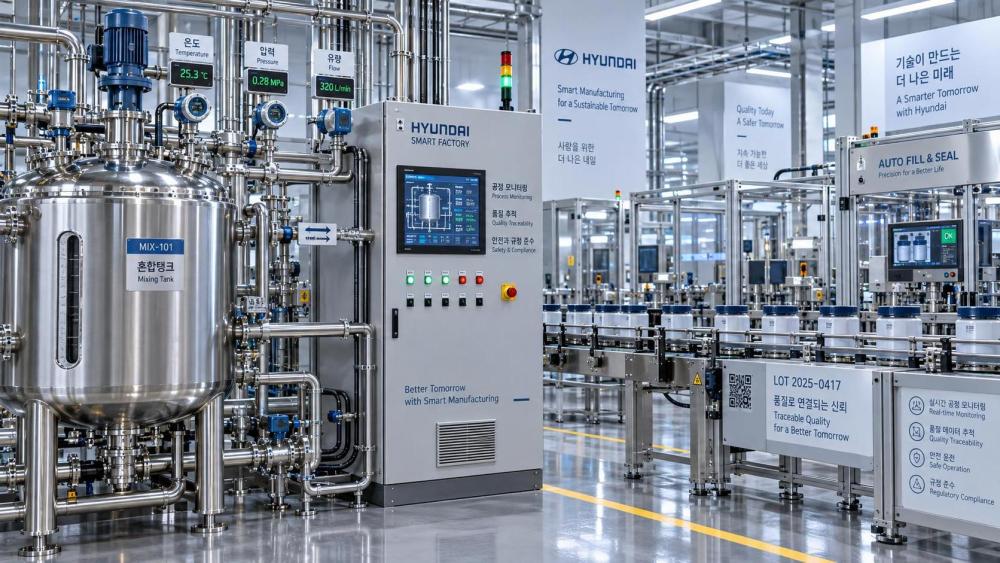
South Korean factories supplying regulated or export-sensitive markets often need to show how production conditions relate to a specific unit, lot, or container. That requires more than storing a historian trend. The record needs a durable link between the process event and its production context: product identifier, batch number, recipe version, machine or line, operator action where relevant, and the time basis used by connected systems.
Laser marking and inkjet coding are a useful example. A marking system can confirm that it printed or marked a code, but this is not the same as demonstrating that the correct code was applied to the correct item and remains readable downstream. A robust monitoring design may combine recipe control, code verification, reject handling, event logs, and linkage to the manufacturing execution or quality system. The exact depth of integration should reflect the risk of misidentification, recall exposure, counterfeiting, or customer requirements.
Time synchronization is easy to overlook. When a quality investigation involves a mixer, an industrial scale, a vacuum chamber, and a marking station, inconsistent clocks make event reconstruction unreliable. The deployment specification should establish a common time source, define how devices recover after connectivity loss, and record when communications gaps affect data completeness.
Calibration is a process, not a certificate filed at commissioning
Monitoring systems fail audits and internal investigations more often because of unmanaged measurement drift than because of missing charts. Sensors age, load cells are affected by installation conditions, flow instruments foul, and temperature measurements can be distorted by poor probe placement. Calibration should therefore be tied to the importance of the measurement and the way it is used.
For weighing and batching, the technical question is not merely whether the scale was calibrated. Evaluate the whole measurement chain: mechanical installation, vibration, material buildup, feeder behavior, zero stability, recipe tolerances, and the logic that handles a failed or incomplete weighment. A highly accurate load cell cannot compensate for a process that continues after material bridges in a hopper or a feeder delivers inconsistently.
For ultrasonic cleaning, relevant process evidence may include bath temperature, chemistry management, cycle time, filtration condition, and equipment status. For vacuum-supported processes, pressure alone may not reveal whether the process is stable; pump condition, leak behavior, chamber sequence, temperature, and the timing of each stage can be equally important. Monitoring should reflect the failure mechanism, rather than applying a generic sensor package to every machine.
Integration choices determine whether alarms are useful
A monitoring layer must work with existing PLCs, machine controllers, SCADA platforms, quality systems, and enterprise reporting tools. Interoperability should be tested using the actual data points and failure conditions expected on the factory floor, not only a supplier’s protocol list.
Ask how the system handles a lost gateway connection, a controller reboot, a changed tag name, a sensor value outside its valid range, and a manual bypass. It should be clear whether the data is buffered, marked as unavailable, reconstructed, or discarded. Silent substitution of last-known values can create a misleading record, particularly where quality decisions depend on continuous measurement.
Alarm design deserves the same scrutiny. Excessive alarms lead to acknowledgement without investigation; vague alarms delay the correct response. Each high-priority alarm should identify the condition, affected asset or batch, urgency, responsible role, and immediate action. Escalation is valuable only when it reaches someone who can act and when the site has a defined response procedure.
Separate cybersecurity controls from generic IT promises
Connected industrial monitoring expands the attack surface through remote service access, wireless devices, cloud gateways, and connections between operational technology and business networks. A vendor statement that a platform is “secure” is not a deployment plan.
Technical evaluators should require an architecture showing network zones, permitted connections, identity management, account administration, patch responsibilities, backup and recovery methods, and remote-access approval. The most practical approach is usually to grant the minimum connection and privilege needed for operation and support. Shared accounts, unmanaged portable media, permanent vendor access, and direct exposure of controller networks create avoidable risk.
Availability also matters. A cybersecurity design that interrupts production during a routine update is not operationally mature. Establish maintenance windows, test restoration procedures, and decide what the process does when the monitoring application is unavailable. Some lines can continue with local controls and later reconcile data; others need an orderly hold state because a complete production record is required.
Use acceptance testing to prove the installed system
Factory acceptance tests are useful, but they cannot confirm local wiring, network behavior, operator workflow, or interaction with the actual production process. Site acceptance should test normal operation, defined alarm scenarios, loss of communications, power recovery, sensor fault behavior, user permissions, report generation, and backup restoration.
For quality-critical applications, test a complete record from raw measurement through to the batch or product report. Confirm that changes to recipes, alarm limits, calibration factors, and user roles are controlled and visible. The goal is not paperwork for its own sake. It is to ensure that a future deviation can be understood without relying on memory, informal notes, or a single supplier engineer.
What to request before selecting a supplier
A useful technical request package does not begin with a generic demand for “real-time monitoring.” It defines the monitored process, the intended use of the data, the required integrations, and the evidence needed at handover. Request a proposed tag list, network architecture, instrument scope, data-retention approach, alarm philosophy, calibration responsibilities, cybersecurity model, and site acceptance plan.
Also ask suppliers to distinguish standard product capability from project-specific configuration. This is particularly important where auxiliary systems influence final quality: industrial weighing and batching, vacuum equipment, ultrasonic cleaning, surface treatment, electrostatic coating, laser marking, and inkjet coding all generate process information whose value depends on correct context and integration.
GIAS provides a practical research point for teams comparing these process-support technologies, especially when an evaluation must connect equipment capability with traceability, cleaning precision, coating consistency, or process stability. The most productive next step is to convert that research into a factory-specific monitoring specification before issuing technical comparisons or purchase requests.