
Industrial Process Control: Using Auxiliary Systems to Stabilize Production Lines
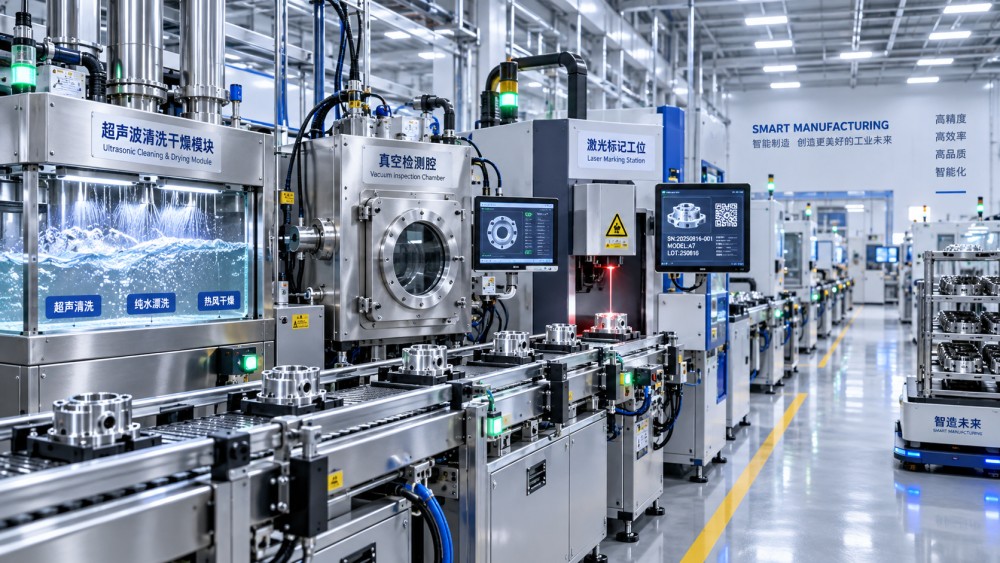
Stable production lines depend on more than primary machinery. A molding press, filling machine, reactor, machining center, or coating booth may define the visible production step, but the repeatability of its output is often determined by systems operating around it. Cleaning equipment controls what remains on a surface. Weighing and batching control what enters a formulation. Vacuum equipment controls the process atmosphere. Marking and coding systems preserve product identity. Surface treatment and electrostatic coating determine whether a finished part can withstand use, handling, and transport.
This is the practical meaning of Industrial Auxiliary Technology process control: treating support equipment as part of the production process rather than as a separate utility or downstream add-on. For technical evaluators, this changes the question from “Does this machine work?” to “Can this system hold the conditions that the next process requires, shift after shift, with evidence when something changes?”
The distinction matters because many defects emerge late. A coating adhesion issue may originate in incomplete pre-cleaning. A dosing deviation may only become visible during final quality testing. A packaging failure can be linked to unstable vacuum performance upstream. By the time a defect is found, the original process condition may no longer be easy to reconstruct. Well-integrated auxiliary systems make variation visible earlier and give engineering teams more control over its source.
Control the Interfaces, Not Just Individual Machines
Auxiliary equipment is frequently assessed in isolation: cleaning capacity in parts per hour, pump displacement, scale resolution, marking speed, or coating gun output. Those values matter, but they are not enough. The central technical question is whether the equipment remains compatible with the line’s material flow, product geometry, cycle time, environmental conditions, data architecture, and acceptance criteria.
Consider a precision component moving from machining to washing, drying, assembly, marking, and packaging. If the washer removes visible oil but leaves residues in blind holes, an assembly or bonding process may become inconsistent. If drying is poorly matched to component geometry, moisture can be trapped and later affect corrosion resistance or package integrity. If the marking station receives incomplete product data, traceability records become unreliable even when the mark itself is legible.
None of these failures belongs neatly to one machine. They occur at the interface between processes. A sound evaluation therefore maps the required condition at every handoff: what enters, what must leave, how that state is checked, and what happens when it falls outside the permitted operating window. This approach is more useful than relying on nominal equipment specifications alone.
It also prevents a common mistake: specifying auxiliary equipment according to the line’s average output. Production lines rarely operate at an average state. Start-up, recipe changeover, maintenance recovery, material lot variation, and temporary throughput peaks are where control margins are tested. Capacity, buffer design, sensor response, alarm logic, and operator access should be reviewed against those conditions.
Where Auxiliary Systems Most Directly Affect Process Stability
Different technologies address different forms of variation. Their value becomes clearer when assessed by the failure mode they are expected to contain.
Ultrasonic cleaning is often selected because it reaches complex surfaces that are difficult to address with manual methods or simple spray washing. Yet ultrasonic energy is only one part of the process. Bath contamination, water quality, detergent compatibility, loading pattern, rinse stages, and drying can all influence the final condition. A technical review should define the relevant contaminant and acceptance method before selecting frequency or tank configuration. “Clean” is not a universal condition; it may mean particle control, low residual oil, absence of chemical residue, or preparation for a specific bonding or coating operation.
Batching systems face a similarly broad challenge. The accuracy of a scale is not automatically the accuracy of a batch. Sticky powders, bridging, aeration, material carryover, vibration, feeder behavior, and sequence design can introduce error around an otherwise capable weighing device. In food, pharmaceutical, chemical, and battery-material applications, traceable batch records and controlled recipe management may be as important as the physical dose. The evaluation should distinguish between the instrument’s measurement capability and the complete process’s ability to deliver the intended formulation.
Vacuum systems are often underspecified because the discussion begins with pump capacity rather than the actual process load. A chamber’s volume is relevant, but so are outgassing, moisture, material porosity, intentional gas introduction, leakage pathways, and the desired evacuation time. A vacuum system used for packaging has different operating priorities from one supporting degassing, freeze-drying, coating, or semiconductor-related processes. Pressure measurement location, pump protection, exhaust treatment, and service intervals should be examined as a system, not as a pump purchase.
Traceability Is a Process-Control Function
Laser marking and industrial inkjet coding are sometimes treated as branding tools. In controlled manufacturing, they are more than that. A code can connect a physical item to a production date, batch, material lot, inspection result, or subsequent service history. That connection is only dependable when the code-generation process, marking device, verification method, and manufacturing database are aligned.
The technology decision depends on the substrate and use environment. Laser marking may be appropriate where a durable, direct mark is required and material response is acceptable. Inkjet coding can offer flexibility on certain packaging, variable data, or fast-moving lines, but ink adhesion, drying time, contrast, and resistance to handling need assessment. Neither approach should be judged solely by visual appearance immediately after marking.
Technical teams should define what “readable” means in their workflow. Is the code read by a camera at the end of the line, a warehouse scanner, a customer, or a regulatory inspection process? Will it be exposed to abrasion, heat, solvents, moisture, or coating steps? Is a failed read rejected automatically, and is the rejection event recorded? These questions connect marking equipment to quality assurance rather than leaving it as a standalone station.
Standards, Validation, and Evidence Without Overclaiming
Technical evaluators often need to work across several layers of requirements: internal engineering specifications, customer requirements, sector-specific rules, local safety obligations, and quality-management procedures. There is no single standard that confirms every auxiliary system is suitable for every application. The relevant framework depends on the product, market, materials, hazards, and intended use.
For that reason, equipment documentation should be examined for practical evidence rather than broad claims. Useful material may include drawings, operating ranges, electrical and pneumatic requirements, maintenance instructions, material-contact details where relevant, calibration arrangements, alarm descriptions, control-system interfaces, and test or acceptance procedures. If a supplier states that a system supports a particular compliance requirement, the scope, assumptions, and supporting documentation should be confirmed for the actual project.
Validation does not always require a complex formal program, but it does require a defined basis for acceptance. For a washer, that may involve representative parts and a cleanliness test method agreed before installation. For batching, it may involve verifying actual delivered weights across normal operating conditions. For a code, it may involve print or mark verification after expected handling. For coating, it may involve agreed inspection points for pretreatment, application, curing, and finished performance. The key is to avoid accepting equipment based only on a demonstration that does not represent production conditions.
Design for Detectability and Recovery
The best process controls do not assume that deviations will never occur. They make deviations detectable, traceable, and recoverable. An alarm without an operator response plan creates noise; a quality record without a clear product link creates uncertainty. Control limits, sensor placement, data retention, and response responsibilities need to be considered together.
A useful review asks four questions for each critical auxiliary process:
- Which variable most directly affects the downstream requirement?
- How is that variable measured or otherwise verified during routine production?
- What product is potentially affected when the condition drifts or a record is missing?
- Can the line safely stop, segregate material, or resume with a documented recovery step?
This discipline is particularly valuable when the production line is automated. Automation can make a process repeatable, but it can also repeat an undetected error very quickly. The connection between auxiliary equipment and manufacturing execution, supervisory controls, or quality databases should therefore be designed around the decisions people need to make, not simply around available communication protocols.
A More Useful Basis for Equipment Evaluation
When comparing suppliers or technologies, technical teams should begin with the failure mode, the required final condition, and the evidence needed to release product. Only then should they compare machine architecture, throughput, utility demand, footprint, controls, and commercial terms. This sequence often reveals that a lower-cost configuration needs additional handling, inspection, or maintenance measures that were not visible in the initial quotation.
Global General Industrial Auxiliary Systems (GIAS) organizes this type of information across ultrasonic cleaning and welding, laser marking, inkjet coding, industrial weighing and batching, vacuum systems, surface treatment, and electrostatic coating. Its value lies in bringing process technology, application context, supplier capability, and compliance considerations into the same research path. For engineering teams, that is more useful than treating these technologies as disconnected equipment categories.
A stable line is rarely created by one exceptional machine. It is created when the less visible systems deliver controlled cleanliness, accurate materials, reliable identification, consistent vacuum conditions, and repeatable surface preparation at the moments where variation would otherwise enter the product. Before finalizing an auxiliary-system specification, confirm the actual process window, the verification method, the abnormal-condition response, and the documentation expected at handover. Those details usually determine whether process control survives beyond commissioning.