
For procurement teams sourcing critical components, qualifying a supplier for anti-corrosion surface treatment in China requires more than comparing quotations or nominal production capacity. A finish that looks acceptable at incoming inspection can still fail months later because of poor pretreatment, an unsuitable coating system, inadequate curing, mixed process records, or a mismatch between the part material and its service environment.
This matters most when corrosion is tied to safety, uptime, warranty exposure, export compliance, or costly field replacement. Hydraulic fittings, fasteners, enclosures, valves, agricultural machinery parts, outdoor electrical hardware, automotive subcomponents, marine assemblies, and energy equipment may all use surface protection, but they do not face the same risks. Buyers need to qualify the process for the actual duty cycle, not for a generic claim such as “salt-spray resistant” or “industrial-grade coating.”
The practical question is not whether a Chinese supplier can apply a coating. Many can. The question is whether that supplier can repeatedly deliver a controlled surface-treatment process, document what happened to each batch, recognize when a part falls outside the approved process window, and support a corrective-action process when corrosion appears in the field.
Start With the Failure Mode, Not the Finish Name
“Anti-corrosion treatment” covers a wide range of technologies: electroplating, zinc flake coatings, anodizing, phosphating, electroless nickel, e-coating, powder coating, liquid paint, thermal spray, passivation, conversion coatings, and multilayer systems. The same broad label can conceal very different performance, cost, appearance, dimensional effect, and regulatory profile.
Before requesting quotes, procurement should define why the part needs protection and how it is likely to fail. This turns supplier comparison into a technical-commercial decision instead of a price exercise.
- Will the part see continuous moisture, intermittent condensation, salt exposure, chemicals, UV radiation, high temperature, abrasion, or galvanic contact with another metal?
- Is the component cosmetic, structural, safety-related, electrically conductive, threaded, sealing-critical, or subject to tight dimensional tolerance?
- Can a coating chip or delaminate during assembly, transport, torque application, vibration, or cleaning?
- Does the product need to meet a customer specification, an OEM-approved standard, a regional chemical restriction, or an industry-specific qualification requirement?
- What is the cost of failure: a cosmetic complaint, rework at the factory, line stoppage, product recall, warranty replacement, or an in-service safety incident?
A zinc-plated indoor bracket and an exposed fastener on agricultural equipment should not be evaluated with the same specification. Likewise, a powder-coated enclosure may perform well in normal outdoor service but be unsuitable where edges are frequently damaged, chemical washdown is severe, or coating thickness interferes with grounding and assembly interfaces.
Buyers should also distinguish red-rust protection from white-corrosion resistance, underfilm creep, adhesion retention, and coating appearance. A supplier may meet one measure while performing poorly on another. Salt-spray results can be useful as a comparative screening tool, but they are not a complete prediction of field life. They do not fully reproduce UV exposure, cyclic humidity, impact damage, crevice corrosion, chemical attack, or real assembly stresses.
Translate Application Requirements Into a Controlled Specification
Many sourcing problems begin with an incomplete drawing note. A requirement such as “zinc plating, corrosion resistant” leaves too much room for interpretation. Suppliers may quote different base processes, coating thicknesses, passivation systems, sealers, rack methods, test durations, or acceptance criteria while appearing to offer the same treatment.
A usable procurement specification should identify the substrate, process family, critical dimensions, functional masking areas, required appearance, test method, acceptance threshold, sampling basis, and documentation required with delivery. Where the final customer controls a proprietary specification, the supplier should be asked to confirm it has the current revision and can execute every applicable requirement.
For threaded parts, mating surfaces, press fits, sealing lands, bearing seats, and electrical contact points, nominal coating thickness is only part of the decision. Thickness distribution can be more important. Electroplating, powder coating, and e-coating have different throwing power and edge behavior. A supplier should be able to explain where coating tends to build, where it tends to be thin, and how it controls parts with recesses, blind holes, sharp edges, or complex geometries.
Evaluate Pretreatment as Carefully as the Final Coating
Procurement discussions often focus on the visible finish because it is easy to compare. In production, pretreatment is frequently where repeatability is won or lost. Oils from machining, welding residues, scale, fingerprints, abrasive media residue, silicon contamination, oxide layers, and poor rinsing can all undermine the final protective layer.
For a supplier handling critical parts, ask for the actual process flow rather than a marketing brochure. The response should clarify incoming material checks, cleaning stages, water-rinse control, chemical concentration management, bath maintenance, drying, curing, inspection, rework handling, and packaging. The exact sequence will differ by technology, but the supplier should demonstrate that each step has ownership and measurable control.
Questions worth asking during qualification include:
- How are cleaning chemistry, pH, conductivity, temperature, contamination load, and replenishment controlled?
- How are pretreatment baths monitored, and what triggers corrective action or bath replacement?
- What method is used to prevent drag-in contamination between stages?
- How are parts handled between pretreatment and coating to avoid flash rust, fingerprints, or recontamination?
- How are racks, barrels, fixtures, and masking materials maintained?
- How are reworked parts identified, and are they subject to different acceptance or traceability rules?
Vague answers should be treated as a qualification signal. A capable operator does not need to disclose every proprietary parameter, but it should be able to describe the control logic, inspection frequency, records retained, and escalation path when a process drifts.
Verify Process Capability With Parts, Not Just Coupons
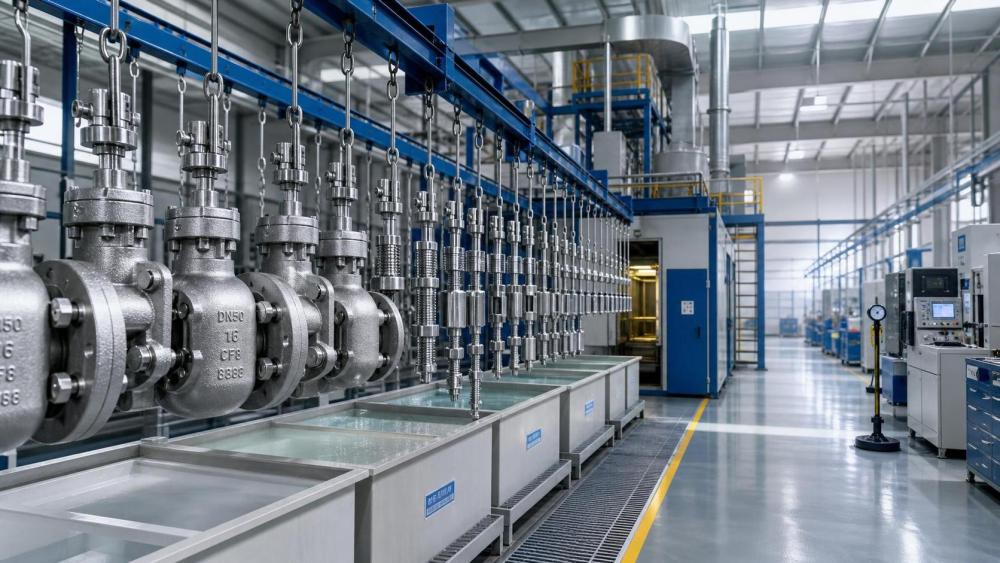
Laboratory panels and standard test coupons are useful for monitoring a coating line, but they cannot replace validation on the buyer’s actual component. Critical parts may include deep recesses, laser-marked areas, welded zones, tight corners, porous castings, threaded holes, mixed-metal assemblies, or masked surfaces that behave differently from a flat panel.
A staged qualification is usually more informative than an immediate large production order. Begin with representative samples, then move to a pilot batch using normal production fixtures, packaging, and handling conditions. The sample set should include parts from different positions on the rack or barrel, not only the most visually attractive pieces selected by the supplier.
Inspection should match the component’s risk profile. Depending on the coating system and application, this may include thickness measurement, adhesion testing, visual checks under agreed lighting, corrosion testing, gloss or color measurement, hardness, porosity evaluation, torque-tension behavior for fasteners, electrical resistance, cross-hatch testing, bend testing, or dimensional verification. Some tests are destructive, so the qualification plan should make clear which samples are retained for testing and which are available for functional assembly trials.
For plated high-strength steels, hydrogen embrittlement deserves specific attention. The relevant risk depends on material strength, process route, stress state, plating chemistry, post-treatment baking, and application severity. A general assurance that “we do baking” is not enough for critical parts. The buyer should require the applicable process controls, timing records, and validation approach to be aligned with the governing specification and the component’s safety significance.
Audit Traceability Before a Failure Forces the Question
When corrosion is discovered after shipment, the commercial impact often depends on whether the supplier can isolate affected lots quickly. Traceability should connect incoming material, pretreatment batch, coating batch, operator or production shift where relevant, test records, packaging, and shipment. The appropriate level of detail varies by part criticality, but the record trail must be usable rather than merely available in principle.
Ask to see a completed batch record, certificate of conformity, test report, nonconformance report, and corrective-action example. These documents reveal more than a certificate displayed in a reception area. Look for clear lot identification, actual measured results, instrument references, dates, specification revision control, authorized release, and evidence that deviations are closed rather than simply noted.
Third-party certifications can provide useful baseline information, particularly when they cover quality, environmental, or occupational-management systems. They should not be treated as proof that a specific surface-treatment line can meet a particular corrosion requirement. Certification scope, current validity, audit exclusions, and the relationship between the certified entity and the actual production facility should all be checked. Where compliance declarations are required, buyers should confirm that the supplier can support the target market’s current requirements rather than relying on a generic statement. Regulatory applicability should be verified for the destination market and product category.
Compare Total Cost, Including Failure and Logistics Exposure
The lowest quoted treatment cost may be reasonable for noncritical indoor parts. It is less persuasive when surface failure can disrupt assembly or trigger downstream claims. Procurement should compare cost at the component lifecycle level: treatment price, yield loss, inspection burden, freight, packaging, lead time, inventory buffer, cost of rework, field-failure exposure, and the cost of qualifying an alternative source.
Chinese suppliers can be competitive on process scale and manufacturing integration, but distance changes the economics of quality escapes. Reworking a coating defect locally may be impossible; returning parts can cost more than replacing them; and a delayed root-cause investigation can affect production schedules across several countries. This is why early process validation, agreed defect definitions, and traceable records are commercial controls, not only quality-system preferences.
Buyers should be alert to quotations that are low because they exclude elements that later become necessary: corrosion testing, masking, special packaging, part-specific fixtures, salt-spray sampling, compliance documentation, rework limits, or tooling maintenance. Request a transparent quotation structure and identify what changes when volumes, part geometry, material condition, or test requirements change.
Use the Supplier Visit to Test Operating Discipline
A site visit, whether conducted directly or through a qualified local auditor, is most valuable when it follows the part through the process. Observe receiving, storage, surface preparation, chemical handling, line loading, coating application, curing or post-treatment, inspection, packing, and segregation of nonconforming material.
Physical conditions matter. Look for clear material flow, stable part identification, protected work-in-process, controlled chemical areas, maintained fixtures, calibrated gauges, adequate ventilation, and separation between approved product and rework. A clean facility alone does not demonstrate capability, but uncontrolled handling, unlabeled containers, improvised masking, or incomplete records are meaningful warning signs.
It is also useful to ask production and quality personnel the same technical question separately. Consistent explanations about inspection frequency, out-of-specification response, and rework controls indicate that the process is understood beyond the sales team. Major differences between departments may signal that documented procedures are not governing daily execution.
Build a Qualification Path That Fits the Part’s Criticality
Not every component requires a full technical audit and extended validation. A practical sourcing program applies more scrutiny where the consequence of failure is higher. Low-risk indoor brackets may need a specification review, sample inspection, and routine supplier monitoring. Safety-relevant, externally exposed, or high-cost-to-replace components may justify site assessment, pilot lots, process approval, periodic revalidation, retained samples, and formal change notification requirements.
The procurement agreement should define which changes require buyer approval: coating chemistry, pretreatment route, subcontracting, production location, major equipment, curing profile, masking method, base-material source, or test laboratory. This is especially important when a supplier offers several finish options under one commercial description. A technically equivalent substitute may still alter appearance, friction, conductivity, thickness, or compliance status.
For critical parts, the strongest supplier relationship is not based on a one-time sample approval. It is based on a shared understanding of the failure mode, a specification that reflects the real service environment, evidence from representative parts, and records that make deviations visible early. That discipline gives procurement teams a better basis for choosing among suppliers of anti-corrosion surface treatment in China, while keeping attention on the outcome that ultimately matters: reliable parts in the field, not simply acceptable parts at shipment.