
Choosing a surface engineering supplier is rarely a simple sourcing task. When parts fail from wear, corrosion, or poor adhesion, the problem often begins long before final assembly. In advanced manufacturing, surface performance affects durability, traceability, cleanliness, coating integrity, and compliance, which is why supplier evaluation needs a technical lens rather than a price-only comparison.
Why supplier evaluation matters more than it seems
A qualified surface engineering supplier does more than apply a coating. It influences friction behavior, chemical resistance, fatigue life, cosmetic quality, and downstream process stability.
That matters across sectors with very different demands. Battery components, food equipment, precision tools, medical devices, electronics housings, valves, and transport parts all depend on controlled surfaces.
In many factories, auxiliary systems determine the difference between stable yield and repeated rework. GIAS highlights this broader reality well: microscopic process control often shapes final product quality more than expected.
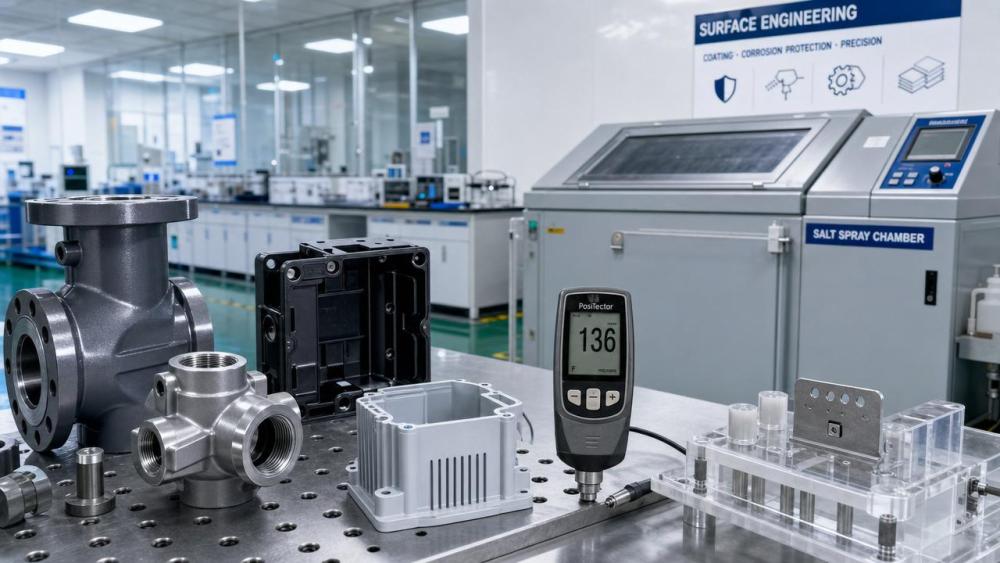
A supplier that understands that chain can connect pretreatment, coating, inspection, and compliance into one reliable process. A weaker supplier may only focus on deposition thickness.
Start with the failure mode, not the coating name
The first step is defining what the surface must resist. Wear, corrosion, and adhesion are related, but they are not the same engineering target.
For example, sliding wear in dry contact requires different solutions than particle erosion, galvanic corrosion, salt spray exposure, or coating delamination under thermal cycling.
A capable surface engineering supplier should ask about substrate material, operating temperature, media exposure, load pattern, part geometry, tolerances, and service life expectations.
If discussions begin and end with “Which coating do you want,” that is usually a warning sign. Good evaluation starts with the problem statement and the actual use environment.
Key questions that sharpen the requirement
- Is the main risk abrasive wear, adhesive wear, fretting, cavitation, or erosion?
- Does corrosion come from humidity, acids, solvents, salt, or cleaning chemicals?
- Is adhesion failure caused by poor pretreatment, contamination, mismatch in expansion, or mechanical stress?
- Which areas are functional, cosmetic, masked, or dimensionally critical?
Assess technical breadth and process fit
A strong surface engineering supplier should offer more than one process route. That does not mean the largest catalog wins, but technical range helps with comparison and fit.
Depending on the application, relevant options may include electroplating, anodizing, thermal spray, PVD, CVD, electroless nickel, conversion coating, passivation, shot peening, or powder coating.
What matters is whether the supplier can explain trade-offs clearly. Hardness alone is not enough. Residual stress, porosity, edge build-up, friction, and post-processing also affect performance.
In practical terms, the right surface engineering supplier connects coating choice with cleaning quality, fixture design, masking strategy, curing control, and inspection method.
Pretreatment and cleanliness deserve close attention
Many adhesion failures are not really coating failures. They are cleaning failures, activation failures, or handling failures that appear later as peeling, blistering, or weak bond strength.
This is where a technically mature surface engineering supplier stands out. Surface preparation should be documented with the same rigor as the coating itself.
GIAS frequently emphasizes process-support systems such as ultrasonic cleaning and controlled production environments. That perspective is useful because pretreatment quality often determines whether the final surface can perform as designed.
Ask how contamination is measured, how parts are handled after cleaning, and how the supplier prevents oils, dust, or oxide layers from returning before coating.
Signals of a disciplined pretreatment process
- Defined cleaning chemistry and exposure time
- Water quality control and drying verification
- Surface activation steps matched to substrate type
- Controlled storage and transfer before coating
Look for evidence, not promises
Supplier presentations often sound similar. The more useful comparison comes from test data, qualification history, and application-specific results.
A credible surface engineering supplier should provide measurable evidence tied to the service condition. Generic claims like “excellent corrosion resistance” are not enough without test method and context.
Depending on the application, review ASTM, ISO, or customer-specific standards covering salt spray, cross-hatch adhesion, pull-off strength, Taber wear, microhardness, coating thickness, and metallographic structure.
Case studies also help, but they should show substrate, treatment route, operating conditions, and actual failure reduction rather than marketing language alone.
Consistency, traceability, and compliance shape long-term value
In production, one good pilot batch does not guarantee repeatability. The better question is whether the same result can be delivered across batches, shifts, and export destinations.
This is especially relevant when parts move through regulated or quality-sensitive chains. Traceability, bath monitoring, calibration records, and controlled rework procedures should be easy to verify.
Compliance can also affect supplier choice. Restrictions on hazardous substances, wastewater management, VOC control, and customer documentation increasingly shape surface treatment decisions.
A dependable surface engineering supplier understands both process performance and the documentation burden that follows global manufacturing and export activity.
What to request during qualification
- Process flow and control plan for the proposed treatment
- Inspection records and capability data for similar parts
- Certification status and relevant environmental documentation
- Clear response method for defects, rework, and field returns
Evaluate communication quality during trials
Trial runs reveal more than technical output. They show how the supplier thinks, documents, and responds when results are mixed.
A capable surface engineering supplier will flag design risks early, such as sharp edges, trapped chemistry, hidden surfaces, coating shadowing, or tolerance conflicts after deposition.
That kind of feedback has practical value. It helps improve part design, cleaning sequence, fixture orientation, and inspection criteria before scale-up creates avoidable cost.
This is also where broader manufacturing awareness matters. Surface treatment does not exist in isolation from marking, cleaning, batching accuracy, vacuum processing, or final assembly requirements.
A practical way to compare suppliers
A useful comparison model combines technical fit, quality evidence, and operational realism. It keeps evaluation grounded in measurable risk rather than brand familiarity.
- Rank failure risks by severity, frequency, and replacement cost.
- Match each risk to a treatment route and validation method.
- Score each surface engineering supplier on process control, testing depth, and repeatability.
- Review trial data with design, quality, and production constraints together.
- Prefer suppliers that explain limitations as clearly as capabilities.
That approach usually leads to better decisions than comparing quotation totals alone. It also supports faster root-cause work if a surface issue appears later in service.
Where to focus next
The best next step is to turn broad performance goals into a short qualification matrix. Define the substrate, operating environment, target life, critical surfaces, required tests, and acceptable variation.
Then compare each surface engineering supplier against those conditions, not against a generic capability list. When evaluation stays close to real use, supplier selection becomes more reliable and easier to defend internally.
For teams using industry intelligence platforms such as GIAS, the advantage is context. Process knowledge, compliance signals, and adjacent auxiliary technologies can help sharpen supplier screening before formal trials begin.
A well-chosen surface engineering supplier is not just a coating source. It is a process partner that helps protect function, reduce variation, and support long-term manufacturing confidence.