
For technical evaluators, the real question behind micro-jet impact force testing is not what the method is called, but whether it gives a dependable answer to a practical problem: did the precision cleaning process actually remove the contamination that matters, without damaging the part or creating process drift?
That question matters because many cleaning lines look effective at the surface while still leaving behind risk. In semiconductor-adjacent parts, medical components, optical assemblies, aerospace hardware, precision molded parts, and high-value industrial subassemblies, the issue is rarely visible residue alone. It is also about repeatability, localized cleaning intensity, and whether a process can be validated across shifts, operators, nozzle conditions, and changing part geometries. Micro-jet impact force testing is increasingly used as one of the few ways to quantify that interaction instead of relying on indirect impressions.
Why this test is getting attention
Precision cleaning has become harder to judge with traditional pass/fail thinking. A part may appear clean after solvent spray, ultrasonic treatment, or mixed-process washing, yet still fail later in assembly, bonding, coating, or electrical reliability checks. In those cases, the cleaning step was not necessarily weak overall; it may simply have been too uneven, too aggressive in one area, or poorly matched to the contamination profile.
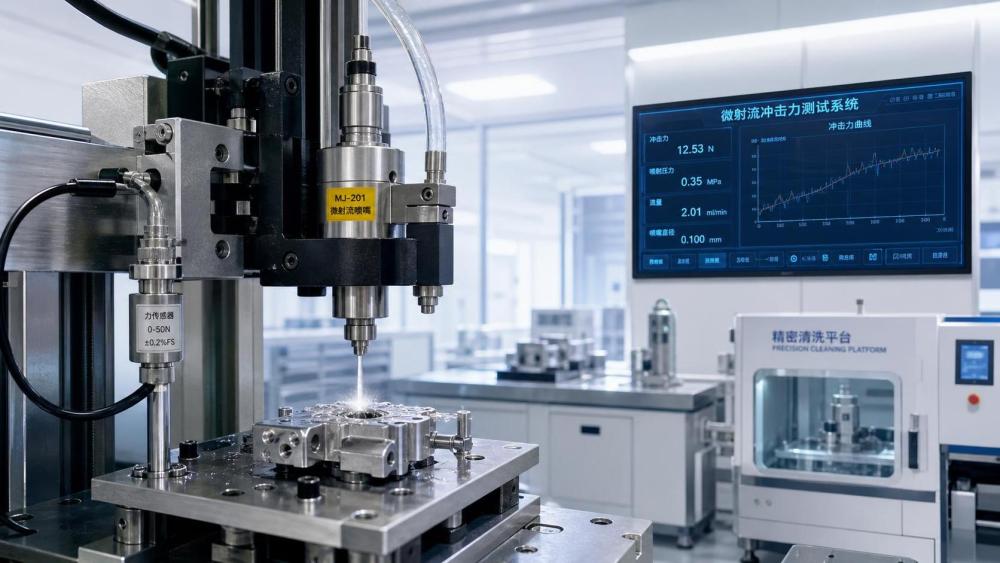
Micro-jet impact force testing helps evaluate the force delivered by a fine cleaning jet at the point of contact. That matters because cleaning performance is not only about chemistry. It is also about mechanical action, flow concentration, standoff distance, nozzle geometry, pulse characteristics, and surface sensitivity. If the jet is too weak, residues remain. If it is too strong, delicate surfaces, microfeatures, coatings, or particle-sensitive structures may be damaged or redistributed.
For technical evaluators, that makes the method useful in two directions at once: it helps confirm whether a process is strong enough to clean, and whether it is controlled enough to be safe.
What it can and cannot tell you
Micro-jet impact force testing is most valuable when it is treated as a validation tool, not as a complete proxy for cleanliness. That distinction matters. A measured impact force does not automatically prove the absence of all contaminants, and a lower force does not always mean poor cleaning if the chemistry, dwell time, or multi-step process is doing the real work.
What it can do well is establish a repeatable mechanical benchmark. That benchmark helps answer questions such as:
- Is the jet delivering consistent energy across the working area?
- Does a nozzle change, pressure change, or fluid change alter process intensity in a meaningful way?
- Are we over-cleaning fragile zones while under-cleaning recessed ones?
- Can the process be reproduced after maintenance, line relocation, or supplier substitution?
What it cannot do by itself is replace residue analysis, surface inspection, extractables testing, ionic contamination checks, particle counting, or application-specific functional tests. In serious procurement or qualification work, it should sit inside a broader verification stack, not stand alone.
Where the method is most useful
The strongest use cases are those where cleaning quality depends on localized jet behavior. That includes precision parts with blind holes, grooves, microchannels, thin-walled structures, bonded surfaces, and components that cannot tolerate broad abrasive action. It is also relevant when a manufacturer is comparing different cleaning technologies or trying to justify a process change to quality, compliance, or customer audit teams.
In practical terms, the method is especially relevant when the buyer needs to compare:
For many plants, the point is not to chase a higher number. It is to define the force window that achieves cleaning without creating collateral damage. That window is often narrower than teams expect.
How evaluators should read the data
The most common mistake is treating the result as a single performance score. In reality, the number only becomes meaningful when tied to a test method with controlled conditions. Evaluators should pay attention to the test setup before trusting the output.
Key variables usually include nozzle type, jet diameter, fluid properties, nozzle-to-surface distance, impact angle, pulse duration, scan speed, and the measuring substrate or sensor arrangement. If those conditions are not controlled and reported clearly, the result is hard to compare across suppliers or even across test sessions on the same line.
A good technical review usually asks three questions:
- Was the test designed to reflect the real cleaning case, or only a laboratory convenience setup?
- Were the results repeatable across multiple runs and operators?
- Did the force range correlate with the downstream result that actually matters, such as particle removal, defect rate, adhesion, or contamination limit compliance?
That last point is the one many presentations skip. A force value is only useful if it correlates with a business or quality outcome. Otherwise it is just a precise number with limited operational meaning.
What standards-minded teams should watch
There is growing interest in standardizing how precision cleaning is validated, but practices are still uneven across industries. Some companies rely on internal methods built around customer specs. Others borrow from broader fluid, surface, or cleanliness testing practices. In many cases, there is no single universally adopted public standard that fully covers the exact use case, so teams need to be careful about overstating compliance claims.
That is especially important in regulated or export-sensitive environments. If micro-jet impact force testing is being used as part of a qualification package, evaluators should verify:
- What the acceptance criteria are based on
- Whether the method has been correlated to product performance
- Whether calibration and traceability requirements are defined
- Whether environmental conditions could affect the reading
In short, the strongest setup is not the one with the highest jet force. It is the one with the clearest link between measurement, contamination removal, and functional performance.
Typical misunderstandings in procurement and validation
One common misconception is that stronger impact force always means better cleaning. That is not true in precision work. Once a process exceeds the useful force range, it can push particles into edges, spread residues, or degrade sensitive surfaces. Another misconception is that a stable force reading guarantees the process is clean. Stability only proves consistency, not adequacy.
A third mistake is to evaluate the cleaning system in isolation from the part. Surface roughness, wetting behavior, geometry, and contamination type all change the result. A process that works well on one part family may fail on another even if the machine settings are unchanged.
For buyers, this is where supplier evaluation should become more rigorous. The relevant question is not whether the vendor can show a nice test curve. It is whether they can explain how the curve maps to real applications, what failure modes were considered, and how the process behaves when conditions drift.
A practical decision framework
For technical evaluators, the most useful way to adopt micro-jet impact force testing is to place it inside a broader qualification workflow. A sensible sequence is:
- Define the cleanliness failure that matters in the product.
- Identify the process variables that influence jet intensity and distribution.
- Set a repeatable force test condition that matches the application as closely as possible.
- Correlate the force data with residue, particle, or function-based validation.
- Use the resulting window for incoming equipment checks, change control, and periodic audit.
This approach is more defensible than treating the method as a marketing claim or a one-off lab demonstration. It also makes procurement decisions easier because the buyer can separate genuine process control from generic equipment performance.
What to ask suppliers or lab teams
When reviewing a proposed system or test report, the most useful questions are direct:
- What exactly is being measured?
- How is repeatability demonstrated?
- How sensitive is the result to standoff distance and nozzle wear?
- What contamination removal result was used to validate the force window?
- How does the method distinguish between cleaning efficacy and surface damage risk?
If those answers are vague, the evaluation is not ready for a purchasing or qualification decision. If they are clear, the method can become a practical tool for controlling precision cleaning performance across production and supplier networks.
As precision manufacturing keeps tightening tolerances and traceability expectations, methods that quantify cleaning intensity will matter more. Micro-jet impact force testing is useful precisely because it turns an otherwise hidden process into something engineers can compare, verify, and defend.