
When technical teams search for GMP requirements for pharmaceutical process equipment, they are usually trying to answer a practical question: what separates equipment that is merely functional from equipment that can stand up to qualification, routine inspection, deviation investigation, and long-term regulated use. In pharmaceuticals, equipment is not judged only by throughput or utility consumption. It is judged by whether it supports product quality, can be cleaned and controlled consistently, and leaves an audit trail that makes process decisions defensible.
That is why pharmaceutical process equipment GMP expectations reach well beyond a nameplate claim or a polished stainless-steel finish. The real evaluation starts with design intent, contact materials, cleanability, contamination control, automation logic, calibration strategy, maintenance access, and the completeness of validation documentation. For buyers, engineering reviewers, and compliance teams, the risk is not usually that an equipment supplier says too little. It is that the supplier says all the familiar things while leaving the critical gaps hidden in details.
Why GMP matters at the equipment stage
In many industries, auxiliary or process-support equipment is treated as secondary. In pharmaceutical production, that assumption breaks down quickly. Mixers, tanks, transfer systems, pumps, filling interfaces, CIP/SIP assemblies, weighing systems, dryers, isolator-connected modules, and packaging-support equipment can all become direct contributors to contamination risk, batch variability, or data integrity concerns.
From a GMP perspective, equipment has to do three things at once. It must perform the process function it was bought for. It must do so in a way that is repeatable across batches and operators. And it must make that repeatability visible through design controls, records, and validation evidence. If any one of those fails, the equipment may still run, but it becomes harder to defend in front of QA, auditors, or customers.
This is also why technical evaluation should begin earlier than factory acceptance testing. By the time equipment reaches site, major GMP weaknesses are expensive to correct. Dead legs, poor drainability, inaccessible welds, undocumented software logic, non-standard instruments, or unsuitable elastomer choices often surface too late.
What GMP-compliant design really means in practice
A common mistake is to reduce GMP design to a checklist of hygienic features. Those features matter, but GMP design is really about controlling failure modes before they become product risks. The relevant question is not only “is this equipment made of stainless steel,” but “does this design reduce the chance of cross-contamination, mix-up, carryover, operator error, and undocumented process drift?”
For pharmaceutical process equipment GMP review, several design areas usually carry the most weight.
Product-contact materials and surface condition
Material selection must fit the product, the cleaning chemistry, the process temperature, and the sterilization method. Stainless steel grades such as 316L are common for product-contact surfaces, but grade alone is not enough. Evaluators also need to review surface finish, weld quality, passivation status, corrosion resistance, and whether non-metallic parts such as seals, hoses, gaskets, filters, and diaphragms are compatible with both process media and cleaning cycles.
Surface roughness limits are often discussed, but teams should be careful about turning one number into a universal acceptance rule. A low Ra value helps, yet it does not compensate for poor geometry, crevices, bad weld transitions, or areas where residue can accumulate. In regulated use, cleanability is demonstrated by the whole assembly, not by one finish certificate.
Cleanability and drainability
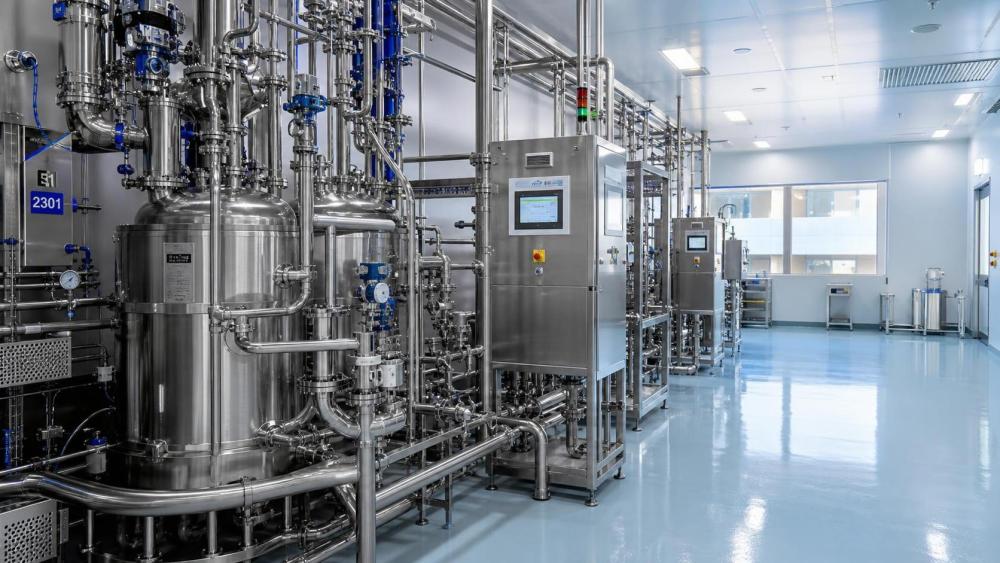
Cleanability is one of the most consequential design issues because it links directly to cleaning validation, changeover time, and contamination control. Equipment should be designed so residues can be removed reproducibly under defined procedures. That typically means minimizing hold-up volume, avoiding shadow zones, eliminating unnecessary horizontal runs, ensuring effective spray coverage where CIP is used, and providing full drainability in realistic installed conditions rather than idealized drawings.
Drainability deserves more scrutiny than it often receives. A vessel that drains on a shop floor may not drain properly once it is connected on site, tilted by pipe loads, or integrated with downstream skids. Residual liquid in low points can become a recurring source of bioburden or cleaning failure. Technical reviewers should ask whether drain tests were performed under representative conditions and whether worst-case locations were identified.
Closed processing and contamination control
Modern GMP expectations generally favor designs that reduce open handling, uncontrolled interventions, and operator-dependent steps. Closed transfer systems, appropriate pressure boundaries, vent filtration, isolator interfaces, barrier integration, and clear segregation between clean and utility sides all support that goal. The exact configuration depends on dosage form, product sensitivity, potency, and facility concept, but the direction is consistent: every open exposure point should be justified.
This is particularly important for sterile processes, high-potency compounds, biologics-related applications, and multi-product facilities, where contamination risk has both product-quality and occupational-safety dimensions. In these settings, equipment design is often inseparable from containment strategy.
One useful rule for evaluators: if the supplier describes contamination control mainly as an operating procedure, and not as a built-in design feature, the risk is probably being pushed downstream to the user.
Validation starts with design, not after installation
Many procurement discussions still treat validation as a final documentation package attached to the equipment. In practice, validation begins much earlier. Design qualification logic starts when user requirements are translated into functional specifications, component choices, control architecture, alarm philosophy, and acceptance criteria. If these steps are weak, later IQ/OQ/PQ activity becomes a documentation exercise built on unstable ground.
For pharmaceutical process equipment, technical evaluators usually want to see a traceable chain across the following elements:
- User Requirement Specification (URS) tied to process and compliance needs
- Functional and design specifications showing how requirements are implemented
- Risk assessments, often using FMEA or similar methods, to identify critical control points
- Material certificates, weld records, calibration records, and component traceability where relevant
- Factory Acceptance Test and Site Acceptance Test protocols aligned to intended use
- IQ/OQ support documentation and defined handover packages
- Software and automation documentation, including access control, backup, and change management
Not every project carries the same validation burden. A non-product-contact support skid does not require the same depth of evidence as a sterile mixing or filling module. But the supplier should be able to explain the rationale clearly. When documentation depth changes with system criticality, that is normal. When it changes because the supplier has no consistent documentation discipline, that is a warning sign.
Automation and data integrity are now part of GMP fitness
For older equipment categories, some buyers still prioritize mechanical build quality and treat controls as a secondary matter. That is increasingly outdated. In many inspections and internal quality reviews, software behavior, electronic records, audit trails, recipe management, alarm handling, and access controls can become just as important as vessel geometry or pump performance.
Any process equipment that stores recipes, controls critical setpoints, logs events, or transmits production data should be reviewed through a data integrity lens. Depending on system role, this may involve expectations related to user permissions, version control, record retention, time-stamped events, backup procedures, and the ability to reconstruct what happened during a batch or deviation. Exact requirements may vary by market and facility architecture, and teams should verify current regulatory expectations for their jurisdiction, but the trend is clear: undocumented automation logic is no longer acceptable in most regulated environments.
Technical evaluators should also distinguish between “PLC-controlled” and “validation-ready.” A machine can have modern controls and still be poorly structured for GMP use if recipes are editable without control, alarm histories are incomplete, or software changes are not traceable.
Where buyers often misjudge equipment suitability
Several recurring assumptions create problems during supplier comparison.
First, certification is often overvalued. There is no single universal certificate that proves complete GMP suitability for all pharmaceutical applications. Suppliers may present material certificates, surface reports, quality-system credentials, or internal compliance statements, and these can be useful. But none of them replaces a context-based assessment of the actual equipment design, intended use, and validation package.
Second, standard equipment is sometimes assumed to become GMP-ready through documentation alone. That is rarely true for critical applications. Documentation can support compliance, but it cannot redesign poor flow paths, remove contamination traps, or fix inaccessible maintenance points.
Third, teams may focus too heavily on purchase price. In pharmaceutical settings, lower upfront cost can be offset quickly by longer cleaning cycles, repeated deviations, slower qualification, spare-parts inconsistency, or extensive site modification work. Total cost of ownership should include commissioning effort, validation burden, downtime risk, cleaning verification effort, and the expected service life of contact components.
How to evaluate a supplier beyond the brochure
For technical assessment personnel, the most useful supplier conversations are usually not about broad claims but about evidence. A capable supplier should be able to discuss where the design is robust, where customization introduces risk, and which assumptions depend on site utilities or operating discipline.
Good evaluation questions often include:
- Which parts are considered product-contact, indirect-contact, and non-contact, and how is that boundary defined?
- What are the hardest-to-clean locations, and how were they identified?
- How are welds inspected and documented for critical assemblies?
- Which components are standard catalog parts, and which are custom-fabricated?
- What documentation is included as standard, and what is optional?
- How are software changes controlled between FAT and site startup?
- What assumptions were made about utility quality, environmental classification, and operator intervention?
- How has the design been adapted for similar pharmaceutical applications before?
The quality of answers matters as much as the answers themselves. Vague references to “meets GMP principles” without design-level explanation usually indicate weak application knowledge. By contrast, suppliers that can discuss worst-case cleaning paths, calibration access, intervention points, and validation boundaries tend to be more credible partners, even when they acknowledge limitations.
Risk areas that deserve more attention in current projects
Across advanced manufacturing, auxiliary systems are becoming more integrated, more automated, and more data-connected. In pharmaceuticals, that creates benefits but also shifts risk into areas that older equipment reviews sometimes underemphasize.
One is integration risk. A well-designed vessel or skid can still fail GMP expectations after integration if field piping introduces dead legs, if third-party sensors lack traceability, or if supervisory software changes how alarms or recipes are handled. Evaluators should review the installed system architecture, not just the OEM package in isolation.
Another is lifecycle risk. Equipment that qualifies successfully on day one may become difficult to maintain if spare parts are proprietary, firmware support is weak, or critical instruments are frequently substituted without change-control discipline. GMP fitness is not only a startup issue; it is a maintainability issue.
A third is cross-functional misalignment. Engineering may approve a design for operability, procurement may push for standardization, and QA may review only at the end. That sequence often creates avoidable rework. The stronger approach is to involve process, quality, validation, and maintenance perspectives early, especially for systems that influence cleaning validation, batch records, or contamination control.
The practical standard for decision-making
For most technical evaluators, the central question is not whether equipment looks compliant. It is whether the design, documentation, and supplier support together reduce the effort needed to achieve and sustain compliance in real production. Pharmaceutical process equipment GMP requirements are best understood as a framework for reducing uncertainty: uncertainty in cleaning, in material compatibility, in operator action, in software behavior, and in deviation investigation.
That is why the best equipment choices often come from disciplined questioning rather than from the longest compliance statement. If a system can be cleaned reproducibly, controlled predictably, maintained without compromising product contact surfaces, and validated with complete and traceable evidence, it is already doing the work GMP asks of it. Everything else is commentary around that core reality.