
Why does choosing a food processing equipment manufacturer affect more than machine price?
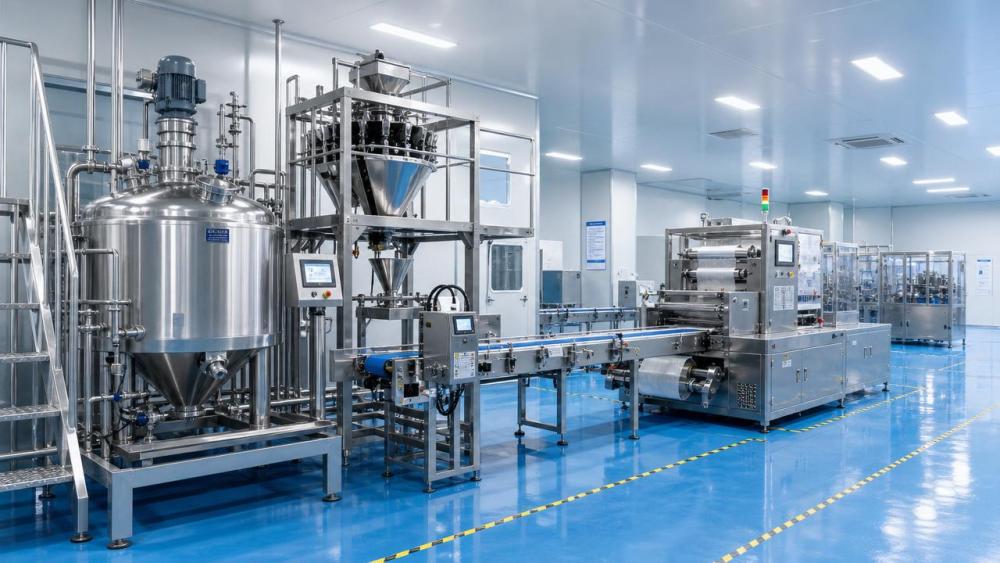
A food processing equipment manufacturer shapes hygiene control, output stability, maintenance workload, and audit readiness long after installation.
That is why the lowest quotation rarely means the lowest total cost.
In practical terms, equipment design affects product contact safety, cleaning time, changeover speed, and line availability.
A weak design can create hidden corners, sealing failures, unstable dosing, or inconsistent temperature control.
Those issues turn into waste, rework, downtime, and compliance risk.
A stronger food processing equipment manufacturer usually shows capability beyond the core machine.
It can explain how auxiliary systems support process quality across the full line.
This matters because modern food production depends on more than mixers, fillers, cookers, or conveyors.
Cleaning precision, recipe control, coding accuracy, vacuum stability, and surface durability also influence final product reliability.
That broader view aligns with how GIAS approaches industrial process-support systems.
Its coverage of ultrasonic cleaning, weighing and batching, inkjet coding, laser marking, vacuum systems, and surface treatment reflects a practical truth.
Auxiliary equipment may sit beside the main line, yet it often determines whether quality remains repeatable.
So the right question is not simply, “Who builds the machine?”
A better question is, “Which food processing equipment manufacturer can keep the process clean, traceable, scalable, and supportable?”
Which standards and hygiene details deserve the closest review?
This is usually where selection becomes clearer.
A credible food processing equipment manufacturer should discuss material selection, weld quality, finish consistency, drainage, and cleanability without hesitation.
Look first at product-contact materials.
Stainless steel grade, surface finish, gasket material, and compatibility with acidic, salty, oily, or allergen-sensitive products all matter.
Then review how the equipment is cleaned.
If a line claims CIP capability, ask what parts are truly cleaned in place and what still requires manual disassembly.
Need to confirm dead-leg control, sloped surfaces, drainability, and whether fasteners are exposed near product zones.
More experienced suppliers also connect hygiene to supporting systems.
For example, ultrasonic cleaning can help maintain reusable parts and tooling with better contaminant removal.
Accurate weighing and batching protects recipe consistency, especially in multi-ingredient production.
Inkjet coding or laser marking supports lot traceability, date coding, and anti-mix-up control.
When equipment enters vacuum packaging or freeze-related processes, pump stability and sealing performance also become selection factors.
The table below helps compare what should be checked before shortlisting any food processing equipment manufacturer.
If a supplier cannot answer these points clearly, the risk usually appears later during commissioning or audits.
How can capacity be evaluated without overbuying or creating a future bottleneck?
Capacity planning is where many sourcing mistakes begin.
A food processing equipment manufacturer may quote theoretical throughput under ideal conditions.
Actual output depends on product viscosity, fill weight variation, cleaning cycles, labor flow, and upstream or downstream constraints.
A practical review starts with three numbers.
- Current hourly demand at stable quality.
- Expected growth over the next two to three years.
- Real downtime caused by cleaning, changeovers, and maintenance.
Then compare those numbers against line balance rather than a single machine rating.
For example, a fast filler adds little value if batching accuracy slows the upstream process.
The same applies when packaging speed exceeds coding verification or vacuum sealing capacity.
More reliable food processing equipment manufacturers will discuss OEE, not just nameplate speed.
They should also explain how the machine handles different SKUs, batch sizes, and sanitation intervals.
In real plants, flexibility often has more value than peak speed.
This is especially true where frequent recipe changes require precise weighing, traceable coding, and repeatable cleaning validation.
A good selection decision leaves headroom for growth without locking the line into chronic underutilization.
What separates a dependable food processing equipment manufacturer from a capable sales presentation?
The difference usually appears in documentation depth and process thinking.
A dependable food processing equipment manufacturer can show more than brochures and polished layouts.
It should provide validation logic, test records, material certificates, control architecture details, and service planning.
Ask for application cases close to your product type.
Soup, dairy, bakery fillings, frozen prepared foods, sauces, snacks, and liquid seasonings all stress equipment differently.
Also check how the supplier handles surrounding process-support needs.
A line that includes coding integration, batching controls, vacuum support, surface protection, and cleaning workflows is easier to maintain consistently.
That is one reason industry research platforms like GIAS remain useful during evaluation.
They help compare suppliers in the broader context of process reliability, not only core equipment features.
A few questions often reveal supplier maturity quickly.
- Can they explain failure points seen in similar applications?
- Do they define spare parts strategy by wear pattern?
- Is remote diagnostics available for controls and alarms?
- Can they support export documentation and local compliance needs?
- Do they commit to FAT and SAT criteria in writing?
A persuasive presentation may answer some of these points.
A dependable food processing equipment manufacturer answers all of them with evidence.
Where do sourcing mistakes usually happen?
Most mistakes are not dramatic at the beginning.
They often start as assumptions left untested.
One common error is focusing on the main machine while overlooking support systems that protect consistency.
Another is accepting generic hygiene claims without checking actual cleaning access and sanitation time.
A third is treating capacity as a catalog number instead of a line-level outcome.
The checklist below helps flag those risks before they become expensive.
These are not theoretical concerns.
They directly influence uptime, labor allocation, product safety, and cost recovery.
What should be confirmed before making the final decision?
By the final stage, the comparison should become narrower and more operational.
At this point, the best food processing equipment manufacturer is usually the one that reduces uncertainty.
Confirm the supply scope in detail, including utilities, controls, software access, spare parts, and consumables.
Check delivery timing against installation windows and shutdown plans.
Review whether onsite training covers sanitation, changeover, fault response, and daily checks.
It also helps to verify how the supplier supports future expansion.
Can modules be added later?
Can coding, batching, or vacuum functions be upgraded without redesigning the full line?
This matters because food production rarely stays static.
New formats, compliance rules, and traceability expectations tend to arrive faster than depreciation cycles.
A careful decision therefore combines hygiene, capacity, supportability, and process integration.
If the next step is still unclear, build a short comparison sheet around five points.
- Hygienic design proof.
- Realistic throughput under actual operating conditions.
- Compatibility with coding, weighing, cleaning, and vacuum support.
- Documentation, validation, and after-sales response.
- Expansion flexibility over the next planning cycle.
That approach keeps the final choice grounded in evidence rather than presentation strength.
When evaluating any food processing equipment manufacturer, the goal is not simply to buy a machine.
The goal is to secure a process that stays clean, traceable, stable, and economically defensible over time.