
Compliance Starts Before the Quotation
Exporting industrial equipment to the United States is viable for many overseas manufacturers, but a machine that performs well in its home market can still be delayed, rejected by a buyer, or become costly to support if its U.S. compliance position is unclear. For business evaluators, the first question is rarely whether a product can be shipped. It is whether the exporter can document that the equipment is suitable for the intended U.S. installation, industry, power supply, operator environment, and regulatory scope.
There is no single “U.S. industrial machinery certificate” that automatically clears every product for sale. Requirements depend on what the equipment does, how it is powered, where it will be installed, whether it creates emissions or radiation, and whether it enters a regulated production process. A vacuum pump used in a general manufacturing plant, an ultrasonic cleaner for precision components, a laser marking station, and a batching system for food or pharmaceutical production may all face different compliance questions.
A sound industrial equipment export USA strategy therefore begins with classification and evidence. Competitive price, delivery time, and core specifications matter, but they do not compensate for an unresolved electrical listing issue, an incomplete technical file, or a mismatch between machine documentation and the buyer’s site requirements.
Separate the Authorities That May Affect the Equipment
U.S. compliance is often misunderstood because several authorities can be relevant at the same time, each addressing a different issue. Customs entry is one issue. Product safety at the installation site is another. Worker safety, electromagnetic compatibility, environmental obligations, and sector-specific rules may create additional requirements.
At the border, U.S. Customs and Border Protection focuses on admissible entry, customs valuation, classification, country of origin, marking, and required import documentation. Customs clearance does not prove that a machine satisfies electrical, workplace, or local installation requirements. A shipment can be entered correctly and still be unacceptable to a plant engineer, insurer, authority having jurisdiction, or corporate safety team.
For electrically powered industrial machinery, buyers frequently expect evidence that relevant electrical components or the completed assembly have been evaluated by a Nationally Recognized Testing Laboratory, commonly called an NRTL. The exact expectation depends on the equipment and local enforcement practice. In many facilities, a recognized listing or field evaluation is treated as a practical condition for installation, even where the manufacturer assumes a declaration of conformity is sufficient.
The Occupational Safety and Health Administration does not generally pre-approve every machine before sale. Its rules and enforcement framework nevertheless shape buyer expectations around guarding, lockout capability, emergency stops, electrical safety, hazardous energy, operator exposure, and safe maintenance. A machine may be technically capable of production while still requiring redesign or added safeguarding before a U.S. employer will place it into service.
Other agencies can become relevant according to the product configuration:
- Equipment containing intentional radio transmitters, wireless modules, or electronic systems that create radio-frequency emissions may fall within Federal Communications Commission requirements.
- Laser marking equipment needs careful attention to laser classification, protective housings, interlocks, warning labels, operating instructions, and applicable U.S. radiation-control requirements.
- Systems used in food, pharmaceutical, medical, chemical, or other controlled applications may be assessed against sector-specific expectations that go beyond the machine itself.
- Coating, cleaning, surface-treatment, or process systems using chemicals, solvents, exhaust streams, or treatment media can raise environmental, ventilation, waste-handling, and local permitting issues.
- Industrial weighing systems used for commercial transactions may require evaluation under state or local weights-and-measures rules, especially where the measurement determines the price of a sold material.
The practical lesson is to map the product before promising compliance. “CE marked,” “ISO certified,” or “export version available” are not complete answers to a U.S. buyer’s technical review. They may be useful supporting evidence, but they do not identify every U.S. obligation or site-level acceptance requirement.
Define the Product Being Imported, Not Just the Product Family
Compliance decisions should be made against a specific sellable configuration. Industrial equipment suppliers often describe a product line broadly, while the actual exported unit varies by voltage, control cabinet, motor supplier, laser source, enclosure, HMI, wireless connectivity, fluid type, exhaust arrangement, or optional automation. Those variations can materially change the review.
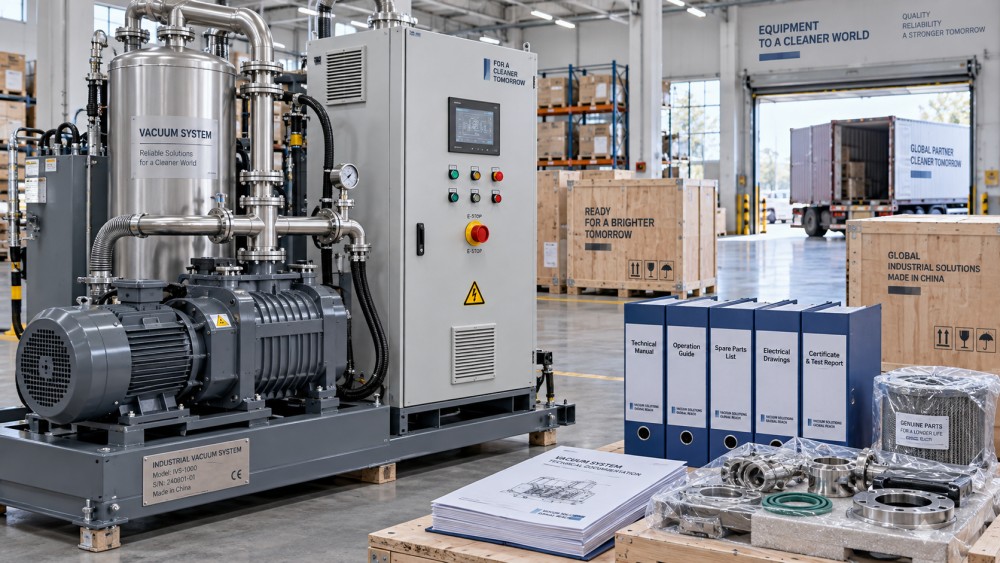
A vacuum system is a useful example. A base pump may be sold as a component for integration, while a packaged vacuum skid can include motors, variable-frequency drives, electrical controls, pressure vessels, cooling circuits, safety devices, and remote monitoring. The packaged system should be evaluated as the system being supplied. Assuming that individual compliant parts automatically settle the status of the assembled machine can create a documentation gap.
The same issue appears in automated ultrasonic cleaning lines. A standalone tank, a multi-stage cleaning line with heating and drying, and a robotic loading cell present different safety and installation considerations. Laser marking equipment may be delivered as an enclosed Class 1 production station, an open marking head for integration, or a workstation with automation and extraction. The compliance route, labels, risk controls, manuals, and purchaser responsibilities should match the actual delivery scope.
Before issuing a final quotation, an exporter should be able to state clearly:
- Whether the equipment is a finished machine, a partly completed machine, a component, or a system requiring field integration.
- The intended power configuration, including voltage, frequency, phase, rated current, grounding arrangement, and any site-supplied disconnect requirements.
- Which safety functions are included by the manufacturer and which must be provided by the purchaser or integrator.
- Whether consumables, chemicals, compressed air, cooling water, exhaust, vacuum lines, process gases, or fire protection are required.
- Which optional modules are included in the quoted unit and whether they change the regulatory profile.
- Who will install, commission, validate, and maintain the equipment in the United States.
This level of definition protects both sides. It prevents a buyer from assuming the price includes a turnkey, accepted production cell when the exporter intended to provide only the core equipment. It also prevents the seller from making broad compliance claims that cannot be supported by the final bill of materials.
Build a Technical File That a U.S. Buyer Can Actually Use
For industrial auxiliary systems, the technical file often determines whether a buyer moves forward after initial commercial discussions. Procurement teams may start with price and capacity, but engineering, EHS, quality, and maintenance teams will ask for documents that allow them to assess installation risk and operating responsibility.
The file should be organized around the delivered machine rather than assembled from generic brochures. At a minimum, it should include a controlled specification, general arrangement drawing, utility requirements, electrical schematics, pneumatic or hydraulic diagrams where applicable, parts list for safety-relevant components, operating instructions, maintenance instructions, and a machine nameplate image or drawing.
Risk documentation is especially important. A usable risk assessment identifies foreseeable hazards during normal operation, cleaning, setup, fault recovery, maintenance, and disposal. For example, an ultrasonic cleaning system may involve hot liquid, chemical exposure, moving transfer mechanisms, electrical equipment near fluids, and vapor extraction. A powder-coating system may involve electrical charge, powder containment, grounding, ventilation, and ignition-control considerations. A document that merely states “operate safely” does not show how hazards were assessed or controlled.
Safety functions should be described in practical terms. The buyer needs to know what occurs when a door is opened, a light curtain is interrupted, a thermal limit is exceeded, a vacuum level drops, an emergency stop is pressed, or power is restored after an interruption. Where a system depends on external safeguards, that dependency should be visible in the documents and quotation.
English-language documentation should be complete enough for operators, maintenance personnel, and safety reviewers. Translation quality matters. Ambiguous warnings, inconsistent component names, missing wiring references, or dimensions shown only in unfamiliar units can delay acceptance. Where both metric and U.S. customary units are supplied, the source value and conversion should be controlled to avoid installation mistakes.
Certification Claims Need a Narrow, Verifiable Scope
Many export problems begin with overly broad language. “UL compliant,” “UL standard design,” “FDA approved,” or “meets all U.S. standards” can create obligations far beyond what the supplier has documented. A credible claim identifies the product, edition or reference where appropriate, testing or listing body if one exists, and the limits of the conclusion.
Business evaluators should distinguish among several very different situations:
Field evaluation can be a workable route for one-off equipment, custom process lines, or machinery imported in limited quantities. It is usually less attractive when the exporter expects repeated sales of a standardized unit, because late changes can be expensive and delivery schedules become uncertain. A supplier considering the U.S. market as a long-term channel should evaluate whether a repeatable certification and component-control approach will reduce friction across future installations.
Certification is also a change-control issue. Replacing a power supply, PLC, motor, laser source, safety relay, enclosure, or wire type without evaluating the effect on the documented configuration can invalidate the basis for a prior claim. This matters especially for exporters managing alternate suppliers or responding to component shortages. The sales team, engineering team, and procurement team need a process for identifying changes that affect compliance evidence.
Customs Readiness Should Be Treated as a Design Input
Customs planning is often left until the machine is packed. That is late for any equipment with complex origin, valuation, or classification questions. The U.S. importer is generally responsible for entry obligations, but exporters influence the quality of the information used by the importer and customs broker.
The commercial invoice should describe the equipment accurately and consistently with the purchase order, packing list, technical literature, and country-of-origin marking. A vague description such as “industrial machine” gives the broker little basis for classification and can obscure the actual function of the item. A clearer description identifies the principal function, major process, model, quantity, and relevant accessories.
Tariff classification should be reviewed against the imported machine as delivered, including separately packed components where appropriate. Classification can affect duty treatment, reporting obligations, and landed-cost assumptions. Country of origin is a separate question from the country of shipment. Equipment assembled in one jurisdiction from components sourced elsewhere requires a defensible origin analysis rather than a casual assumption based on the shipping location.
Importers may also need information supporting customs value, including the transaction structure, assists, tooling, royalties, commissions, and related-party arrangements where relevant. The exporter does not need to turn every transaction into a legal memorandum, but it should avoid informal invoice practices that make the declared value difficult to support.
Physical marking deserves attention. Country-of-origin marking must be legible and suitably permanent for the item, subject to applicable rules and exceptions. Equipment nameplates should also identify the manufacturer, model or type, serial number where used, and electrical ratings. A durable nameplate helps customs review, installation, maintenance, traceability, and later service support.
Buyer Acceptance Is a Separate Gate From Regulatory Entry
The U.S. buyer may impose requirements that exceed the minimum legal baseline. Large manufacturers often have internal electrical, cyber-security, documentation, spare-parts, welding, ergonomic, or validation standards. A pharmaceutical customer may focus on cleanability, material traceability, calibration records, software access control, and batch documentation. A semiconductor or battery manufacturer may scrutinize vacuum performance, contamination control, chemical compatibility, exhaust routing, and recovery after power loss.
These requirements should be surfaced early, before a supplier commits to a delivery date. A commercial offer can include an acceptance matrix that separates included compliance evidence, purchaser-provided site conditions, optional upgrades, and items outside the supplier’s scope. That document is more useful than a broad assurance that the machine will “meet U.S. requirements.”
For process-support equipment, factory acceptance testing should also be defined in terms of measurable functions. A laser marker may need to demonstrate code readability and traceability output. A batching system may need to demonstrate repeatability, recipe control, audit functions, and calibration arrangements. An ultrasonic cleaning line may need agreed parts, contaminants, cleaning media, dwell time, and cleanliness evaluation criteria. Export readiness improves when the machine’s performance evidence and compliance evidence are aligned rather than developed independently.
A Practical Market-Entry Sequence
For an exporter entering the market, the most effective sequence is usually to select one defined product configuration and one target application rather than attempting to certify every variation at once. Identify the likely buyer environment, map the authorities and site rules that apply, decide the required evidence route, and lock the bill of materials before making expansive claims. The initial package should include clear English documentation, an accurate electrical and safety design, customs-ready product information, and a defined installation boundary.
That approach is particularly relevant for auxiliary industrial systems. Their importance can be underestimated because they sit beside the main production asset. Yet a marking station that cannot satisfy traceability expectations, a vacuum package that lacks usable installation documentation, or a coating system with unresolved safety controls can hold up an entire line. U.S. market entry is less about collecting the maximum number of certificates than about proving that the specific equipment can be imported, installed, operated, and supported in the conditions for which it is being sold.