
Why coastal projects in the UAE rarely share the same corrosion profile
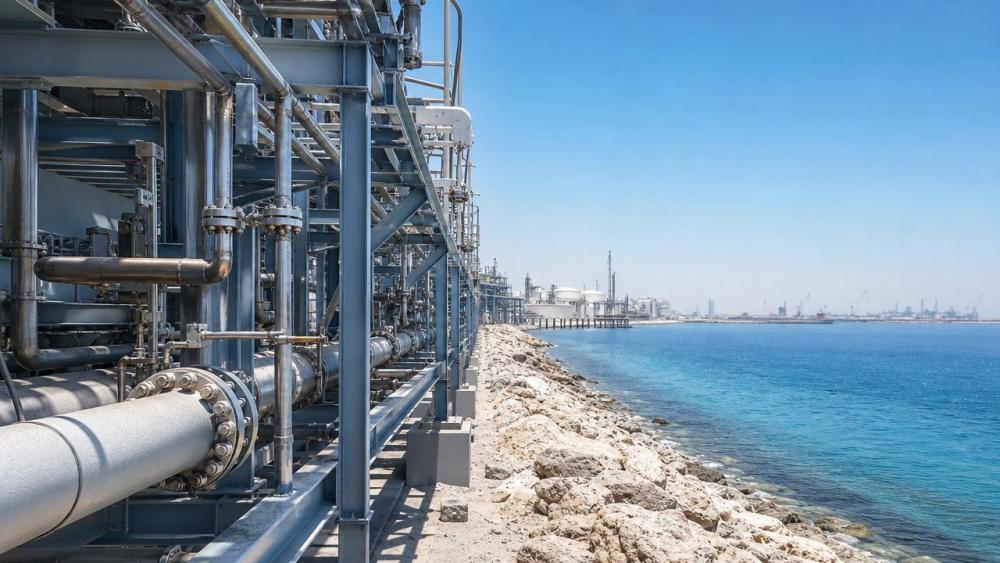
In the UAE, corrosion protection engineering UAE decisions begin with exposure, not with a paint brand or a metal grade.
Salt-laden wind, high surface temperature, humidity swings, and industrial pollutants do not affect every asset in the same way.
A pipeline rack near open shoreline behaves differently from a chilled water skid inside a semi-enclosed utility zone.
That is why corrosion protection engineering UAE should be treated as a matching exercise between environment, substrate, coating build, and maintenance access.
In practice, the highest cost often comes from wrong assumptions made early.
Projects sometimes specify one coating system across steel structures, fasteners, tanks, ducting, and support frames, then expect equal durability.
That shortcut rarely works in coastal conditions.
For industrial platforms that track process quality and surface performance, such as GIAS, this is a familiar pattern.
Surface treatment is not isolated from the rest of industrial reliability.
Cleanliness before coating, traceability after fabrication, and consistency during application all shape service life.
The first real split is between splash exposure, atmospheric exposure, and sheltered exposure
Many coastal failures happen because these three conditions are treated as similar.
They are not.
Splash or washdown zones face constant wetting, salt concentration, and mechanical stress.
Atmospheric zones mainly battle UV exposure, airborne chlorides, and condensation.
Sheltered areas may look safer, yet trapped moisture and poor drainage can accelerate underfilm corrosion.
In corrosion protection engineering UAE, marine-facing steel often needs a heavier-duty system than interior plant steel, even within the same facility.
A zinc-rich primer with high-build epoxy and polyurethane topcoat may perform well on exposed structural steel.
The same stack may be less suitable on edges, bolts, or complex weld zones if film build becomes uneven.
Where washdown chemicals, abrasion, or frequent maintenance contact exist, glass flake epoxies or reinforced systems may be more appropriate.
A quick comparison helps clarify the judgment points
When coated carbon steel works well, and when it becomes a maintenance burden
Coated carbon steel remains common because it balances structural strength, fabrication familiarity, and budget control.
Still, corrosion protection engineering UAE should not assume carbon steel is always the economical choice.
It performs best where preparation quality is controlled, geometry is coating-friendly, and inspection can be repeated without operational disruption.
Pipe supports, access platforms, cable trays, and secondary steel can be good candidates if edge rounding, weld finishing, and dry film thickness control are done properly.
Problems appear when design detail is ignored.
Tight crevices, bolted overlaps, water traps, and unsealed cut edges shorten coating life faster than many specifications admit.
In real projects, the difference between six years and fifteen years can come from detailing discipline more than from adding another nominal coat.
This is where auxiliary process control matters.
Surface cleanliness verification, controlled blasting, and coating process consistency have the same logic as weighing, marking, or vacuum control in other industrial systems.
Small process deviations create large lifecycle consequences.
Some UAE coastal assets justify stainless steel or duplex earlier than expected
Not every environment should be solved with thicker coating.
In corrosion protection engineering UAE, there are cases where material upgrade is the lower-risk path.
This is common for fasteners, valve hardware, instrument supports, handrails, marine utility skids, and equipment with frequent washdown.
If damage is likely during operation, relying only on a coating barrier can be fragile.
Stainless steel improves resilience, but the grade matters.
In chloride-rich air, 304 often underperforms.
316 may be acceptable in moderate exposure, while duplex grades become more attractive for higher chloride loads or critical service continuity.
The tradeoff is not just material price.
Fabrication method, welding procedure, surface finish, and galvanic compatibility all affect field performance.
A poor stainless finish can become a corrosion initiation site.
Mixed-metal assemblies also need careful isolation to avoid shifting the problem elsewhere.
Typical cases where material upgrade deserves early review
- Items that are frequently touched, adjusted, or opened during maintenance.
- Components with sharp edges or thin sections that are hard to coat evenly.
- Assemblies installed in permanently damp or poorly ventilated corners.
- Parts where shutdown cost is far higher than the initial material premium.
Processing and utility equipment often need a different coating logic than structural steel
This distinction is easy to miss in mixed industrial projects.
Tanks, vacuum-related systems, batching frames, enclosures, and process-support skids do not fail in the same pattern as open steelwork.
Some face chemical splash.
Others face internal condensation, cleaning agents, particulate contamination, or traceability requirements after coating.
For these assets, corrosion protection engineering UAE should consider both external exposure and process interaction.
A coating that survives marine air may still be unsuitable if it sheds particles, blisters under cleaning cycles, or interferes with permanent identification.
That is why surface treatment decisions increasingly connect with other auxiliary systems.
Ultrasonic cleaning before coating can improve adhesion on precision parts.
Laser marking or coding may need to remain legible after finishing.
Electrostatic coating can offer consistency on certain fabricated components, but only when geometry and cure control are suitable.
Different project conditions change the best-fit strategy more than spec sheets suggest
The same coastal project can contain very different decision zones.
A practical review usually compares fabrication route, access for recoating, shutdown tolerance, and expected contamination.
The table below shows why corrosion protection engineering UAE is often a portfolio decision rather than a single specification.
Where teams often misjudge corrosion protection engineering UAE
One common mistake is selecting by nominal salt spray hours alone.
Laboratory claims do not replace site geometry, surface preparation, or maintenance reality.
Another mistake is separating coating choice from fabrication details.
Sharp edges, weld spatter, and inaccessible crevices can defeat a strong specification.
There is also a tendency to compare only purchase cost.
In coastal service, access systems, shutdown windows, recoating intervals, and inspection labor may dominate total cost.
A final blind spot is ignoring process-support implications.
If a coated surface sits near cleaning, coding, vacuum, or product-contact support operations, contamination and durability criteria become tighter.
A practical way to move from generic specification to site-fit selection
A better approach starts with exposure mapping.
Separate splash, atmospheric, sheltered, chemical, and access-limited zones before choosing materials.
Then review which assets are easy to inspect and which ones become expensive after commissioning.
For each group, confirm five practical points.
- Actual chloride and moisture exposure, not assumed marine severity.
- Substrate type, weld quality, edge condition, and drainage design.
- Whether coating damage is likely during routine operation.
- Compatibility with cleaning, marking, or other auxiliary processes.
- Inspection interval, repair access, and shutdown consequences.
That review usually clarifies whether coated carbon steel, stainless steel, duplex, or a mixed strategy is the more stable answer.
For corrosion protection engineering UAE, the best result is rarely the most aggressive system everywhere.
It is the strategy that fits real exposure, process needs, and lifecycle constraints with the fewest hidden compromises.
Before finalizing specifications, it is worth building a simple asset-by-asset matrix.
List environment, material, coating build, expected damage mode, and maintenance route side by side.
That step turns corrosion protection engineering UAE from a generic compliance item into a controlled engineering decision.