
Coating failure rarely starts with a dramatic defect. It usually begins with poor surface preparation, weak film build, or an overlooked exposure condition. That is why coating performance standards matter well before shipment.
For industrial products, appearance is only one part of the story. Adhesion, durability, and corrosion resistance influence service life, warranty risk, compliance confidence, and downstream safety across metal parts, enclosures, tools, piping, and fabricated assemblies.
Within advanced manufacturing, these checks connect closely with auxiliary systems. Cleaning quality, weighing accuracy, vacuum stability, surface treatment control, and electrostatic coating consistency all affect whether a tested coating performs as expected.
Why coating performance standards deserve closer attention
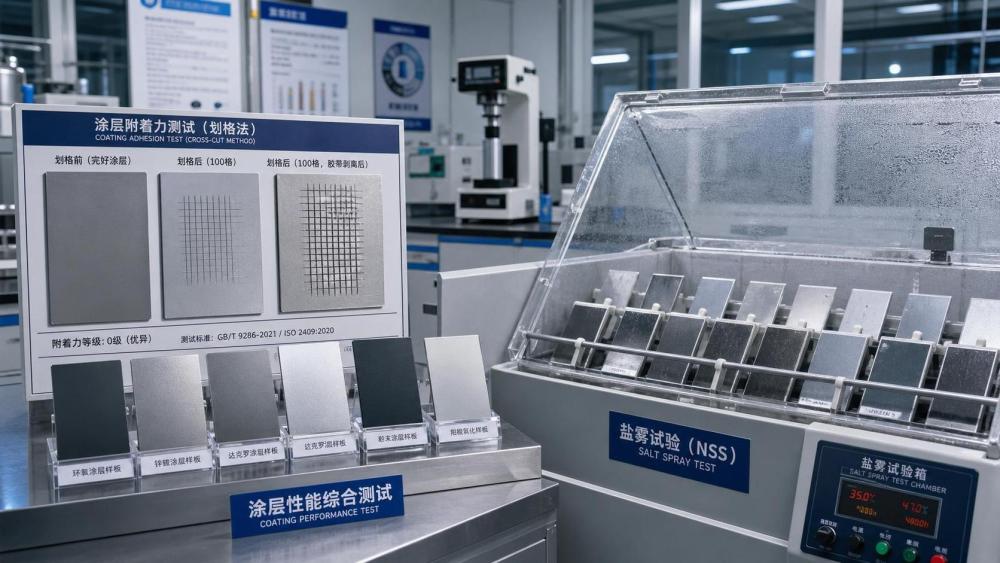
A coating can pass visual inspection and still fail in use. Blistering, edge rust, flaking, or chipping often appear after transport, cleaning cycles, chemical contact, or outdoor exposure.
Coating performance standards give manufacturers a shared way to judge those risks. They reduce subjective decisions and create a technical basis for supplier comparison, process qualification, and batch release.
This matters even more in global supply chains. Exported parts may face different climates, handling conditions, and compliance expectations. A coating that works in one environment may underperform in another.
Platforms such as GIAS have made this topic more visible because coating quality is tied to upstream process control. Micron-level contamination, poor pretreatment, unstable curing, or uneven powder delivery can all distort test outcomes.
What coating performance standards actually measure
In practice, coating performance standards are not a single rulebook. They are a group of test methods and acceptance criteria used to evaluate how a coating behaves under defined conditions.
Some standards focus on bond strength between coating and substrate. Others examine resistance to impact, abrasion, humidity, salt exposure, chemicals, or ultraviolet light.
The most useful standards do two things at once. They simulate a realistic stress, and they make results repeatable enough to support procurement, quality control, and compliance decisions.
Three performance dimensions usually define the discussion
- Adhesion: whether the coating remains bonded after cutting, pulling, bending, or impact.
- Durability: whether the film tolerates wear, deformation, weather, cleaning, and repeated handling.
- Corrosion resistance: whether the coated part continues protecting the substrate in humid, saline, or chemically active conditions.
These dimensions overlap. Poor adhesion often becomes a corrosion problem later. Limited durability can expose bare metal, which then accelerates corrosion at edges or impact points.
Which tests matter most for adhesion
Adhesion is often the first checkpoint because it reveals whether pretreatment, application, and curing worked together. If the bond is weak, other performance claims become less credible.
Cross-cut adhesion testing
ASTM D3359 and similar methods are widely used for quick production checks. A lattice pattern is cut into the coating, tape is applied, and the amount of removed coating is rated.
This method is practical for painted panels, powder-coated parts, and finished assemblies. It is especially useful when comparing pretreatment lines, coating lots, or curing changes.
Pull-off adhesion testing
ASTM D4541 provides a more quantitative view. A loading fixture is bonded to the coating and pulled until failure occurs. The result helps separate adhesive failure from cohesive film failure.
This approach is common where high-performance coatings protect steel structures, tanks, pipelines, and industrial equipment exposed to demanding service conditions.
Bend and mandrel tests
When coated parts will be formed or flexed, bend tests show whether the film cracks or detaches under deformation. That matters in appliances, sheet metal housings, brackets, and transport components.
How durability is usually judged
Durability is broader than hardness alone. A hard coating may still chip under impact or lose appearance after cleaning and abrasion. Useful coating performance standards therefore look at several stress types.
Impact resistance
ASTM D2794 evaluates how the coating reacts to sudden deformation. This is relevant for metal furniture, electrical cabinets, storage systems, machinery covers, and any part that may be knocked during handling.
Abrasion and wear testing
Methods such as Taber abrasion help estimate how quickly a coating loses thickness or appearance under repeated friction. That matters for touch surfaces, carts, tools, consumer-facing hardware, and factory equipment.
Hardness and solvent resistance
Pencil hardness and solvent rub testing are often used as process indicators. They are not full durability proofs, but they can quickly reveal under-curing, poor formulation balance, or contamination.
Corrosion tests often carry the most weight
Corrosion protection is where coating performance standards become highly visible to customers, auditors, and warranty teams. Failure here can damage both the part and the brand behind it.
Salt spray testing
ASTM B117 remains one of the most recognized tests. Coated samples are exposed to a controlled salt fog environment for a defined period, then checked for rust creepage, blistering, or coating breakdown.
Salt spray is popular because it is standardized and easy to compare across suppliers. Still, it should not be treated as a perfect predictor of outdoor service life.
Humidity and condensation testing
These methods help assess coatings used in indoor wet zones, food equipment enclosures, HVAC systems, and packaging environments where constant moisture is the main threat.
Cyclic corrosion testing
For automotive, infrastructure, and outdoor equipment, cyclic tests can be more informative than simple salt fog. They combine wet, dry, salt, and temperature phases to better reflect real exposure patterns.
A test is only meaningful when the process behind it is controlled
Many coating failures are process failures first. The standard detects the weakness, but it does not create it. That is why test interpretation should always trace back to the line conditions.
This is where the broader GIAS perspective is useful. Coating performance should be read alongside cleaning, batching, vacuum, and traceability systems rather than treated as an isolated finishing issue.
Choosing standards by product risk, not by habit
One common mistake is relying on the same test package for every coated part. Coating performance standards should reflect substrate type, coating chemistry, service environment, and failure consequences.
A decorative indoor enclosure may need strong adhesion, color consistency, and basic humidity resistance. A coastal equipment housing may require cyclic corrosion testing, edge evaluation, and stricter pretreatment control.
For export products, specification clarity matters. Requirements should state the standard version, sample preparation method, test duration, acceptance threshold, and failure location criteria.
Useful selection questions
- What substrate and pretreatment system are being used?
- Will the part face impact, abrasion, solvents, humidity, or salt?
- Is the test for process control, supplier approval, or customer compliance?
- Does the pass criterion reflect actual service risk?
- Can results be traced back to line conditions and production batches?
Reading results with more discipline
Numbers alone can mislead. A high salt spray hour rating does not automatically mean better field performance if edge coverage is poor or the tested panel differs from the real part geometry.
The same applies to adhesion ratings. A passing cross-cut result is useful, but it should be reviewed together with film thickness, cure records, pretreatment logs, and defect patterns.
Coating performance standards work best when they support trend analysis. Repeated data across lots, shifts, and suppliers usually tells more than a single pass report.
Where to focus next
A useful next step is to map current coating performance standards against actual failure modes. That quickly shows whether the test plan reflects customer exposure, compliance risk, and process weak points.
It also helps to review coating data together with upstream auxiliary systems. Cleaning precision, surface preparation stability, dosing accuracy, curing control, and traceability often explain why test outcomes drift.
The strongest programs do not chase more tests for their own sake. They select the right coating performance standards, define clear acceptance criteria, and use results to improve the process that creates the coating.