
Why does coating adhesion performance ASTM matter so much in production?
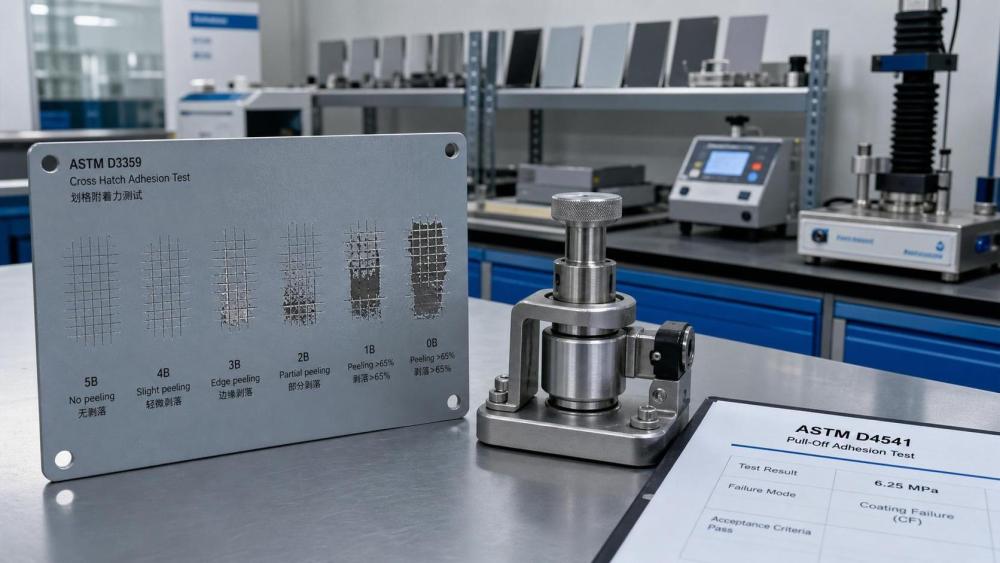
Coatings fail quietly before they fail visibly. That is why coating adhesion performance ASTM standards matter in daily process control.
A finish may look smooth after curing, yet still detach under impact, humidity, salt exposure, or thermal cycling.
In practical terms, adhesion testing checks whether the coating truly bonds to the substrate and intermediate layers.
This is especially relevant in advanced manufacturing, where surface treatment supports corrosion resistance, traceability, appearance, and compliance.
Across industrial auxiliary systems, surface quality rarely stands alone. Cleaning precision, drying conditions, vacuum stability, and coating application settings all influence adhesion.
That broader process view is one reason technical platforms such as GIAS emphasize how small control points affect final product reliability.
So when people search for coating adhesion performance ASTM, they usually want more than a definition.
They want to know which test fits the part, how to read ratings, and what early failure clues deserve immediate attention.
Which ASTM test method should you look at first?
The short answer is that no single ASTM method fits every coating system.
The most common starting points are ASTM D3359 for tape testing and ASTM D4541 for pull-off adhesion.
ASTM D3359 is widely used for quick screening. It is practical for painted panels, production checks, and comparative process verification.
It uses cuts in the coating, then applies pressure-sensitive tape to see how much coating detaches.
ASTM D4541 measures tensile force required to pull a bonded dolly from the coated surface.
That makes it more quantitative, especially when a specification demands measurable strength rather than a visual rating only.
Other methods may also matter, depending on the coating and service environment.
- ASTM D3359: fast field or lab check for relative adhesion performance.
- ASTM D4541: pull-off strength for thicker, critical, or specification-driven coatings.
- ASTM D6677: scratch adhesion resistance in selected applications.
- Related exposure tests: humidity, salt spray, or immersion often reveal weak bonding that a dry test can miss.
A useful rule is simple. If the goal is routine line control, tape tests often come first.
If the goal is qualification, dispute resolution, or warranty-sensitive performance, pull-off data usually carries more weight.
How do ASTM adhesion ratings translate into a real pass or warning sign?
This is where confusion often starts. A rating is not meaningful unless the substrate, coating thickness, cure state, and test method are documented.
For ASTM D3359, results are commonly expressed as 5B to 0B.
A 5B rating means the coating edges remain smooth and no squares detach. Lower numbers indicate increasing removal.
For ASTM D4541, the number alone is still not enough. The failure mode matters as much as the pull value.
An adhesive failure at the substrate interface points to bonding weakness. A cohesive failure inside the coating suggests a different limitation.
The table below helps connect common test outputs with likely interpretation.
In other words, coating adhesion performance ASTM data only becomes useful when paired with failure location and process history.
What usually causes poor adhesion even when the coating looks fine?
The most common causes appear before coating application, not after it.
Residual oil, fingerprints, oxide, dust, blasting residue, or trapped moisture can all reduce bond strength.
That is why pretreatment and cleaning systems are tightly linked to coating adhesion performance ASTM results.
For example, ultrasonic cleaning may remove fine contaminants that standard washing leaves behind.
In coating lines using vacuum-assisted drying or controlled surface treatment, better environmental stability often means fewer unexplained failures.
Application variables matter too. Low film build, over-thick film, poor flash time, and incomplete cure can all distort adhesion outcomes.
A frequent mistake is treating an adhesion failure as a paint problem only.
More often, it is a process-chain problem involving cleaning, handling, timing, temperature, and substrate condition.
- Contamination not visible to the eye
- Incorrect surface profile for the coating type
- Under-cure or over-bake
- Excess delay between pretreatment and coating
- Intercoat window exceeded
- Humidity or condensation during application
When weak adhesion appears repeatedly, the faster route is usually process mapping rather than repeated retesting alone.
Can one test result predict service life in harsh conditions?
Not reliably by itself. That is one of the biggest misunderstandings around coating adhesion performance ASTM standards.
A strong initial tape or pull-off result is useful, but field durability depends on combined stresses.
Corrosive media, UV exposure, mechanical abrasion, chemical splash, and thermal expansion can change the failure pattern over time.
That is why qualification programs often combine adhesion with salt spray, humidity, cyclic corrosion, or immersion testing.
It is also wise to inspect edges, weld zones, corners, and repaired spots separately.
These areas frequently fail first, even when flat panel results look acceptable.
For operations managing traceability, linking adhesion test results with batch data, oven profiles, cleaning records, and coating lots adds practical value.
That integrated view supports the kind of process intelligence increasingly expected across modern auxiliary manufacturing systems.
What failure clues should trigger action before corrosion or safety risk grows?
The earliest clues are often small and easy to dismiss.
Look closely for edge lifting, pinpoint blistering, unusual tape removal patterns, or coating loss around cut marks.
A sudden drop from stable ratings to marginal ratings is also important, even if the part still appears acceptable.
When reviewing coating adhesion performance ASTM data, these warning signs deserve structured follow-up:
- Same coating passes on one substrate but fails on another
- Results vary sharply between shifts or lines
- Pull-off values are acceptable, but failure mode moves toward the substrate interface
- Failures cluster near welds, corners, or high-heat zones
- Retests pass only after rework, indicating unstable baseline conditions
These clues usually point to process drift, not random noise.
The practical response is to isolate variables, confirm cleanliness, verify cure, and compare current data against historical control limits.
How should ASTM adhesion testing be built into a working control plan?
A useful control plan balances speed, consistency, and technical depth.
Routine checks should not be so complex that they are skipped, but they must still reveal meaningful risk.
In many facilities, a sensible structure includes incoming substrate checks, pretreatment verification, in-process adhesion screening, and periodic destructive validation.
Documentation matters as much as the test itself. Record the substrate, surface condition, coating type, cure schedule, thickness, tape type, pull rate, and failure mode.
Without that detail, coating adhesion performance ASTM data becomes difficult to compare over time.
A practical next step is to build a short decision matrix for each coating family.
Define which ASTM method applies, what result is acceptable, when retesting is allowed, and what investigation starts after a borderline outcome.
That approach helps turn adhesion testing from a checkbox into a useful early-warning tool.
If the goal is better long-term performance, start by reviewing the full process chain behind the coating, not just the final film.
Then compare ASTM methods against actual service conditions, failure history, and documentation discipline. That is usually where the most reliable improvements begin.