
Industrial IoT Applications in Manufacturing: 7 Use Cases That Improve Uptime and Traceability
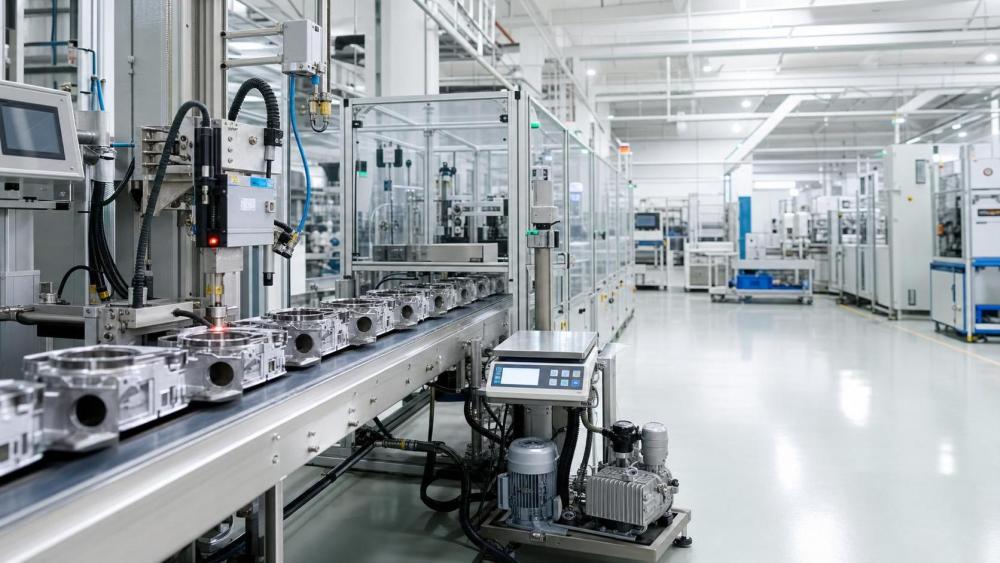
Industrial IoT applications are reshaping manufacturing by turning equipment, process data, and product information into actionable insight.
For operations leaders, the shift is practical, not theoretical.
The biggest gains usually come from better uptime, faster response, and cleaner traceability across complex production environments.
That matters even more in facilities where auxiliary systems quietly influence final quality.
Ultrasonic cleaning, laser marking, vacuum control, industrial weighing, and coating processes often decide whether output meets customer, audit, and compliance expectations.
This is where industrial IoT applications create measurable value.
They connect machines, sensors, operators, and production records into a usable decision layer.
Below are seven use cases that improve uptime and traceability without turning the factory into an IT science project.
1. Predictive maintenance for critical auxiliary equipment
One of the most proven industrial IoT applications is predictive maintenance.
Instead of reacting after failure, teams monitor vibration, temperature, current draw, pressure, and cycle counts.
This works especially well for vacuum pumps, ultrasonic generators, conveyors, dosing units, and marking equipment.
A vacuum pump rarely fails without warning.
It usually shows early signals through heat, unstable pressure, rising power use, or slower evacuation time.
When those signals feed into IIoT dashboards, maintenance becomes scheduled and targeted.
- Reduce unplanned downtime on support equipment
- Extend service intervals based on condition, not guesswork
- Prioritize parts replacement before production losses escalate
- Build maintenance history for vendor comparison and budgeting
2. Real-time process monitoring for stable product quality
Another high-value category of industrial IoT applications is process monitoring.
This is less about machine health and more about process health.
In actual operations, many defects start with slight process drift.
An ultrasonic cleaning bath may lose effectiveness.
A coating line may see inconsistent film thickness.
A batching system may begin dosing outside tolerance.
IIoT sensors help track variables such as temperature, pH, conductivity, flow, weight, pressure, humidity, and cycle duration.
When thresholds move, alerts trigger before scrap rates rise.
That is why industrial IoT applications are now central to process consistency in regulated and quality-sensitive sectors.
3. End-to-end traceability through marking, coding, and data capture
Traceability is no longer just a label on a box.
It is a connected data record tied to batches, machines, operators, and process parameters.
Here, industrial IoT applications work closely with laser marking and inkjet coding systems.
Each mark or code can link to timestamps, material lots, cleaning cycles, weld settings, and inspection outcomes.
This creates a digital thread that supports recalls, anti-counterfeiting, compliance checks, and customer investigations.
More importantly, it shortens response time when something goes wrong.
Instead of isolating an entire day of production, teams can identify the exact affected units or lots.
- Connect product IDs with process data automatically
- Improve audit readiness and export documentation
- Support root-cause analysis with timestamped evidence
- Strengthen brand protection through permanent identification
4. Smart weighing and batching for recipe control
In food, pharma, chemicals, and battery production, accuracy is operational risk control.
That makes weighing and batching one of the most practical industrial IoT applications in manufacturing today.
Connected weighing systems can compare actual dosing against target values in real time.
They also log every recipe event automatically.
This helps prevent subtle formulation errors that may only appear later as product instability, waste, or customer complaints.
From a business perspective, the value goes beyond compliance.
It improves material utilization, reduces giveaway, and supports faster product changeovers.
Among industrial IoT applications, this one often delivers quick returns because material losses are easy to measure.
5. Remote visibility across multi-site operations
As plants expand across regions, standardization becomes harder.
This is where industrial IoT applications help create a common operating view.
Remote dashboards can compare OEE trends, downtime causes, process alarms, energy use, and quality deviations across facilities.
The benefit is not just convenience.
It supports faster decisions on capacity, maintenance priorities, supplier performance, and process replication.
For example, if one site gets better coating uniformity or lower vacuum downtime, the underlying parameters can be reviewed and reused elsewhere.
That turns local success into repeatable operational knowledge.
6. Automated compliance records and digital audit trails
Compliance pressure is rising in almost every industrial sector.
Manual logs are still common, but they are slow, incomplete, and hard to verify.
Industrial IoT applications solve this by capturing production events at the source.
Cleaning validation, batch weights, marking confirmation, vacuum levels, and coating temperatures can all be stored automatically.
This reduces human error and makes records easier to retrieve during audits or customer reviews.
It also supports stronger internal discipline.
When operators know events are recorded automatically, process adherence usually improves.
For many manufacturers, this is one of the less visible but more strategic industrial IoT applications.
7. Energy and utility optimization for support systems
Not every IIoT project starts on the production line.
Some of the best industrial IoT applications begin with utilities and support systems.
Vacuum systems, compressed air, pumps, curing ovens, and cleaning units consume significant energy.
Yet many plants still treat that cost as fixed overhead.
Connected monitoring reveals leaks, idle running, unstable load patterns, and inefficient scheduling.
The result is lower energy waste and better asset utilization.
This use case becomes even more valuable when sustainability targets and operating costs are both under pressure.
In many cases, energy data also helps explain hidden uptime problems.
How to prioritize industrial IoT applications without overcomplicating deployment
The smartest approach is not to connect everything at once.
Start where downtime, scrap, traceability gaps, or audit exposure already create measurable pain.
From recent market changes, a clearer signal is emerging.
Manufacturers get better results when industrial IoT applications are linked to a specific operational problem.
- Identify one high-cost failure point
- Choose a process with reliable baseline data
- Define response actions before alerts go live
- Connect machine data with traceability records
- Measure savings in uptime, quality, and labor hours
This also means vendor selection matters.
Sensors alone do not create value.
The real value comes from combining equipment insight, process knowledge, and clear action rules.
Final takeaway
Industrial IoT applications are no longer optional experiments for advanced plants only.
They are practical tools for improving uptime, traceability, and process discipline.
The strongest opportunities often sit inside auxiliary systems that affect cleanliness, identification, batching accuracy, vacuum stability, and coating performance.
When those systems become visible through data, better decisions follow faster.
If the goal is reliable output, stronger compliance, and more resilient manufacturing, start with one use case that solves a real operational bottleneck.
That is usually where industrial IoT applications prove their value first, and scale with the least friction.