
A recall becomes expensive and difficult when the affected population cannot be defined with confidence. Complex medical device traceability reduces that uncertainty by linking a finished device to its serial identity, production route, component lots, process conditions, inspection results, packaging status, and distribution records. When a quality signal appears, the traceability record supports a narrow question with a practical consequence: which individual units, configurations, lots, or shipments share the relevant exposure?
That answer is rarely found in one database or one printed label. A complex device may combine machined metal parts, molded housings, coated surfaces, electronics, sterile barriers, software-controlled assemblies, and purchased subcomponents. Each layer introduces a different failure path. A coating issue may concern only one surface-treatment batch. A firmware problem may follow a version and configuration history rather than a material lot. A damaged sterile barrier may be associated with a packaging line, seal parameter drift, or a particular shipping condition. Traceability reduces recall risk when these paths remain connected instead of being reconstructed from disconnected records after an event.
Recall scope is determined by evidence, not by the finished-device label alone
A unique device identifier or serial number is useful only when it opens a reliable chain of evidence. A finished product record that contains a serial number but lacks the installed component lot, rework history, inspection disposition, and shipment destination cannot distinguish a contained issue from a broad one. The result is often an overly inclusive recall because exclusion cannot be supported.
Traceability has to match the way failure can travel through the process. For a reusable surgical instrument, relevant links may include raw material heat, machining program revision, passivation or electropolishing batch, laser-marking verification, final inspection, and repair activity. For an infusion or diagnostic system, the meaningful relationship may run through circuit-board revision, loaded firmware, calibration record, battery lot, and final functional test. For a sterile single-use assembly, component traceability must remain joined to welding conditions, cleaning validation status, packaging materials, sealing parameters, and release records.
These distinctions matter because a common date code does not prove common exposure. Products made on the same day can have different component substitutions, process routes, inspection outcomes, or repair histories. Conversely, products built weeks apart may share a single purchased component lot or a software image. A traceability design that relies mainly on production date creates a false sense of control.
Permanent marking is the physical anchor
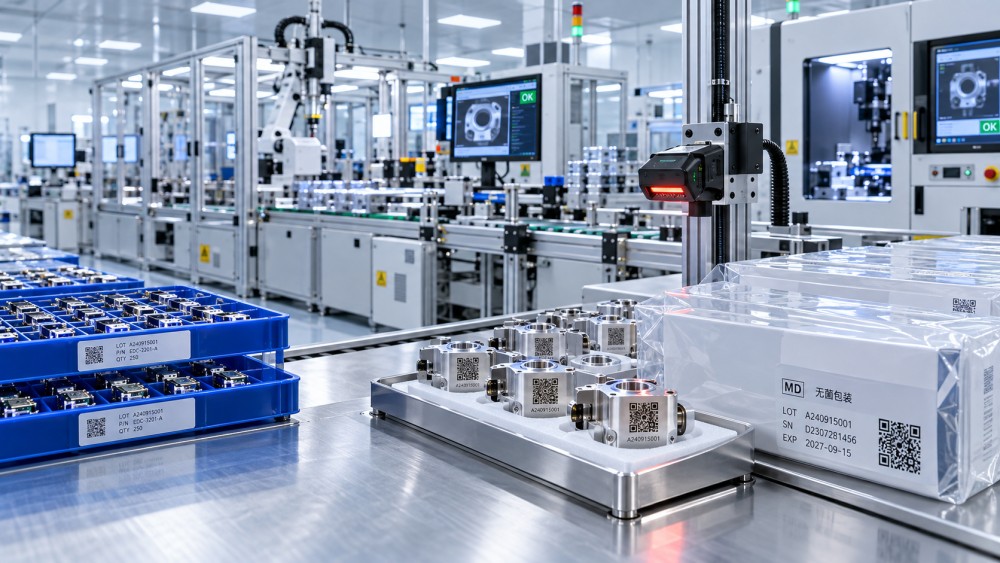
Electronic records are only useful if the physical device, subassembly, tray, pouch, or shipping unit can be identified reliably when it is received, serviced, returned, quarantined, or investigated. Permanent direct-part marking is often appropriate for durable metal and engineering-plastic components, while labels, inkjet codes, or packaging marks may carry identity where the substrate, geometry, sterility barrier, or intended life does not suit direct marking.
The choice of marking method must be assessed as part of the device design and process, not treated as a final cosmetic operation. Laser-marked characters can be highly durable, but contrast, depth, heat effect, and legibility vary with alloy, surface finish, coating, curvature, and cleaning method. A code that scans cleanly on a flat matte sample can perform poorly after passivation, repeated disinfection, abrasion, condensation, or glare from a polished surface.
For polymer parts, excessive marking energy can discolor the material, produce stress-sensitive areas, or reduce code contrast after aging. On coated components, marking before coating may conceal the code; marking after coating can disturb the protective layer. Inkjet coding provides flexibility for cartons, pouches, and some production-stage identification, but adhesion, cure state, rub resistance, and solvent exposure need to be aligned with handling and transport conditions. The objective is not simply to place a readable code on a product. It is to preserve a trustworthy identity through the point at which the device could need to be located.
Verification also needs to be separated from visual appearance. A human-readable serial number may look acceptable while a machine-readable symbol fails due to low contrast, cell deformation, insufficient quiet zone, or surface reflection. A scanner reading one sample on the line does not establish stable performance across material variation, marking-head condition, focus position, and post-process cleaning. Recording the verification result against the serial identity closes a gap that otherwise remains invisible until a returned device cannot be decoded.
The genealogy record needs controlled relationships
Complex medical device traceability depends on a product genealogy: a controlled record of what was built, from which inputs, using which approved route, and with what result. The central design task is choosing the right level of granularity. Recording every consumable against every unit can create data volume without improving containment. Recording only finished-goods lots can leave major exposure paths unresolved.
A useful approach begins with failure modes. Where a component defect could affect every device containing a specific supplier lot, the component lot needs a direct relationship to affected serial numbers or production lots. Where a calibration value is assigned individually, the value and its test status belong at the unit level. Where a process is controlled by a batch solution, cure cycle, or cleaning load, the traceability model needs to show which assemblies passed through that batch or load.
Relationships must remain valid when the normal production route changes. Rework is a frequent weak point. A device may be disassembled, receive a replacement component, repeat cleaning, move through a second test station, or be repackaged. If the original history remains in the record without a clear disposition, the genealogy can falsely imply that both the removed and replacement components are installed. A controlled rework transaction must preserve the prior state, record the reason and authorization, identify the new input, and update the final configuration.
Similar problems occur when components are split, merged, or relabeled. A bulk material lot may be divided into several internal lots; several subassemblies may be combined into one finished unit; a supplier code may be translated into an internal identifier. The data model must maintain parent-child links through these events. Relabeling without linkage is not traceability. It is a loss of the original evidence.
Process data becomes useful only when it is attributable
Production equipment generates extensive information, but a large archive of machine data does not automatically reduce recall scope. The relevant question is whether a recorded condition can be attributed to a defined population and interpreted in context. A vacuum chamber pressure excursion, ultrasonic cleaning cycle deviation, laser-marking fault, weigh-and-batch discrepancy, or seal-temperature variation becomes actionable only when the associated device or lot identities are known.
Attribution requires disciplined timing and transaction control. If a work order is scanned only at the start of a shift, but devices move between stations throughout the shift, machine events cannot be tied accurately to individual product flow. If batch completion is entered manually after material has already been transferred, the recorded time may not represent the real sequence. Barcode, two-dimensional code, or RFID capture at meaningful handoff points can reduce this ambiguity, provided the scan event is controlled against the actual unit, container, or batch.
Data completeness and data correctness are separate concerns. A required field can be populated with an incorrect lot number, an outdated revision, or a copied value. Effective controls therefore include source-based capture where practical, validation of allowed material and revision combinations, restricted changes after release, and an audit trail for corrections. Manual entry remains necessary in some environments, especially during exception handling, but exception records need a reason that is specific enough for later investigation.
Equipment identity also deserves attention. A process record may show that an assembly passed test, cleaning, welding, or marking, yet omit the station, fixture, sensor, or program revision used. That omission matters when an issue is later linked to a worn fixture, a software update, an out-of-tolerance sensor, or a maintenance action. Capturing every machine parameter is unnecessary; retaining the equipment and recipe identity needed to reconstruct an exposure path is not.
Containment fails at the handoffs
Traceability commonly weakens where physical movement and digital status are managed separately. Material may be moved to a staging area before its electronic receipt is completed. A quarantined item may share a rack with released inventory. A repaired device may return to inventory under its original status without the service event being linked to the serial record. These are operational control failures, even when the underlying database is capable of storing complete genealogy.
Clear status labeling, controlled locations, and timely transactions matter because recall investigations begin with imperfect information. The first response often requires an immediate hold on a suspected population while the causal boundary is still being established. If physical and digital statuses disagree, the hold can miss units or immobilize unaffected stock. The ability to query a population is valuable; the ability to locate and segregate it is what turns a query into containment.
Distribution records require the same precision. A shipment number alone may identify a carrier movement but not the consignee, shipped serial numbers, replacement status, or later redistribution. For devices that are serviced, loaned, returned, refurbished, or installed as part of a system, post-release changes can be as important as the original shipment. A serial number that follows the device through service creates a more reliable path for corrective action than a record that ends at the warehouse door.
Testing the traceability system reveals its real recall boundary
A traceability process should be challenged with realistic questions rather than reviewed only as a collection of fields. Start with a selected component lot and determine every released unit containing it. Then reverse the direction: select a returned serial number and reconstruct its material, process, test, packaging, release, shipment, and service history. The two paths expose different defects. Forward tracing finds potential exposure; backward tracing tests whether a field unit can be explained from its identity.
Useful exercises also involve awkward conditions: a superseded component revision, a device that passed through rework, an incomplete scan, a replacement label, a mixed container, or a unit completed during an equipment alarm. These conditions reveal whether the system handles exceptions as controlled states or silently converts them into ordinary production history.
The quality of the result should be judged by the evidence produced, not merely by how quickly a report appears. A rapid report with uncertain joins, missing service records, or unexplained discrepancies can widen a recall rather than contain it. A defensible record shows why particular units are included, why others are excluded, and what source record supports each conclusion.
When permanent identification, controlled genealogy, attributable process data, and accurate movement records remain connected, a quality event no longer forces a search across every similar product. The investigation can follow the actual route of exposure, hold the relevant population, and preserve the evidence needed to make the recall boundary proportionate to the problem.