
Where packaging uptime is really won
On a packaging line, the machine that stops production is not always the cartoner, the filler, or the case packer. Very often, the interruption starts in a support layer that was treated as secondary during line design: a coder losing print quality, a vacuum circuit drifting out of range, a weighing system rejecting too many packs, or a surface treatment step that looked stable in trials but becomes inconsistent after long shifts. That is where industrial process support systems packaging decisions become operational decisions, not accessory purchases.
The reason is simple. Packaging lines are judged by output, but they live or fail through repeatability. A line can be mechanically fast and still underperform if it cannot keep code readability, seal integrity, batch accuracy, or traceable product identification stable across product changes, cleaning cycles, and operator handovers. Support systems sit in those exact pressure points.
In food, pharma, personal care, chemicals, and export-oriented industrial goods, traceability now reaches well beyond putting a date code on a box. Plants are expected to maintain legible identification, link batches to process records, and avoid rework caused by unreadable marks, weight deviation, contamination, or package failure in logistics. That is why the conversation has moved from “Which machine prints the code?” to “Which supporting system keeps the line verifiable at speed?”
Coding and marking are usually the first places where hidden instability becomes visible. A packaging line can tolerate a small mechanical variation for a while; it cannot tolerate unreadable lot codes for long. Once codes start smearing, fading, drifting, or failing inspection, operators slow the line, perform manual checks, or isolate suspect batches. The downtime may appear minor in the maintenance log, but the real loss is often in accumulated interruptions and quality holds.
The practical choice between laser marking and inkjet coding is rarely just about print permanence. Surface condition, substrate color, condensation, line speed, code content, and available installation space matter more than brochure-level comparison. Flexible films, coated cartons, molded plastic parts, and corrugated transit packaging do not respond the same way. A line running short SKU cycles also places more stress on recipe management and message control than a long-run line with stable packaging formats.
In plants that export or operate under strict retailer requirements, the traceability risk is often not whether a code can be printed, but whether it remains consistently readable after handling, stacking, abrasion, or environmental exposure. Permanent marking can be attractive in those conditions, but it also requires attention to fume extraction, material response, and integration with vision inspection. In contrast, inkjet systems may fit better where substrate variety is high, but maintenance discipline becomes more important. Missed cleaning routines, ink management problems, or unstable ambient conditions can turn a low-cost coding choice into a recurring source of rejected output.
When weighing becomes a control point, not a checkpoint
Packaging teams often think of industrial weighing as a downstream verification step. In many lines, that is too narrow. Weighing and batching systems influence uptime earlier than people expect because they expose variation in filling, dosing, product density, and even upstream material flow. If a checkweigher starts rejecting packs in clusters, the root cause may not be the checkweigher at all. It may be unstable feed, inconsistent product temperature, vibration from adjacent equipment, or poorly controlled handoff timing between filler and conveyor.
That distinction matters during project evaluation. A system that performs well in a controlled demonstration may behave differently on a line with floor vibration, frequent washdown, or multi-format product changeovers. Accuracy on paper is only part of the decision. The more relevant question is whether the weighing system can remain stable under the site’s actual disturbances and whether its data can be used to correct process drift before rejects accumulate.
For regulated or tightly specified products, weight records also become part of traceability. When batch identity, coding records, and weight verification can be tied together, investigations move faster. Without that link, teams end up reviewing separate logs that do not align in time or product count. The line may still run, but the plant loses the ability to explain deviations cleanly.
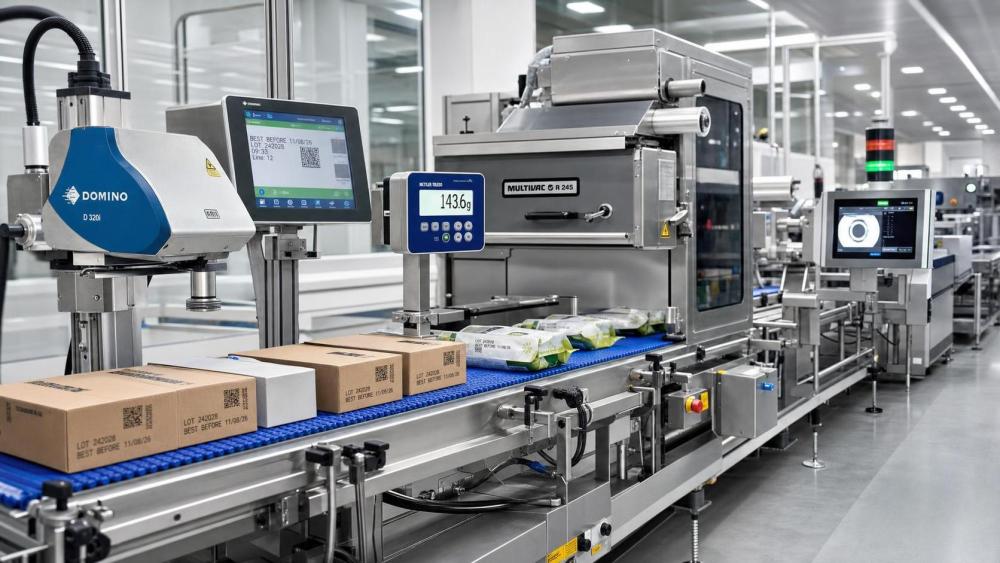
Vacuum support is another area that tends to be underestimated until package defects become expensive. On thermoforming, sealing, modified atmosphere packaging, or vacuum-assisted material handling lines, stability matters more than peak performance. A vacuum pump that looks correctly sized may still cause trouble if the system experiences leakage, poorly designed piping runs, contamination carryover, or load swings across shifts. What operators see on the floor is not “vacuum efficiency.” They see incomplete evacuation, weak seals, film misbehavior, or longer cycle times.
This is one of the clearest examples of why industrial process support systems packaging strategy needs site-specific judgment. A centralized vacuum arrangement may reduce maintenance concentration in some plants, but it can also increase dependency on pipe layout and response behavior. A decentralized approach may simplify local control while increasing the number of service points. Neither is universally better. The right answer depends on line density, hygiene zoning, service access, contamination risk, and the cost of a single line stoppage in that product family.
In food and pharmaceutical environments, cleaning methods and environmental controls also change the equation. Moisture, particulates, and cleaning chemicals affect service life and reliability. If the plant expects aggressive sanitation cycles, the discussion has to include protection level, maintenance access, and how quickly the system can recover to stable performance after cleaning. Those are practical uptime issues, not secondary engineering details.
Cleanliness and surface condition usually show up later, but they start earlier
Some packaging failures originate well before the package is formed or coded. Precision cleaning, surface treatment, and electrostatic processes can determine whether components bond correctly, coatings adhere consistently, or contamination interferes with downstream marking and sealing. These support steps are easy to dismiss when the line seems mechanically complete, yet they often explain stubborn quality variation that operators misread as machine instability.
Take component packaging for electronics, medical devices, or high-value industrial parts. If micron-level contaminants remain on parts before sealing, labeling, or marking, the visible symptom may be poor print quality, weak adhesion, cosmetic defects, or shortened package integrity in storage. The packaging line appears to be at fault because the problem becomes visible there. In reality, the issue began in surface preparation. Ultrasonic cleaning and related precision cleaning methods are especially relevant where residues are too small to be seen but still large enough to disrupt downstream reliability.
A similar logic applies to plastic component welding in packages or subassemblies where adhesives are undesirable. Ultrasonic welding can improve consistency and reduce material variables, but only if part geometry, material behavior, and fixture repeatability are understood. Poorly matched tooling or unstable part presentation can create intermittent defects that operators experience as random downtime. The process itself is not necessarily wrong; the support conditions are.
What separates a support system that works in trials from one that survives production
A useful way to judge support technologies is to stop asking whether they can run and start asking how they fail. On real packaging lines, the common failure modes are rarely dramatic. They are gradual: code contrast declines, reject rates creep up, vacuum recovery slows, contamination levels drift, coating uniformity becomes operator-dependent. Those are the conditions that eat uptime because teams keep running while losing confidence.
Several checks help expose the difference between nominal suitability and real fit:
- Whether the system can hold performance through shift length, not just during a short acceptance run.
- Whether cleaning, changeover, and consumable handling are realistic for the site’s staffing and maintenance discipline.
- Whether alarms and data outputs are meaningful enough to support traceability, root-cause review, and operator action.
- Whether installation constraints such as line space, access clearance, environmental exposure, and upstream/downstream timing have been treated as design inputs rather than retrofit problems.
One recurring mistake is selecting by isolated equipment specification without mapping interaction points. A coder depends on substrate presentation. A weighing system depends on conveyor stability. A vacuum system depends on piping and leakage control. A surface treatment step depends on contamination discipline upstream. Support equipment is called “auxiliary,” but in operational terms it behaves like connective tissue. If those interfaces are weak, the line loses both uptime and traceability.
A practical comparison of packaging support priorities
For project teams, the useful takeaway is not that every line needs every support technology in a complex form. It is that packaging performance becomes more predictable when these systems are selected as part of process control rather than treated as bolt-ons. The right level of sophistication depends on product sensitivity, regulatory exposure, SKU turnover, and the cost of quarantine or recall if traceability fails.
When a packaging line is already in operation and underperforming, the fastest improvement often comes from tracing interruptions backward through these support layers. Look at code rejection patterns before replacing core mechanics. Check weighing drift against environmental and conveyor conditions. Review vacuum behavior across cleaning cycles and product changes. Ask whether contamination or surface condition is the hidden variable behind recurring package defects. Those questions are usually more useful than broad assumptions about line speed or operator error.
That is also where a platform like GIAS is relevant. Across ultrasonic systems, laser marking, inkjet coding, industrial weighing, vacuum systems, surface treatment, and electrostatic technologies, the real value is in understanding how small process-support decisions shape final packaging reliability. On paper, these systems sit beside the main line. On the factory floor, they often decide whether uptime is stable and whether traceability stands up when something goes wrong.