
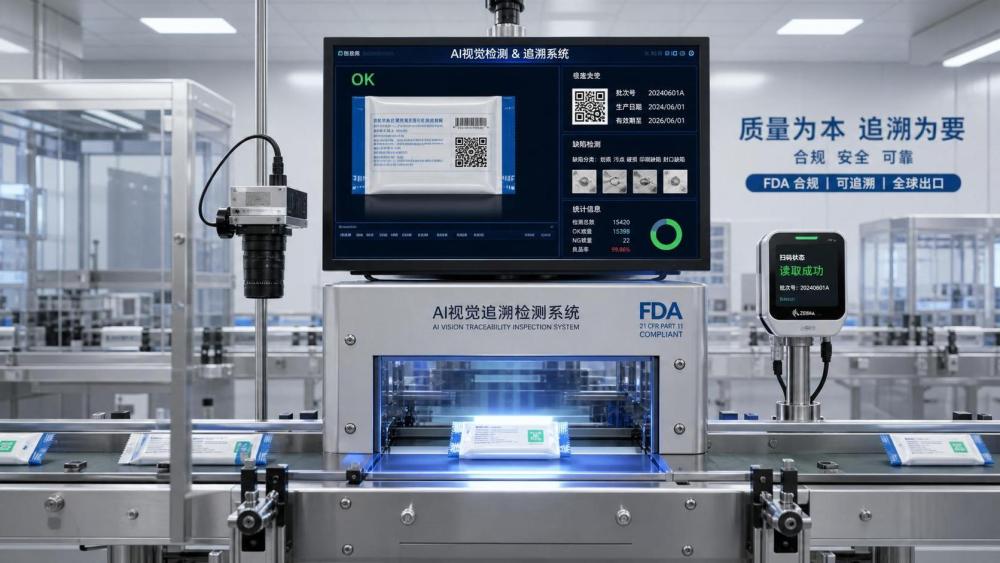
On June 28, 2026, the U.S. FDA published the final guidance titled Traceability Vision Systems for FDA-Regulated Industries: Validation Guidance, setting new requirements for traceability vision systems used in exports to the U.S. The document draws immediate attention from medical device, pharmaceutical, and food packaging production lines, as well as system suppliers and export-facing manufacturers, because it links technical validation of AI-assisted defect recognition directly to market access and on-site audit performance from December 1, 2026.
What the FDA Final Guidance Confirms
According to the information provided, the FDA released the final version of its guidance on June 28, 2026. The guidance applies to traceability vision systems for FDA-regulated industries and requires systems exported to the U.S. to pass explainable AI (XAI) validation. It also requires support for real-time defect classification confidence output at a level of at least 99.5%.
The guidance is scheduled to become mandatory on December 1, 2026. The stated direct impact is on export eligibility and on-site audit pass rates for traceability vision systems used on medical device, pharmaceutical, and food packaging production lines.
Where the Immediate Pressure Will Appear
Export-oriented manufacturers will face a compliance screening issue
From an industry perspective, manufacturers shipping FDA-regulated products or related production systems to the U.S. may be affected because traceability vision capability is no longer only a production efficiency matter. It now connects to whether the relevant system can satisfy the validation expectations described in the final guidance. The business impact is most likely to appear in export preparation, production-line qualification, and audit readiness.
Vision system suppliers will need to address verification depth
Suppliers of traceability vision systems may be affected at the product and documentation level. Analysis shows that the requirement is not limited to defect detection performance alone; it also points to explainability validation and real-time confidence output. That means suppliers should pay close attention to how system performance is demonstrated, documented, and presented in customer-facing validation processes.
Procurement and quality teams will need tighter technical alignment
For procurement, quality, and compliance-facing teams, the issue is likely to surface during supplier selection, technical review, and acceptance criteria discussions. What deserves closer attention is whether existing or planned systems can support the required confidence output and whether the AI-assisted classification logic can be validated in a way that stands up in customer audits or FDA-related review contexts.
What Companies Should Watch Before December 2026
Distinguish between having AI functions and proving them
Analysis shows that the practical issue is not simply whether a system uses AI-assisted defect recognition. The more immediate question is whether the system can complete XAI-related validation and present real-time defect classification confidence output at the required threshold. Companies should therefore focus on verifiable evidence, not only feature claims.
Review contracts, specifications, and delivery assumptions
For export projects already in planning or execution, businesses should examine whether technical specifications, supplier commitments, and acceptance terms reflect the new guidance requirements. Observably, delivery risk may arise if system capability, validation scope, and customer expectations are not aligned before installation or audit stages.
Prepare for customer and audit communication early
Companies serving U.S.-bound medical device, pharmaceutical, or food packaging lines should pay attention to how they explain compliance status to customers, auditors, and internal stakeholders. What deserves closer attention is the consistency between technical documents, system outputs, and the way teams describe validation results during review.
Keep watching for any follow-up clarifications
Although the final guidance has been issued, companies should still monitor whether subsequent official wording, interpretive updates, or implementation-related explanations affect execution details. This is especially relevant for teams making near-term procurement or upgrade decisions tied to the December 1, 2026 effective date.
Why This Reads as More Than a Narrow Technical Update
As an editorial observation, this development is more appropriate to understand as a concrete compliance signal rather than a routine specification adjustment. The reason is that the guidance connects AI explainability and confidence output to export access and audit outcomes in FDA-regulated environments. That raises the relevance of validation quality, documentation discipline, and supplier selection across multiple business functions.
At the same time, it should not be overstated as a complete reshaping of the market based on the information currently available. Observably, the confirmed facts establish a clear implementation requirement and timeline, while broader commercial consequences still need to be tracked through actual adoption, audit practice, and customer response.
How the Industry May Best Read This Development Now
At this stage, the most balanced reading is that the FDA has set a defined compliance direction for traceability vision systems tied to U.S.-bound regulated production lines. For affected companies, the significance lies less in headline value and more in the operational need to verify system explainability, confidence output, and audit readiness before the rule becomes mandatory. It is more appropriate to understand this as an actionable near-term requirement with longer-term implications that still warrant close observation.
Basis of This Article and What Still Needs Verification
This article is based on the user-provided news title, event date, and event summary regarding the FDA final guidance released on June 28, 2026. For this type of industry update, commonly relevant source categories may include official announcements, company statements, industry association information, authoritative media coverage, and standards-related documents.
No specific official source link was provided in the input, so the exact official link remains to be verified on an ongoing basis. Follow-up attention should remain on any later FDA clarifications, implementation details, and how the guidance is applied in export review and on-site audit scenarios.