
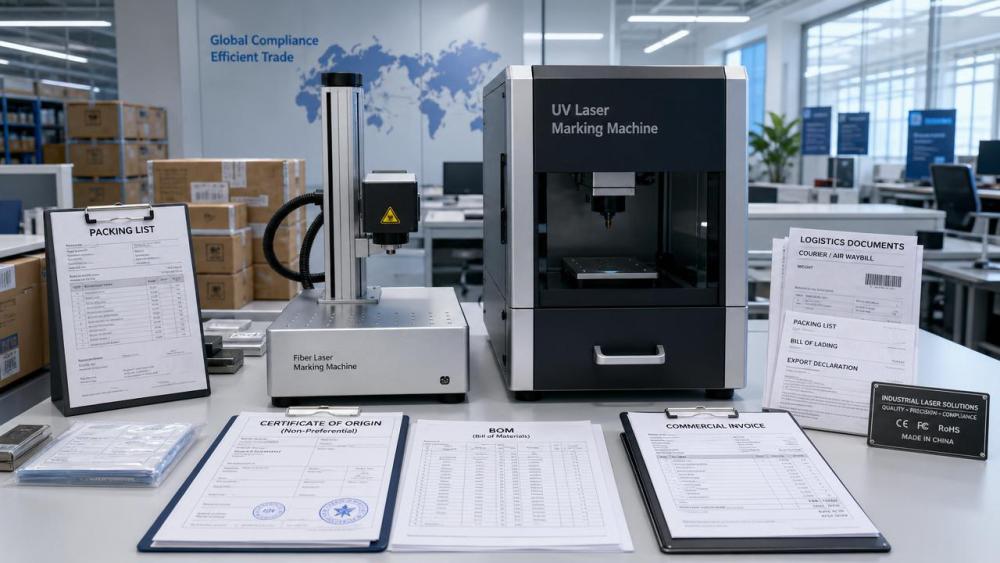
From April 1, 2026, RCEP upgrades the origin requirements for high-value marking equipment such as fiber and UV laser markers for exports to Japan and South Korea. For preferential treatment, shipments must now meet both a regional value content threshold of at least 40% and a de minimis threshold of no more than 7%, while a blacklist mechanism adds further compliance pressure. For exporters, importers, and supply chain service providers involved in cross-border equipment trade, the development deserves attention because it raises the cost of compliance and increases the intensity of document review around bills of materials and proof of originating materials.
What the Rule Change Confirms
The confirmed change is that, starting in April 2026, RCEP applies an upgraded origin standard to high value-added marking equipment including fiber and UV laser markers for the Japan and South Korea markets. To obtain preferential treatment in these two markets, exporters must satisfy two conditions at the same time: regional value content of 40% or more, and de minimis content of 7% or less.
The update also introduces a blacklist mechanism. If declarations are found non-compliant three times within two years, preferential qualification will be cancelled. Based on the information provided, this change materially increases compliance costs for Chinese laser marking equipment exports to Japan and South Korea and raises the scrutiny applied to supporting trade documents.
Where the Pressure Is Likely to Appear First
Export transactions face stricter document risk
From an industry perspective, direct trading companies are likely to feel the impact first at the declaration stage. The dual-threshold requirement means origin claims can no longer rely on a single metric, and the blacklist mechanism makes repeated filing errors more consequential. What deserves closer attention is whether internal review of BOM traceability and origin evidence is strong enough before shipment.
Manufacturing and sourcing teams must verify material origin earlier
For manufacturers and procurement teams, the likely impact sits upstream in component sourcing and production documentation. Because preferential treatment depends on both regional value content and a tight de minimis cap, the supporting basis for each material line in the BOM becomes more important. Observably, the pressure is not only on production itself but on whether material origin records can be matched clearly to export declarations.
Importers in Japan and South Korea carry more coordination work
For overseas buyers and importers, the change matters because preferential access depends on the exporter's ability to present compliant origin support. The information provided already indicates that importers need to work with Chinese suppliers in advance to verify BOM traceability and proof of originating materials. In practice, this shifts more due diligence into the pre-order or pre-shipment stage.
Supply chain service providers may face heavier review workloads
For customs, logistics, and trade documentation service providers, the likely impact is operational. Analysis shows the combination of stricter thresholds and a blacklist mechanism can increase the sensitivity of document preparation, consistency checks, and correction cycles. The key issue is less about volume than about the precision required in origin-related paperwork.
Practical Priorities for Companies Now
Check whether current BOM evidence can support both thresholds
Companies involved in eligible exports should focus first on whether existing BOM and material files can support both the 40% regional value content requirement and the 7% de minimis ceiling. This is a practical review point tied directly to the new rule rather than a general compliance exercise.
Separate policy wording from filing execution
What deserves closer attention is the difference between understanding the rule and proving compliance in actual declarations. Even where teams understand the upgraded standard in principle, the filing risk remains high if internal document logic, supplier evidence, and shipment records do not align.
Prepare for stricter customer and importer verification
Because overseas importers are expected to coordinate earlier with Chinese suppliers, exporters should be ready for more detailed pre-shipment questions on originating materials, supporting records, and declaration consistency. This is especially relevant where delivery schedules depend on smooth customs treatment and use of RCEP preferences.
Monitor follow-up clarification around implementation
Analysis shows that businesses should also watch for any follow-up clarification in formal expressions of the rule or in practical implementation expectations. The current information confirms the upgraded thresholds and penalty mechanism, but companies still need to track how these requirements are applied in daily documentation review and transaction workflows.
Why This Looks Like More Than a Routine Compliance Update
Observably, this development is not just a technical wording adjustment for origin rules. The dual-threshold requirement and blacklist mechanism together send a stronger signal about enforcement discipline in preference claims for higher value-added equipment. Analysis shows that the immediate effect is compliance-oriented, but the broader significance lies in how it pushes origin verification further upstream into sourcing, production records, and importer-supplier coordination.
It is more appropriate to understand this as a concrete near-term rule change with longer-term implications for trade process management, rather than as a fully settled industry outcome. The commercial impact will depend on how consistently companies can document origin claims under tighter review conditions.
How the Market May Need to Read This Update
At this stage, the update is best read as a compliance and execution signal for exporters of fiber and UV laser markers to Japan and South Korea. It does not by itself prove a wider structural shift across all equipment categories, but it clearly raises the threshold for claiming RCEP preferences in the affected trade flows. A neutral reading is that companies should treat it as an actionable operational change now, while continuing to observe whether similar enforcement logic extends further in practice.
Basis of This Article
This article is generated from the user-provided news title, event date, and event summary. The specific official source link was not provided in the input, so further verification is still necessary. For this type of development, commonly relevant source categories may include official notices, company disclosures, industry association information, authoritative media reporting, and standards-related documents. Continued attention should be paid to any subsequent official clarification, implementation guidance, and market-side compliance responses related to origin declarations for exports to Japan and South Korea.