
In automotive manufacturing, marking is no longer a finishing touch. It is part of the quality record, the compliance record, and often the only durable link between a physical part and its digital history. That is why laser marking solutions automotive teams evaluate must do more than leave a readable code. They need to match material behavior, survive the full lifecycle of the part, and support traceability without slowing production.
Fiber and UV systems often sit at the center of that decision. Both can create permanent identification, but they behave very differently on metals, plastics, coatings, and sensitive electronic components. The right choice depends less on laser power alone and more on how traceability is built into the process.
Why marking choice matters in automotive production
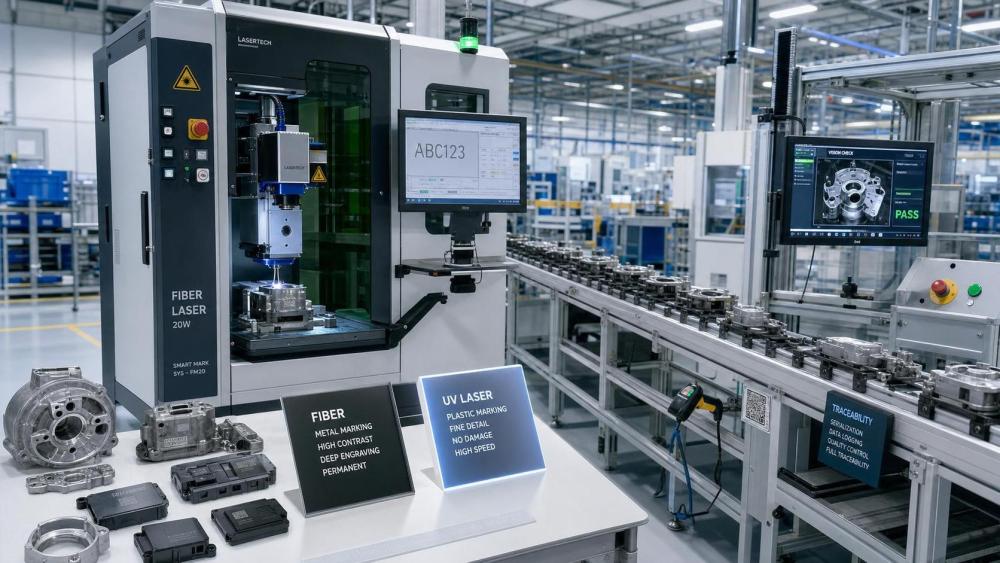
Automotive parts move through a demanding chain of stamping, machining, molding, assembly, logistics, and field use. A code that looks acceptable at the line may still fail later if it fades under heat, oil, abrasion, or chemical cleaning. When that happens, traceability breaks, and so does the ability to isolate defects quickly.
This is where laser marking solutions automotive projects rely on become a process-control issue. Marking quality affects recall response, counterfeit prevention, warranty investigation, and internal audit readiness. It also supports safety-critical documentation on parts that must remain identifiable for years.
GIAS treats this topic as part of a broader industrial auxiliary system landscape. Like ultrasonic cleaning, inkjet coding, vacuum support, and surface treatment, laser marking sits behind product reliability rather than in front of it. Yet it can influence yield, compliance, and brand trust just as strongly as primary equipment.
Fiber and UV do not solve the same problem
Fiber lasers are usually the stronger option for metals. They create deep, crisp marks on aluminum, stainless steel, copper alloys, and coated metal surfaces. In automotive plants, that makes them a practical fit for VIN plates, engine components, transmission parts, brake elements, and many metal subassemblies.
UV lasers work differently. Their shorter wavelength allows finer energy control, which is useful when the surface cannot tolerate heat or mechanical stress. On plastics, thin films, wire insulation, connectors, and many electronic housings, UV often produces cleaner contrast with less risk of burning, cracking, or deformation.
The practical question is not which technology is “better.” It is which one protects the part while still giving a durable code. In laser marking solutions automotive teams compare, material compatibility usually decides the outcome before speed or price do.
A simple comparison frame
Traceability needs should shape the specification
A marking system is only as useful as the data it can support. If the plant needs basic part identification, a visible serial code may be enough. If the line requires downstream scanning, genealogy tracking, or anti-counterfeiting control, the marking must stay readable after transport, storage, finishing, and service exposure.
That is why laser marking solutions automotive programs should be evaluated against the traceability chain, not just the mark itself. The code has to match the database structure, scanner sensitivity, part geometry, and inspection frequency. A perfect-looking mark that cannot be read consistently is a process risk, not a success.
In practice, this means checking contrast, depth, permanence, and placement together. For safety-related parts, traceability often demands more than identification. It may require proof that the mark survives cleaning agents, vibration, temperature cycles, and handling at every node in the supply chain.
Where fiber and UV usually fit best
The most common fiber applications are metal-intensive. Think chassis components, powertrain parts, tool inserts, fasteners, and serialized metal labels. In these cases, mark depth and abrasion resistance are often more important than ultra-fine resolution.
UV tends to appear where materials are more fragile. Wiring harness parts, sensor housings, display components, battery-related plastics, and small molded pieces often need clean contrast without thermal distortion. In those environments, the visible result matters, but so does preserving the part’s mechanical integrity.
A practical way to compare laser marking solutions automotive options is to map each part family by substrate, lifetime requirement, and inspection method. That avoids one-size-fits-all decisions and helps keep capital spending aligned with actual process needs.
Questions worth asking during evaluation
- Will the mark remain readable after heat, oil, abrasion, or coating?
- Does the material tolerate fiber energy, or does it need UV-level precision?
- Is the code only visual, or must it support automated scanning and genealogy?
- Can the mark be placed without affecting function, sealing, or appearance?
What quality and safety teams should watch first
One of the most useful habits is to test the mark under real production and service conditions. A label that looks strong on a sample plate may behave differently on a curved housing, a reflective metal, or a textured plastic surface. Process validation should include reading performance, contrast stability, and repeatability across shifts.
Safety review should also consider mis-marking risk. If a code is placed in the wrong position or becomes unreadable, the problem is not just cosmetic. It can interrupt recall containment, complicate inspection records, and delay shipment release. For that reason, laser marking solutions automotive selections are often strongest when the marking workflow is tied to line controls and verification logic.
GIAS regularly frames auxiliary systems through this kind of operational lens. The value is not in the equipment alone, but in how it protects product consistency, traceability, and compliance across the full process chain.
A practical way to move forward
The best next step is to build a part-by-part decision list. Separate metal, plastic, and electronic surfaces. Define the required mark life, scanning needs, and environmental exposure. Then compare fiber and UV only where the part actually demands a choice.
That approach keeps laser marking solutions automotive decisions grounded in real production risk instead of generic equipment preference. It also makes supplier comparison easier, because specifications can be checked against traceability goals, not just machine features.
When the traceability target is clear, the technology choice usually becomes clearer too. From there, the focus can shift to mark quality, verification reliability, and long-term process stability.