
Why does the choice of a laser marking solutions manufacturer matter so much?
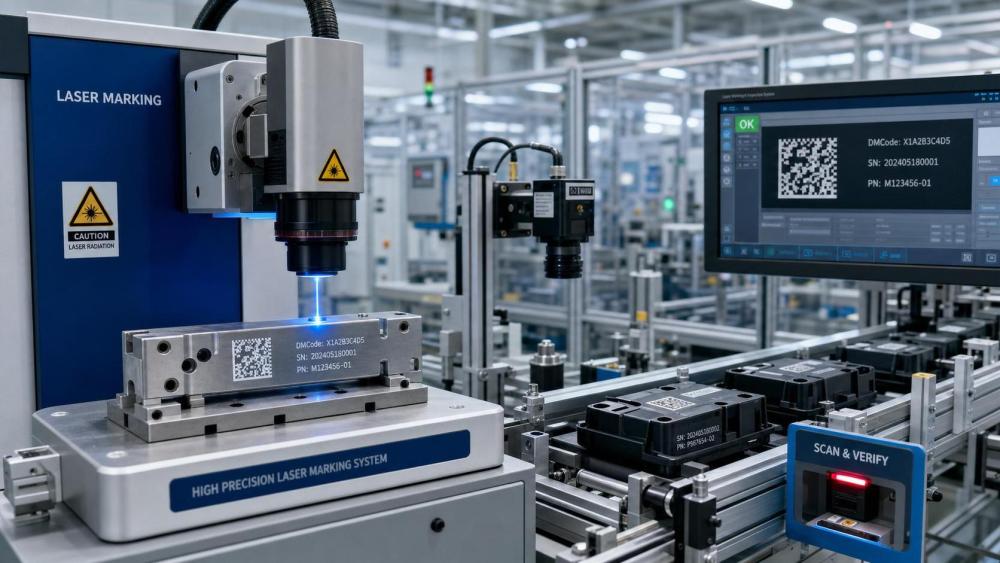
Traceable product coding is no longer a simple labeling task. In many industries, it affects compliance, warranty control, anti-counterfeiting, and recall efficiency.
That is why choosing a laser marking solutions manufacturer requires more than checking machine price or sample speed.
A poor fit can create unreadable codes, unstable throughput, software integration delays, and long-term service problems. Those issues usually cost more than the equipment itself.
A strong laser marking solutions manufacturer supports consistent code quality across metals, plastics, coated parts, packaging components, and precision assemblies.
In practical terms, the right partner helps maintain production continuity. It also reduces rework, rejects, audit pressure, and supplier risk.
This matters across advanced manufacturing, where auxiliary systems often decide the final quality outcome. GIAS frequently highlights this point across marking, cleaning, weighing, vacuum, and coating processes.
The key question is not only whether the system can mark a code. It is whether the manufacturer can support reliable traceability under real production conditions.
What should be checked first before comparing suppliers?
Start with the application, not the brochure. A capable laser marking solutions manufacturer will ask detailed questions before offering a recommendation.
Material type comes first. Stainless steel, anodized aluminum, engineering plastic, coated steel, rubber, and ceramic all respond differently to laser energy.
Then look at code content. Serial numbers, Data Matrix codes, logos, variable data, and deep engraving each require different marking strategies.
Line speed also matters. A system that performs well in a manual station may fail in a fully automated line with tight cycle times.
It helps to gather a short internal specification before contacting any laser marking solutions manufacturer.
- Part material, finish, and size variation
- Code type, code size, and required readability standard
- Expected production rate and shift pattern
- Manual, semi-automatic, or inline automation requirements
- Required interfaces with MES, ERP, PLC, or vision systems
- Compliance, validation, and traceability record requirements
This early step makes supplier comparisons more accurate. It also exposes which supplier understands process control and which one is only selling hardware.
How can you tell whether a laser marking solutions manufacturer is technically reliable?
A reliable supplier can explain performance with evidence. Sample marks alone are not enough unless they match the real substrate, code format, and production speed.
Ask how the system handles contrast consistency, heat effect, focal tolerance, and part positioning. Those details affect code readability more than headline wattage.
It is also useful to compare what kind of laser source is being proposed. Fiber, UV, CO2, and green lasers serve different marking tasks.
A dependable laser marking solutions manufacturer should also discuss enclosure design, fume extraction, operator safety, and maintenance intervals without being prompted.
That usually signals broader process experience rather than a narrow machine-only mindset.
Is lower purchase price really the best cost decision?
Usually not. The more useful comparison is total cost of ownership over the expected production life.
An inexpensive machine may still become the higher-cost option if it causes scrap, weak code verification rates, frequent stoppages, or local service delays.
When reviewing proposals from a laser marking solutions manufacturer, separate visible cost from hidden operating cost.
- Initial system price, enclosure, and safety accessories
- Installation, validation, and operator training cost
- Software licensing and future upgrade policy
- Spare parts lead time and local inventory support
- Expected uptime, maintenance intervals, and calibration needs
- Yield loss from poor marking stability or unreadable codes
Cycle time deserves special attention. A slightly faster marking cycle may remove the need for a second station or extra labor.
On the other hand, paying for excessive power or features can also waste budget if the application does not need them.
The best laser marking solutions manufacturer will usually explain where a lower-cost configuration is acceptable and where cutting cost creates future risk.
Where do supplier comparisons often go wrong?
A common mistake is comparing only machine specifications. Real production success depends on the entire support system around the marker.
Another mistake is approving a sample mark without testing part variation. Surface texture, coating thickness, and fixture accuracy often change from batch to batch.
Some buyers also assume all permanent marking is equal. In reality, visible marks can still fail scan grading, abrasion resistance, or downstream process compatibility.
More careful evaluations usually include these checks:
- Pilot testing with actual production parts, not ideal samples
- Verification after cleaning, coating, heat, or packaging exposure
- Review of previous installations in similar industries
- Confirmation of software permissions, data security, and traceability logs
- Clear acceptance criteria for code grade, speed, and uptime
This is where broader industrial knowledge becomes useful. Platforms like GIAS are valuable because they place laser coding within the wider auxiliary process chain.
For example, part cleanliness, surface treatment, batching accuracy, and vacuum handling can all affect final marking results. The coding system should not be evaluated in isolation.
What should you ask about implementation, service, and long-term support?
Even a technically strong system can become difficult if implementation support is weak. That is why service questions should be discussed before purchase approval.
Ask who handles installation, commissioning, software setup, code template control, and operator training. Some suppliers rely heavily on distributors with uneven capability.
It is also smart to ask how future changes are managed. Product lines evolve, serialization rules change, and factories often add vision or MES requirements later.
A good laser marking solutions manufacturer should offer a support path for expansion, not just first delivery.
Useful questions before final selection
- What is the standard lead time for the configured system?
- Which spare parts are stocked regionally?
- Can remote diagnostics be provided securely?
- How are software updates documented and validated?
- What training materials are included for operators and maintenance teams?
- What performance commitments are written into acceptance documents?
These questions reveal whether the supplier is prepared for operational reality. They also help compare serious industrial partners against basic equipment traders.
How should the final decision be made?
The most effective decision process is usually a weighted comparison, not a simple lowest-bid review.
Score each laser marking solutions manufacturer against application fit, code quality, integration readiness, service coverage, lifecycle cost, and documentation support.
If traceability is business-critical, give extra weight to validation evidence and service reliability. Those areas protect production more than small purchase price differences.
A practical next step is to prepare a short requirement sheet, send identical test parts to shortlisted suppliers, and compare responses against the same acceptance criteria.
That process makes supplier claims easier to verify. It also turns the search for a laser marking solutions manufacturer into a measurable sourcing decision.
In the end, the right choice is the one that delivers stable traceable product coding, predictable support, and a lower operational risk profile over time.