
Choosing laser marking systems in the United States is rarely a simple equipment comparison. The right decision depends on substrate behavior, code permanence, plant compliance rules, and the real cost of keeping marks readable through production, logistics, and field use.
That is why the topic matters across advanced manufacturing. In sectors where traceability, export readiness, and process stability shape commercial outcomes, laser marking systems USA buyers evaluate become part of quality control, brand protection, and operational discipline.
Why laser marking has become a strategic process step
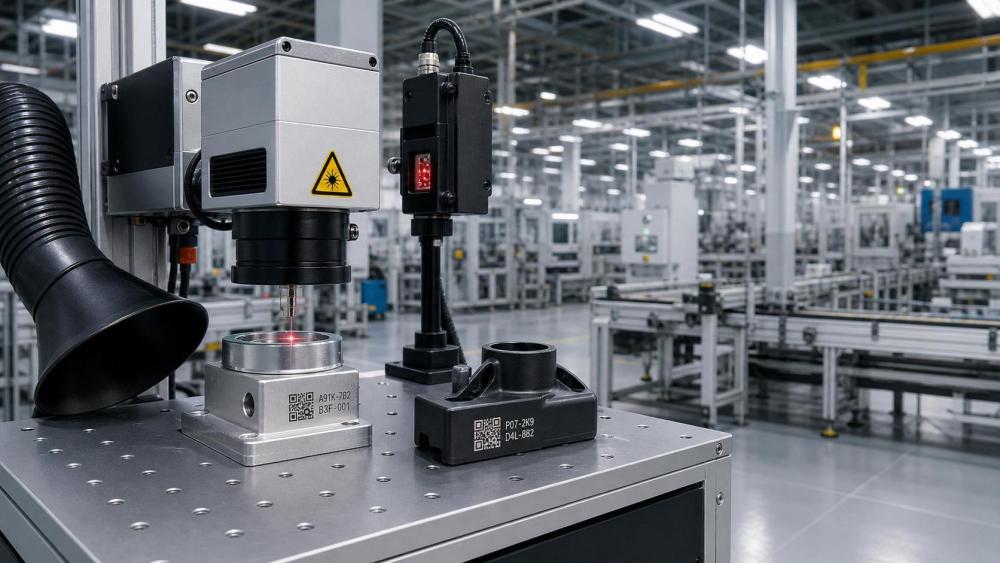
On many lines, marking is still treated as a downstream task. In practice, it influences inspection flow, recall readiness, serialization accuracy, and the credibility of product identification long after shipment.
A permanent mark can carry serial numbers, lot codes, UDI data, 2D Data Matrix symbols, logos, anti-counterfeit identifiers, and machine-readable production records. Those functions connect directly with broader auxiliary systems used to protect process quality.
That perspective aligns with the industrial logic behind GIAS. Across cleaning, weighing, vacuum, coating, and coding technologies, small process controls often shape final product performance more than they first appear.
Start with material behavior, not machine power alone
The first filter for laser marking systems USA sourcing decisions is material compatibility. A fast system that damages a surface, weakens a coating, or creates poor contrast is expensive even if the purchase price looks attractive.
Different materials respond to different wavelengths and pulse characteristics. Metals, plastics, ceramics, glass, coated parts, films, and sensitive electronics do not behave the same under laser energy.
Common material-to-system matching logic
This table is only a starting point. Additives, pigments, coatings, and surface finishes often matter more than the base material listed on a drawing.
In actual qualification work, sample marking should include abrasion testing, chemical exposure, vision inspection, barcode grading, and downstream cleaning or coating steps. Marks that look acceptable at the machine may fail after the next process.
Traceability requirements shape the system specification
Many buying mistakes happen because the mark is evaluated visually, while the production requirement is digital traceability. A readable serial number is not the same as a code that scans reliably after packaging, transport, and service exposure.
For laser marking systems USA facilities use in regulated or export-oriented environments, the specification should define more than content. It should define permanence, contrast range, code size, placement tolerance, and verification method.
Questions worth settling before supplier comparison
- Will the mark support human reading, machine vision, or both?
- Is the part exposed to heat, oils, sterilization, solvents, or outdoor wear?
- Does the code need to meet UDI, aerospace, automotive, or internal serialization rules?
- What barcode grade is acceptable at line exit and after aging?
- How will mark data connect with MES, ERP, or quality records?
Those points affect scanner selection, software integration, marking field size, and fixture design. They also determine whether an apparently lower-cost machine can actually support the required process discipline.
Compliance in the USA goes beyond laser safety labels
Compliance is often reduced to enclosure and operator safety. That is necessary, but incomplete. Laser marking systems USA buyers need to review product, workplace, and industry-specific obligations together.
At the equipment level, FDA laser product requirements, OSHA workplace safety expectations, and proper guarding, interlocks, and fume extraction are basic checkpoints. Local installation standards may add electrical and ventilation conditions.
At the application level, the mark may need to support sector rules. Medical device identification, aerospace part traceability, automotive component history, and electronics anti-counterfeit programs each raise different documentation expectations.
More importantly, compliance should be tested in process context. If a mark becomes unreadable after ultrasonic cleaning, coating, passivation, or packaging, the issue is no longer only marking quality. It becomes a system-level compliance gap.
System type, factory layout, and throughput must fit together
A technically correct laser can still underperform if the integration model is wrong. Desktop workstations, inline heads, robotic cells, and enclosure-based systems serve very different production realities.
Small-batch precision parts may benefit from enclosed workstations with flexible fixturing. High-volume packaging lines usually need continuous marking with synchronized motion control. Heavy components may require gantry or robot access instead of manual loading.
Line speed matters, but so do changeover time and part presentation. If parts arrive with inconsistent orientation, the burden shifts to fixtures, sensors, and software correction. That can change the economics more than laser wattage does.
Operational details that affect buying decisions
- Available floor space and enclosure footprint
- Required cycle time at peak output
- Fixture repeatability and part loading method
- Fume extraction and maintenance access
- Software support for recipes, serialization, and audit trails
ROI depends on more than the quoted machine price
Return on investment is where disciplined comparison becomes valuable. Laser marking systems USA procurement teams review should be measured against direct cost, hidden process cost, and avoided failure cost.
Direct cost includes capital price, installation, guarding, extraction, software, validation, training, and spare parts. Hidden process cost includes setup time, rejected marks, scanner downtime, and operator dependence.
Avoided failure cost is often the largest number. Poor traceability can trigger shipment holds, customer complaints, rework, recall exposure, or lost confidence during audits.
A practical ROI view
In many cases, a higher-specification system earns back the difference through fewer code failures and cleaner integration. That is especially true where every unit must remain traceable for years.
Supplier evaluation should include process evidence
A credible supplier discussion should move quickly from brochure claims to application proof. Sample libraries are useful, but process-specific trials are more reliable than generic demonstrations.
Request marked samples on actual substrates, not substitutes. Ask for barcode grading reports, maintenance schedules, expected source life, software compatibility details, and references from similar production environments.
This is where information platforms such as GIAS add value. Cross-process insight matters because marking performance is linked with cleaning quality, coating response, batching discipline, and broader manufacturing control.
A mark that survives the line is useful. A mark that remains readable after cleaning, coating, shipment, and field exposure is the one that supports long-term manufacturing reliability.
What to do before the final sourcing decision
A strong decision process starts with a written requirement set. Define the material mix, code content, target contrast, scan grade, line speed, integration points, and relevant compliance obligations before comparing quotes.
Then review laser marking systems USA options through controlled trials, not assumptions. Compare total operating impact, not only machine speed. Include downstream exposure tests and data workflow checks in the same evaluation cycle.
When the selection is grounded in material response, regulatory fit, and measurable ROI, the marking system becomes more than a coding device. It becomes a dependable part of traceability, process quality, and scalable production planning.