
How Laser Processing Technology Creates Durable QR Codes on Metal and Plastic Parts
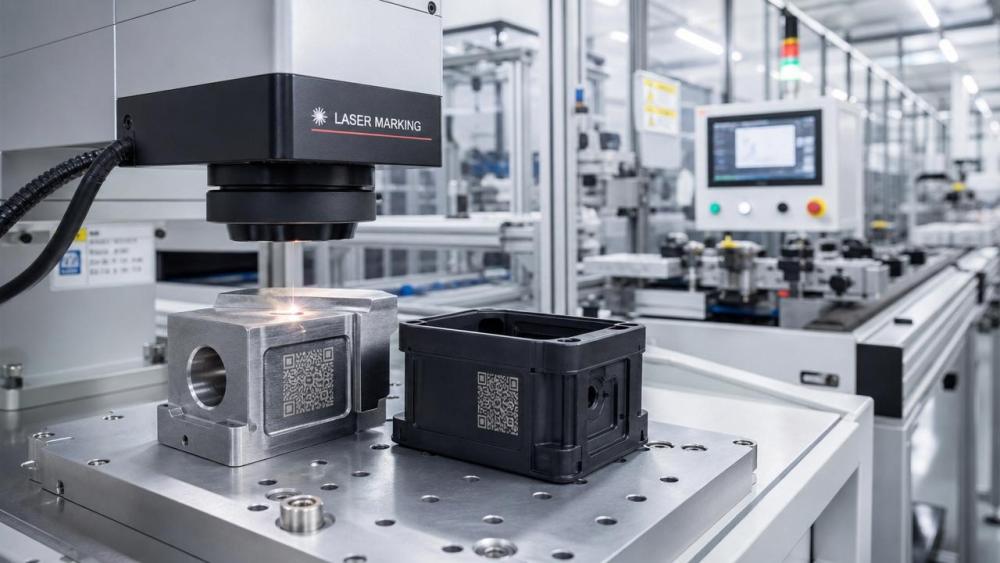
For technical evaluators, laser processing technology QR codes are not just labels.
They support traceability, product history, anti-counterfeiting, and stable identification through the full product lifecycle.
That matters even more when parts face oil, solvents, abrasion, heat, UV exposure, or repeated cleaning.
In those cases, laser processing technology QR codes usually outperform stickers, printed ink, and mechanical tags.
The reason is simple.
Laser energy changes the surface itself, so the code becomes part of the component rather than an added layer.
This article explains how laser processing technology QR codes are formed, what affects durability, and how to evaluate them on metal and plastic parts.
Why durable QR codes matter in industrial production
A QR code often carries batch data, serial numbers, production dates, shift records, and inspection results.
If that code fails, traceability breaks.
In automotive, electronics, medical devices, aerospace, and industrial tools, that creates quality and compliance risks.
More manufacturers now require direct part marking because supply chains demand faster recall control and cleaner digital records.
That is where laser processing technology QR codes fit naturally.
They support automated scanning, MES integration, warranty verification, and shop-floor data capture without adding consumables.
In practical terms, a durable code reduces rework, audit friction, and identification failures at receiving, assembly, and service stages.
How laser processing technology QR codes are created
Laser marking systems generate focused energy on a controlled area.
That energy changes the surface through engraving, annealing, foaming, carbonization, or color contrast formation.
The method depends on material type, surface finish, code size, and required readability.
Common marking effects on metal
On stainless steel, black annealed marks are common when surface integrity must stay intact.
On aluminum, fiber lasers often create engraved or oxidized contrast depending on settings and alloy response.
On coated metals, the laser may remove top layers selectively to expose a contrasting base color.
Common marking effects on plastic
On plastics, laser processing technology QR codes rely on foaming, bleaching, carbonization, or pigment activation.
ABS, PC, PA, PBT, and filled engineering plastics can all respond differently.
That is why substrate testing matters before final equipment selection.
What determines code durability on metal and plastic parts
Not every laser mark is equally durable.
A durable result depends on both process control and part condition.
The following factors usually decide performance:
- Material composition, including alloy type, resin family, fillers, additives, and colorants.
- Surface state, such as roughness, coating thickness, oxidation, oil residue, and mold release contamination.
- Laser wavelength, pulse duration, focal quality, scanning speed, repetition rate, and energy density.
- Code geometry, including cell size, quiet zone, depth, and contrast ratio.
- Environmental exposure, such as rubbing, chemical wash, salt spray, outdoor weathering, or high-temperature cycles.
From a technical evaluation perspective, durability is never only about appearance on day one.
It is about whether the code still scans after the real process loads begin.
Laser types and their fit for QR code applications
Different laser sources produce different results.
Choosing the right one is central to reliable laser processing technology QR codes.
Fiber laser
Fiber lasers are widely used for metals and some engineering plastics.
They offer fine beam quality, high speed, and stable direct part marking for serial production.
UV laser
UV lasers are often better for heat-sensitive plastics and very small codes.
They can reduce thermal damage while keeping edge quality clean.
CO2 laser
CO2 systems are common for organic materials and selected plastics.
They can work well when the polymer absorbs that wavelength efficiently.
In recent projects, the best source is usually the one matched to the substrate, not the one with the highest nominal power.
Key evaluation criteria for readable and permanent QR codes
A code may look sharp to the eye and still fail machine reading.
That is why evaluation must combine visual quality, scan quality, and durability testing.
For formal programs, many teams also check verification grades using recognized code quality standards.
That step makes supplier comparison more objective.
Common risks that reduce QR code performance
Even well-designed laser processing technology QR codes can underperform if process details are missed.
The most common risks include:
- Marking over oil, dust, or release agents that interfere with surface response.
- Using too much energy, causing melted plastic edges or excessive metal roughness.
- Using too little energy, leaving weak contrast that fades after handling.
- Choosing a code size below scanner capability for the real working distance.
- Ignoring part curvature, which can blur modules outside the focal range.
- Skipping environmental validation, especially for chemicals, abrasion, and thermal cycling.
A useful rule is this.
If the mark is critical for compliance or warranty history, test the code under end-use conditions, not only in the lab.
How to evaluate suppliers and process capability
When comparing equipment or service providers, ask for more than sample photos.
A strong evaluation process should include technical data, validation logic, and application fit.
- Request sample marks on actual production materials, including the same finish and color.
- Confirm laser type, wavelength, power range, optics, software, and code verification capability.
- Review cycle time at target throughput, not only isolated test speed.
- Check whether the system supports data communication with plant traceability platforms.
- Ask for durability evidence after abrasion, solvent exposure, heat, and cleaning tests.
- Verify maintenance needs, uptime expectations, enclosure safety, and operator training support.
This approach helps separate a nice-looking sample from a production-ready identification process.
Where laser processing technology QR codes create the most value
The value becomes clearer when codes stay readable across manufacturing and field use.
Typical high-value applications include battery components, electronic housings, machined parts, medical plastic assemblies, valves, tools, and coated industrial products.
In these environments, laser processing technology QR codes support process accountability and reduce identification loss.
They also align well with the broader move toward smarter factories, cleaner data exchange, and tighter product genealogy control.
Final takeaways for process selection
Laser processing technology QR codes work best when material behavior, code design, and production conditions are evaluated together.
On metal and plastic parts, durability comes from controlled surface interaction, not from marking speed alone.
For teams reviewing technical options, the smartest path is to validate real substrates, real exposure risks, and real scanning conditions before scaling.
That makes laser processing technology QR codes a practical tool for traceability, compliance, and long-term manufacturing reliability.
If the goal is permanent identification with fewer failure points, this is one process worth evaluating in depth.