
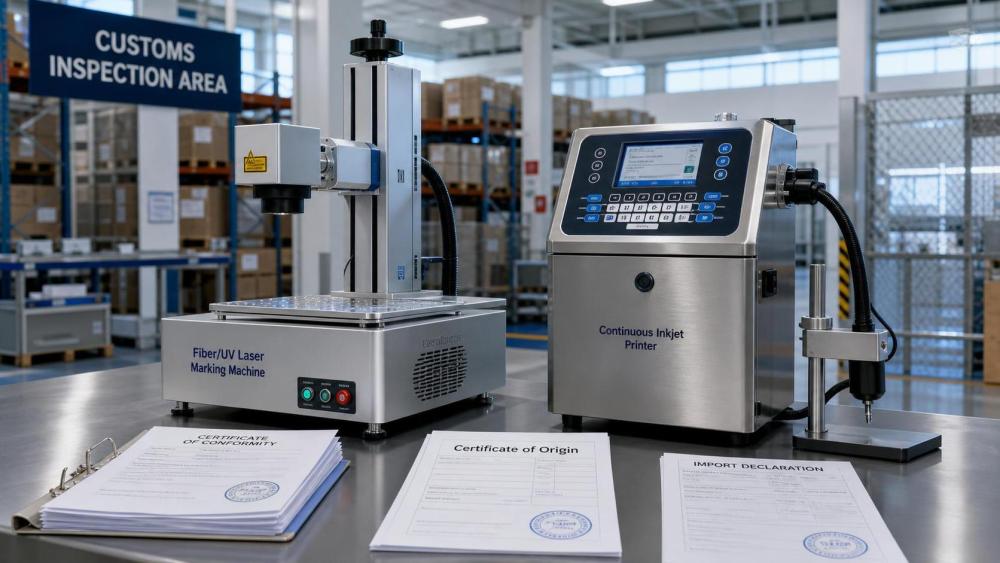
On 2026-08-01, the first month of full enforcement under China’s Tariff Law coincided with a stricter compliance review on imported industrial marking equipment. The joint inspection focus covers Fiber/UV Laser Markers and Continuous Inkjet Printers, with importers now expected to submit IEC 60825-1, EN 62271, and a full chain of origin proof before customs clearance. For overseas buyers, distributors, and sourcing teams that import these units into China, the key issue is no longer only price and lead time, but whether documents, certification, and trade records can support clearance without delay.
What the new clearance check is actually requiring
The confirmed facts are straightforward: in August 2026, Tariff Law enforcement entered a strengthened phase; the General Administration of Customs and the State Administration for Market Regulation launched a special compliance check on imported industrial marking equipment; the targeted products include Fiber/UV Laser Markers and Continuous Inkjet Printers; and importers are required to provide IEC 60825-1 for laser safety, EN 62271 for electrical safety, plus full chain proof of origin. Without those materials, the goods will not be released for customs clearance.
How the pressure spreads across the trade chain
Importers and direct traders face a document-first clearance model
Importers are the first group affected because clearance now depends on whether the shipment file is complete before arrival. This changes the practical order of work: commercial terms, shipping schedules, and customs filing can no longer be separated from the underlying safety and origin paperwork. For traders handling marking equipment, the main risk sits in missing certificates, inconsistent model descriptions, or origin records that do not align across the supply chain.
Buyers and procurement teams need to align sourcing with compliance evidence
For overseas procurement teams buying from China, the impact is not limited to customs processing in one market. The new requirement increases the importance of supplier due diligence, because procurement decisions now have to account for certification availability and traceability records at the sourcing stage. Orders that are technically ready to ship may still face clearance delays if the buyer has not secured the required documents in advance.
Certification and testing services move closer to the purchase cycle
Testing bodies, compliance consultants, and certificate-handling intermediaries are likely to become part of the early purchasing workflow rather than a late-stage support function. The reason is simple: IEC 60825-1 and EN 62271 are no longer optional supporting materials in this context; they are part of the clearance package. That raises the value of document coordination, file consistency checks, and pre-shipment verification.
Logistics and delivery planning become less forgiving
Freight forwarders and supply chain service providers may also feel the change because customs timing becomes more sensitive to file readiness. A shipment can still move physically, but the delivery promise becomes conditional on whether the import dossier is complete. For projects that depend on installation windows or line commissioning, any delay at clearance can cascade into downstream delivery and acceptance steps.
What companies should focus on now
Check whether the clearance file is complete before shipment
For relevant imports, the minimum practical task is to verify that the safety certificates, product description, and origin documentation are aligned before the cargo leaves. The issue here is not only whether the documents exist, but whether they can be presented as a coherent set during inspection.
Separate the rules for laser markers and inkjet printers carefully
Fiber/UV Laser Markers and Continuous Inkjet Printers are both within the scrutiny scope, but they may raise different documentation needs in real-world filing. Companies should not assume that one product family can be cleared with another product’s file structure. The safer approach is to keep each model, certificate, and origin record traceable to the specific shipment.
Review purchase terms and delivery timelines with compliance in mind
Where procurement contracts still treat compliance as a post-sale matter, this is a weak point. Buyers and suppliers should re-check lead times, document handover dates, and responsibility for certificate preparation. In practice, the party controlling the paperwork timeline now has a direct influence on delivery certainty.
Watch for further official wording and filing practice
Analysis shows that this looks less like a one-off administrative action and more like an enforcement signal. What deserves closer attention is whether the filing practice, document scope, or product coverage is clarified further through later official wording. Until that happens, companies should treat the current requirement as an active clearance condition, while still monitoring whether implementation details become more specific.
Why this looks like an execution signal, not just a policy headline
From an industry perspective, the current development is best understood as a compliance tightening that has moved into the transaction stage. It is not enough to read it as a policy statement in the abstract; the practical effect is already tied to customs release, certificate preparation, and origin traceability. That means market participants should focus on how the rule is being applied in filing and inspection, rather than assuming that commercial customs practice will remain unchanged.
What this means for the next round of shipments
The immediate takeaway is cautious but clear: imported industrial marking equipment now faces a more document-intensive clearance environment, and the burden falls first on importers, buyers, and their service providers. The most reasonable reading is that this is a live enforcement shift that needs to be handled as such, while the precise execution rhythm, certification interpretation, and market response still deserve continued observation.
Source note and follow-up points
This article was generated from the user-provided title, event time, and summary. No specific official source links were provided in the input. For this type of development, the relevant reference materials would normally include customs and market supervision announcements, trade authority notices, standard documents, and industry association updates. The points that still need monitoring are the detailed enforcement wording, certification handling practice, tender and procurement file changes, and feedback from importers and logistics providers.