
Anti-counterfeiting marking has moved from a packaging detail to a strategic control point. When products travel across regions, channels, and contract manufacturing networks, the mark on the part or package often becomes the first line of defense for traceability, brand protection, and compliance. Comparing laser, inkjet, and serialized codes is therefore less about choosing a label format, and more about deciding how identity, durability, and data will hold up in real production.
Why marking choices now carry more business weight
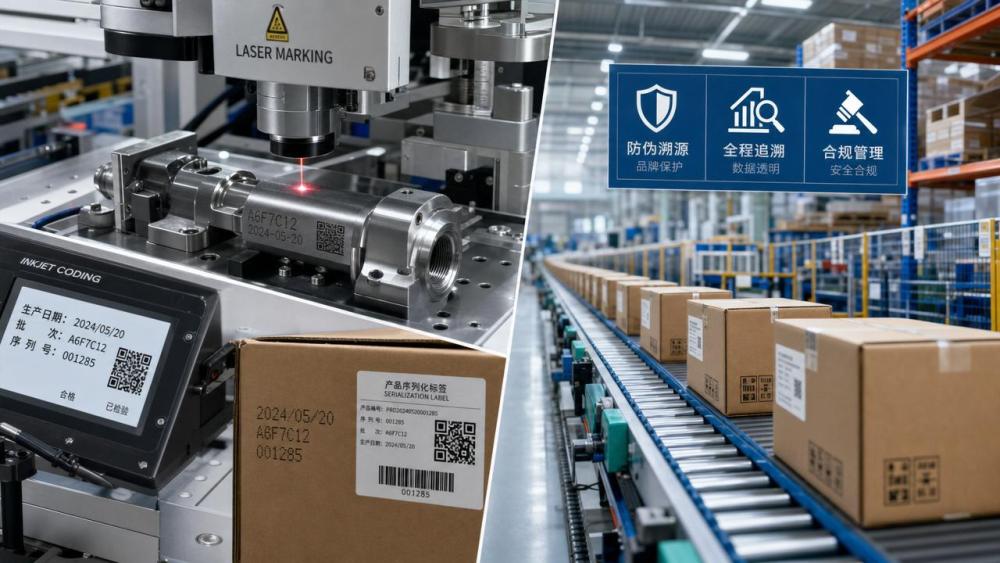
Counterfeit risk no longer affects only luxury goods or consumer electronics. It now reaches industrial components, medical devices, chemical packaging, automotive parts, batteries, and exported assemblies.
A weak mark creates more than a security gap. It can break recalls, confuse warranty claims, slow audits, and reduce confidence in supply chain records.
That is why anti-counterfeiting marking increasingly sits beside quality control, surface treatment, cleaning precision, and coding integrity as part of a wider process reliability discussion.
In advanced manufacturing, auxiliary systems often decide whether product data stays readable through heat, abrasion, solvents, moisture, and handling. GIAS follows this logic closely because identification quality is inseparable from final product quality.
What anti-counterfeiting marking actually means in practice
At a basic level, anti-counterfeiting marking is any identification method that helps verify product authenticity and distinguish legitimate goods from copied or diverted ones.
The mark may be visible, machine-readable, or both. It may sit directly on the product, on primary packaging, or on secondary logistics units.
Its value depends on three linked functions.
- It identifies the item or batch.
- It connects that item to production or supply chain data.
- It resists tampering, duplication, or unreadable degradation.
Laser marks, inkjet codes, and serialized systems support these functions differently. The best option depends on substrate, throughput, regulatory expectations, and how deeply the code must connect to enterprise data.
Laser marking: durable identity for demanding environments
Laser marking creates a permanent mark by changing the surface of the material. Depending on the application, it may engrave, anneal, foam, or discolor the substrate.
For anti-counterfeiting marking, the major strength is permanence. A well-formed laser mark usually survives friction, solvents, UV exposure, and long storage far better than printed alternatives.
This makes it attractive for metal tools, automotive parts, electronics housings, medical instruments, and industrial nameplates. In these settings, the mark is expected to remain legible through the product life cycle.
Laser also supports high-resolution text, logos, Data Matrix codes, and micro-marking. That matters when available marking space is limited but traceability requirements are strict.
Still, permanence is not the same as security by itself. If the content of a laser code is easy to predict, counterfeiters may imitate it. The marking method must therefore be paired with controlled serialization, database checks, or verification logic.
Where laser marking fits best
- Direct part marking on metal, rigid plastic, and coated surfaces
- Products exposed to wear, cleaning chemicals, or outdoor conditions
- Industries needing long-term traceability and audit readiness
- Applications where consumable reduction matters operationally
Inkjet coding: flexible deployment across fast-moving lines
Inkjet systems apply text or codes without physical contact. They are widely used on cartons, films, bottles, labels, pouches, and other packaging formats that move quickly through production.
For anti-counterfeiting marking, inkjet offers speed and versatility. It can print changing batch data, production dates, barcodes, QR codes, and serialized identifiers on a wide range of substrates.
This is especially useful when the product itself cannot be marked directly, or when packaging changes frequently across SKUs and regional variants.
The trade-off is durability. Ink adhesion depends heavily on surface energy, drying conditions, storage, and handling. A code that looks sharp at line exit may fade, smear, or scan poorly later if process control is weak.
In practical terms, inkjet anti-counterfeiting marking performs well when supported by substrate testing, vision inspection, and a clear understanding of logistics conditions.
When inkjet becomes the stronger option
- High-speed packaging lines with variable printing content
- Shorter product life cycles or frequent artwork changes
- Packaging-based verification rather than direct part authentication
- Operations balancing moderate security with lower entry cost
Serialized codes: security grows when data stays trustworthy
Serialized codes are not a separate physical marking technology. They are a data strategy that assigns a unique identity to each item, bundle, or case.
That identity may be printed by inkjet or marked by laser. The anti-counterfeiting marking value comes from uniqueness, traceable events, and the ability to verify whether a code belongs to a legitimate record.
This approach is increasingly relevant where supply chains are global and channel diversion is costly. A copied static code can circulate widely. A controlled serial number can be checked against production time, shipment path, and scan history.
However, serialization succeeds only when the data layer is disciplined. Duplicate generation, weak access control, poor aggregation, or disconnected systems can damage trust even if the printed code is clear.
In other words, serialized anti-counterfeiting marking is as much an information management project as a coding project.
A practical comparison across core decision factors
The choice often becomes clearer when technical and commercial factors are reviewed together.
Many operations do not choose only one. A common model uses laser for permanent part identity and serialized inkjet coding for packaging, aggregation, and market verification.
Where implementation often succeeds or fails
The performance of anti-counterfeiting marking usually depends less on brochure specifications and more on surrounding process discipline.
Several factors deserve early attention.
- Surface condition matters. Oils, dust, coating inconsistency, and poor pretreatment can reduce readability.
- Verification matters. Vision systems and scan grading help detect quality drift before codes fail in the field.
- Data governance matters. Secure serial number creation, access control, and event logging protect system credibility.
- Regulatory fit matters. Some sectors require specific traceability depth, retention periods, or marking permanence.
- Lifecycle thinking matters. A code must remain useful after transport, warehousing, installation, and service.
This is where broader auxiliary process knowledge becomes relevant. Cleaning systems, surface treatment, and line integration can influence marking quality as much as the coding device itself.
How to frame the next decision
A useful evaluation starts with risk, not equipment. Ask what kind of counterfeit exposure exists, where product identity must be proven, and how long the mark must stay readable.
Then map that requirement against material, line speed, packaging format, and data infrastructure. A durable mark without traceable records may be incomplete. A serialized system without stable code quality may be equally weak.
For many industrial programs, the most effective anti-counterfeiting marking strategy combines physical permanence, readable coding, and verifiable data. That combination creates stronger protection than any single technology viewed in isolation.
The next step is usually a structured comparison: test marks on actual substrates, review code readability after environmental exposure, and examine how line equipment connects with traceability software. That process turns anti-counterfeiting marking from a compliance checkbox into a measurable part of manufacturing resilience.