
How Continuous Inkjet Technology Enables Reliable Batch Coding on High-Speed Lines
A batch code may occupy only a few square millimeters of packaging, yet it can determine whether a product can be released, traced, recalled, exported, or defended against a counterfeiting claim. On a high-speed production line, the challenge is not merely to place characters on a moving item. The code must remain legible after handling, survive the intended distribution environment, match the production record, and appear in the correct location on every unit.
Continuous inkjet technology batch coding is widely used because it combines non-contact printing with high operating speed and broad substrate tolerance. It can mark bottles, cans, flexible films, cartons, cables, caps, pouches, coated containers, and many irregular surfaces without requiring direct contact between the printhead and the product. For technical evaluators, however, the real question is not whether a CIJ printer can print a date or lot number. It is whether the complete coding system can maintain code quality when line conditions become less than ideal.
That distinction matters in food, beverage, pharmaceutical, chemical, personal care, electronics, building materials, and industrial component production. In each sector, the coding requirement may differ, but the operational risks are familiar: product movement, changing surfaces, condensation, dust, vibration, washdown exposure, variable shifts, frequent SKU changes, and pressure to keep the line running.
Why CIJ Fits Moving, Variable Production Environments
A continuous inkjet printer forms a steady stream of ink droplets. Selected droplets are electrically charged and deflected toward the substrate to create characters, while unneeded droplets are collected and recirculated. This approach allows the printhead to operate at a distance from the product, which is valuable when the surface is curved, uneven, wet, hot, or difficult to reach with a contact-based marking method.
The non-contact principle is particularly useful on conveyor systems where small changes in product height or orientation are unavoidable. A PET bottle may rotate slightly; a flexible pouch may flutter; a cable may pass continuously through an extrusion line; a metal can may present a curved surface. CIJ does not eliminate the need for mechanical control, but it tolerates a wider range of product presentation than many coding methods.
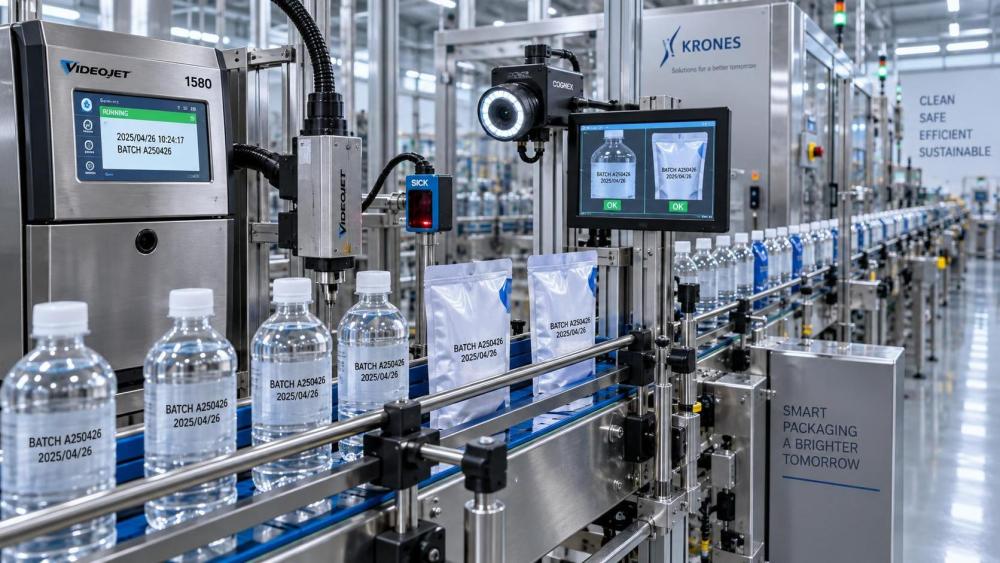
At high throughput, timing becomes as important as print formation. The printer needs a reliable trigger signal to identify when a product enters the print zone. Depending on the line, this signal may come from a photoelectric sensor, a product-detect device, or an integrated control architecture. An encoder can provide speed feedback when conveyor velocity changes, helping the printer maintain character width and placement. Without sound triggering and speed reference logic, even a well-maintained printhead can produce stretched, compressed, shifted, or missing codes.
This is why a CIJ installation should be evaluated as a line system rather than as an isolated machine. Print quality is affected by conveyor stability, guide rails, sensor location, ambient airflow, product spacing, rejection capability, and the way production data reaches the coder.
The Conditions Behind a Reliable Code
A readable batch code depends on a chain of controls. Ink selection, printhead position, message design, substrate condition, and inspection all influence the result. A weak link may not be obvious during a short factory trial, especially if the trial uses clean samples at reduced line speed. The more useful evaluation is one that reflects normal production variability.
Ink-substrate compatibility is not a secondary decision
Different inks are formulated for different drying, adhesion, contrast, and resistance requirements. A code on glossy film may need rapid drying to prevent transfer at downstream guides or pack-off points. A mark on a returnable bottle may need to withstand moisture and abrasion. A code on an industrial component may need resistance to oil, heat, solvents, or subsequent processing. Dark substrates may require a high-contrast ink, while light packaging often uses conventional dark inks.
Technical evaluation should consider the entire product journey rather than only initial legibility. Ask whether the coded surface will be refrigerated, frozen, sterilized, rubbed against adjacent packs, exposed to condensation, handled repeatedly, or packed before the ink has fully dried. If the product is exported, the test conditions should also reflect the likely logistics environment. Adhesion and resistance claims should be verified against the actual material and process conditions, not assumed from an ink description.
Print geometry deserves measurement
The distance between printhead and substrate, commonly called throw distance, affects dot placement and character definition. So do the angle of the head, the direction of product travel, and the available print window. In practice, a printer may perform well on a stationary sample but lose definition when a rounded container oscillates or when a pouch varies in height.
There is no universal setting that guarantees quality across every application. The correct stand-off distance and message height depend on the printer design, line speed, code content, substrate, and available space. Technical teams should document the approved mechanical position, including brackets and adjustment limits, so that a maintenance intervention does not quietly change the validated print condition.
Message complexity consumes the available print window
A simple date code requires less print time than a multi-line message containing lot data, shift identification, production time, plant code, variable expiry information, and a machine-readable symbol. The desired character height and resolution also affect what can be printed within the available distance on a moving product.
This does not mean every code should be shortened. It means the message should be designed around its traceability purpose. A batch format should be understandable to the people and systems that need to use it during quality investigations, stock control, or market withdrawal. Where barcodes or 2D codes are used, the selected code structure, print quality criteria, and verification method should be agreed with downstream users and applicable customer or market requirements.
Speed Is More Than a Printer Specification
Supplier literature often expresses coding capability in terms of maximum line speed or characters per second. Those values are useful for an initial comparison, but they are not enough to approve a production application. Actual performance depends on message layout, font, print orientation, product pitch, detection repeatability, and line acceleration or deceleration.
Consider a line that operates smoothly at a nominal rate but accumulates products at an infeed or runs through frequent micro-stops. If the coding logic does not account for changing speed or irregular spacing, the result can be duplicate codes, inconsistent positioning, or missed products. In another common situation, a printer is asked to mark two sides of a package using product rotation or multiple heads. The mechanical process may create more risk than the coding technology itself.
For this reason, a meaningful factory acceptance or line trial should include realistic production conditions: normal line speed, start-stop behavior, representative containers, actual code content, expected environmental conditions, and at least a basic review of reject handling. The purpose is not to create an unnecessarily complex qualification exercise. It is to reveal whether the print system remains stable when production behaves like production.
Traceability Depends on Data Control, Not Just Legible Ink
A perfectly printed but incorrect batch code is still a serious quality failure. On high-speed lines, message control should therefore receive the same attention as print quality. Operators need a controlled way to select the correct product message, update date information, and confirm that the active code matches the production order.
The appropriate level of control varies by industry and risk profile. Some operations use locally stored message templates with access restrictions. Others connect coders to line controllers, manufacturing execution systems, or enterprise data sources. In regulated or customer-controlled environments, teams may need to assess user permissions, change records, electronic data integrity expectations, and procedures for message approval. The relevant requirements should be determined by the manufacturer’s quality system and the markets served; they should not be inferred solely from a printer’s connectivity features.
Vision inspection can add another layer of control by checking code presence, position, readability, or content against defined rules. Yet inspection only helps when reject logic is dependable. A rejected item must be physically separated, accounted for, and prevented from re-entering the accepted product flow. Technical evaluators should review the full loop: print, inspect, reject, confirmation, and exception handling.
Environmental Factors That Often Cause Avoidable Failures
CIJ systems are designed for industrial operation, but their performance still depends on suitable installation and maintenance conditions. Dust can contaminate the print area. Strong air movement can disturb the path between printhead and product. Condensation can affect both the substrate and nearby sensors. Vibration may slowly alter head alignment. In washdown areas, enclosure protection, cable routing, and cleaning procedures must be considered as part of the installation rather than added after commissioning.
Consumable handling also deserves practical attention. Ink and make-up fluids are process materials, not generic maintenance supplies. Teams should establish clear controls for correct fluid identification, storage conditions, replenishment, spill response, and disposal in line with supplier guidance and site procedures. Where a facility handles flammable or volatile materials, the local safety assessment and equipment suitability need separate review.
Downtime is often linked less to an inherent printer limitation than to neglected routine care: an uncovered printhead during long stops, dried ink around the nozzle area, incorrect cleaning methods, delayed replacement of service items, or poorly trained shift personnel. A maintenance plan should distinguish between operator tasks, planned technical service, and escalation conditions that require specialist support.
A Practical Evaluation Framework
When comparing continuous inkjet options, it is useful to start with the code requirement and work backward to the equipment. The following questions usually expose whether a proposed solution is properly matched to the line:
- What information must be coded, and which elements are fixed, variable, or generated from production data?
- Which substrate, surface finish, color, temperature, and contamination conditions will exist at the actual print point?
- What must the code withstand after printing: rubbing, moisture, refrigeration, chemicals, heat, or secondary packaging contact?
- How stable are speed, spacing, orientation, and product height during routine operation rather than during a demonstration?
- How will the factory prevent wrong-message selection and verify that failed prints are removed from the accepted stream?
- What service access, consumable supply, documentation, and operator training are needed at the installation site?
This approach prevents a common purchasing mistake: selecting a coder based mainly on headline speed, then trying to solve message control, bracket design, or ink durability after the line is already running. A coding project is usually more reliable when quality, engineering, operations, maintenance, and packaging teams agree on acceptance criteria before equipment selection is finalized.
Where CIJ Sits Among Auxiliary Manufacturing Systems
Coding is one of the auxiliary processes that can appear peripheral until a failure interrupts shipment or complicates a traceability investigation. The same pattern applies across advanced manufacturing: cleaning quality affects bonding and assembly, weighing accuracy affects formulation consistency, vacuum stability affects process repeatability, and surface treatment affects coating adhesion and corrosion resistance.
Global General Industrial Auxiliary Systems (GIAS) examines these process-support technologies in that broader context. For manufacturers assessing inkjet coding, the useful comparison is not simply CIJ versus another marking method. It is the relationship between identification requirements, packaging materials, line design, quality controls, maintenance capability, and the cost of a coding failure. Laser marking may be appropriate where permanence and material response support it; CIJ may be the more practical route where flexibility, non-contact operation, or changing packaging formats dominate. The decision should follow the application, not a technology preference.
Reliable batch coding on a fast line is built through controlled details: the correct ink on the real substrate, stable product detection, disciplined message management, sensible printhead positioning, and inspection that connects to effective rejection. Continuous inkjet technology provides the necessary speed and adaptability, but the final result depends on how carefully those details are engineered and maintained. Before approving a system, validate it against the actual line, actual code, and actual distribution risks that the product will face.