
Foaming in a mixing tank is rarely caused by the metal itself. Operators often blame the vessel because the foam appears in the tank, climbs the wall, interferes with level control, or spills into vents and downstream lines. In practice, foam forms when the process pulls gas into the liquid faster than the liquid can release it. Tank geometry, impeller choice, speed, fill level, viscosity, temperature, and product chemistry all shape that result. Stainless construction matters mainly because these tanks are widely used in beverage, alcohol, food, and sanitary liquid processing, where surface finish, cleaning requirements, and agitation control are closely tied to product behavior.
For operators, foaming is more than a cosmetic nuisance. It can reduce usable batch volume, create unstable density readings, slow transfer, upset filtration, and leave inconsistent alcohol or ingredient distribution if the batch cannot be mixed at the intended speed. In some processes, the response to foam causes a second problem: the team reduces agitation so much that blending becomes incomplete.
Why foam appears during mixing
Foam needs two things: gas bubbles and a liquid system capable of keeping those bubbles from collapsing quickly. Agitation supplies the first part. Proteins, sugars, surfactants, oils, detergents, suspended solids, and fermentation residues often supply the second. Even when a recipe is not designed to foam, trace surface-active components can stabilize bubbles long enough to create a visible layer.
Inside stainless steel mixing tanks, gas usually enters in one of four ways:
- Surface vortexing that drags air down into the batch
- Splashing from poor liquid entry or return-line placement
- Dissolved gas release caused by temperature or pressure change
- Intentional or accidental gas injection during blending or cleaning transitions
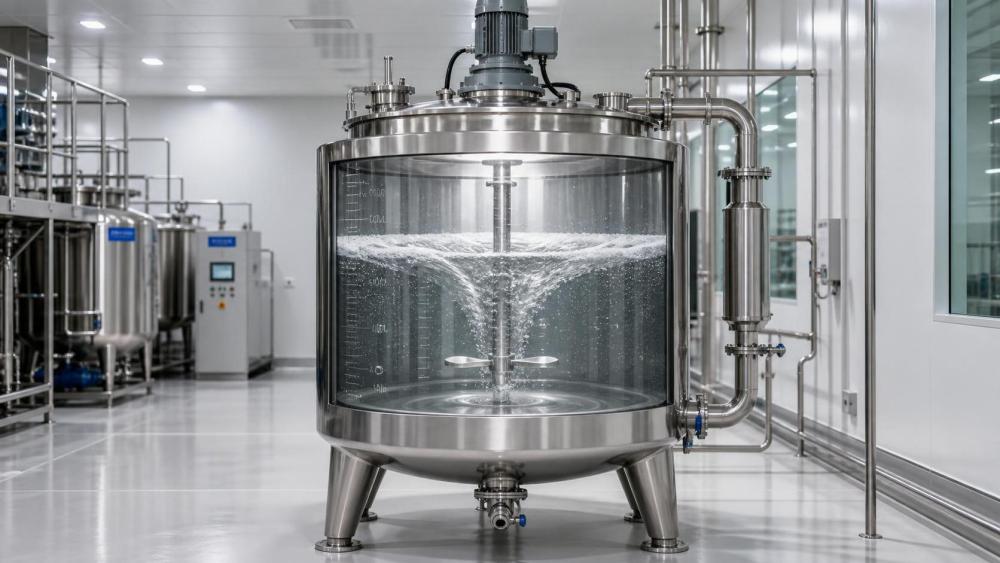
If the impeller creates strong top-surface circulation, a funnel forms. Once that funnel reaches the impeller zone, air is continuously entrained. A small vortex may look harmless, but in low-viscosity liquids it can feed a surprising amount of gas into the batch. Operators then see persistent foam, especially when the product also contains alcohol, flavoring agents, proteins, or cleaning carryover that lowers surface tension.
Tank cleanliness can also affect foaming, though not in the simple “dirty tank equals foam” sense. Residual cleaning chemicals, incomplete rinse-out, or traces of previous product may change the liquid’s surface behavior. In sanitary applications, a polished interior helps cleaning and reduces hold-up points, but it does not prevent foam if the agitation pattern is wrong for the liquid.
How process settings change foam behavior
Impeller speed
Speed is usually the first variable adjusted on the floor, and often the one that causes the problem. Once rotational speed rises beyond what the liquid can absorb without surface drawdown, the flow pattern shifts from circulation to aeration. This is common when operators try to shorten mixing time by increasing rpm rather than checking whether the impeller type is suitable for the viscosity and batch size.
A faster impeller does not always mean better mixing. In many low-viscosity beverage or alcohol blends, excessive speed increases shear near the surface and deepens the vortex before it significantly improves bulk homogenization. The result is more foam with only modest gain in blending time.
Fill level
The same tank can behave very differently at 30% fill and 80% fill. At low fill levels, the impeller is closer to the surface, so surface disturbance becomes much stronger. Return flow strikes the top of the batch with greater intensity, and the liquid has less hydrostatic head to suppress bubble expansion. Many operators notice that a recipe foams only during partial batches or startup additions; fill level is often the hidden reason.
Impeller type and pumping pattern
High-shear heads, saw-tooth dispersers, and some radial-flow impellers can create fine bubbles quickly if used near the surface or in thin liquids. Axial-flow impellers generally promote top-to-bottom circulation more gently, but they can still entrain air if the speed is high or the baffle design is poor. Matching agitation to process needs matters more than choosing the strongest mixer available.
When teams review stainless steel mixing tanks for beverage or alcohol service, the useful question is not just tank material or capacity. It is whether the agitation system, impeller placement, and operating range fit the product’s tendency to trap air during blending, ingredient addition, or proof adjustment.
Baffles and tank geometry
Baffles interrupt rotational flow and usually reduce vortex formation, but their effect depends on liquid properties and mixer design. In a baffled tank, the impeller’s energy is redirected into circulation rather than spinning the whole batch like a solid body. Without baffles, even moderate speed can create a central funnel. With poorly sized baffles, dead zones or localized turbulence may replace the vortex problem.
Bottom shape matters too. Dished, cone-bottom, and flat-bottom tanks each change how liquid returns to the impeller. In some applications, recirculation from the bottom can lift already aerated liquid back into the high-energy zone and maintain the foam layer longer.
Temperature and viscosity
Warm liquids may foam more or less depending on composition. Lower viscosity can allow faster bubble rise and collapse, but it can also make surface entrainment easier because the liquid moves more freely. Cooler, thicker products may suppress vortex depth yet hold bubbles for longer once they form. Operators often focus on mixer settings alone and miss the fact that temperature shifts between winter and summer production alter the same recipe’s foaming behavior.
Ingredient addition sequence
Powders dropped into a high-speed vortex often trap air immediately. Syrups or flavor concentrates added above the liquid line may splash and carry bubbles downward. Alcohol blending can show a similar issue when streams enter too close to the surface or at high velocity. Sometimes the batch foams not because the final formula is foam-prone, but because the addition method creates bubbles before the system is fully diluted.
What operators should check before changing equipment
Foaming complaints often trigger discussion about anti-foam additives or tank replacement, but a structured troubleshooting sequence usually finds simpler causes first.
- Watch the surface during startup. A developing vortex, surface dimpling, or splashing return line gives immediate clues about air entry.
- Record fill level and rpm together. Speed that is acceptable on full batches may be too high on partial batches.
- Confirm impeller submergence. As liquid level drops, the same impeller may start drawing air.
- Check addition points. Ingredients entering above the surface or too near the vortex can create foam before the main batch is stable.
- Review recent cleaning cycles. Residual cleaner or sanitizer can sharply change surface behavior.
- Compare product temperature. A few degrees can alter viscosity and bubble stability enough to change results.
This approach matters because foam is often a combined effect, not a single-fault problem. Reducing rpm may help, but if the real issue is a badly placed return nozzle, the operator may end up with poor mixing and only partial foam reduction.
When agitation is mismatched to the process
Many persistent foam problems come from an agitation system selected for one duty and used for another. A tank intended for dissolving, blending, and holding may be asked to disperse powders, mix alcohol and water, suspend solids, and recirculate product through external equipment. Those duties do not always want the same flow pattern.
Signs of mismatch include:
- Foam appears only when trying to meet shorter batch-cycle targets
- Operators rely on speed reduction as the only control method
- Mixing is uniform in one recipe but unstable in another using the same tank
- Partial batches are far more troublesome than full batches
- Product quality complaints increase after changing ingredient order or line routing
In those cases, the discussion should move from “How do we stop foam?” to “What kind of circulation does this step actually need?” A gentle axial-flow mixer, a lower tip speed, a different impeller diameter, or revised baffle arrangement may solve the issue more effectively than adding more power.
Practical ways to reduce foaming without sacrificing mixing quality
Lower the energy at the surface
If the tank is drawing a vortex, one of the most effective changes is reducing surface disturbance rather than broadly reducing total mixing time. That can mean lowering rpm during the early fill stage, increasing liquid level before full-speed mixing, or changing impeller elevation so the high-energy zone sits farther from the surface.
Use staged mixing instead of one fixed speed
Many batches respond better to two or three operating phases: a slower wet-in phase, a moderate blending phase, and only brief higher-energy mixing if needed. This is especially useful when ingredients are added sequentially and the risk of surface aeration is highest at the start.
Improve inlet and return placement
Feed streams entering below the liquid surface usually generate less foam than streams falling from above. Recirculation returns aimed tangentially near the top can spin the batch and deepen the vortex. Redirecting them lower or changing their angle often improves the tank more than changing the motor setting.
Review impeller selection
If a batch requires circulation rather than strong dispersion, a lower-shear impeller may be more suitable. Where solids suspension is also required, operators may need a compromise design or separate operating windows for different stages. The key is understanding which step actually demands shear and which step only needs turnover.
Control cleaning carryover
Foaming that appears after sanitation but not after plain water trials often points to rinse quality. Even a small amount of residual chemical can make a normally quiet liquid foam aggressively once agitation starts.
How foam affects downstream operations
Operators feel the problem first at the tank, but the cost of foaming usually shows up later. Foam can cause inaccurate level sensing, erratic pump suction, cavitation risk in transfer, and unstable flow into filters or fillers. In alcohol blending, trapped air may also complicate density or proof consistency until the batch has settled. Extra waiting time then becomes part of the process, even if the mixer itself finishes quickly.
That is why the best setting is not always the one with the shortest visible mix time. A slightly slower, less aerating blend can shorten the full production cycle because there is less settling, less rework, and fewer interruptions during transfer.
What to review when evaluating a tank for foam-sensitive liquids
For operators involved in equipment review or process change, a few details deserve more attention than they often receive in purchase documents:
- Expected operating fill range, not just nominal tank volume
- Product viscosity at actual process temperature
- Whether the duty is blending, dissolving, suspension, or gas dispersion
- Impeller type, diameter, and vertical position
- Baffle presence and geometry
- Location of ingredient inlets, spray devices, and recirculation returns
- Cleaning method and risk of residual surfactants
These points are especially important with stainless steel mixing tanks used across multiple recipes. A tank that performs well for one low-foam blend may behave poorly with alcohol-water adjustment, syrup incorporation, or products containing natural foam stabilizers.
Foaming in a stainless tank is usually a process interaction problem, not a vessel material defect. When operators connect the foam pattern to speed, fill level, impeller action, and addition method, the cause becomes easier to isolate. The most reliable fix is to match agitation to the real task in each stage of the batch, so the tank moves liquid efficiently without pulling unnecessary air into it.