
Why does surface treatment technology cost rarely match the quoted machine price?
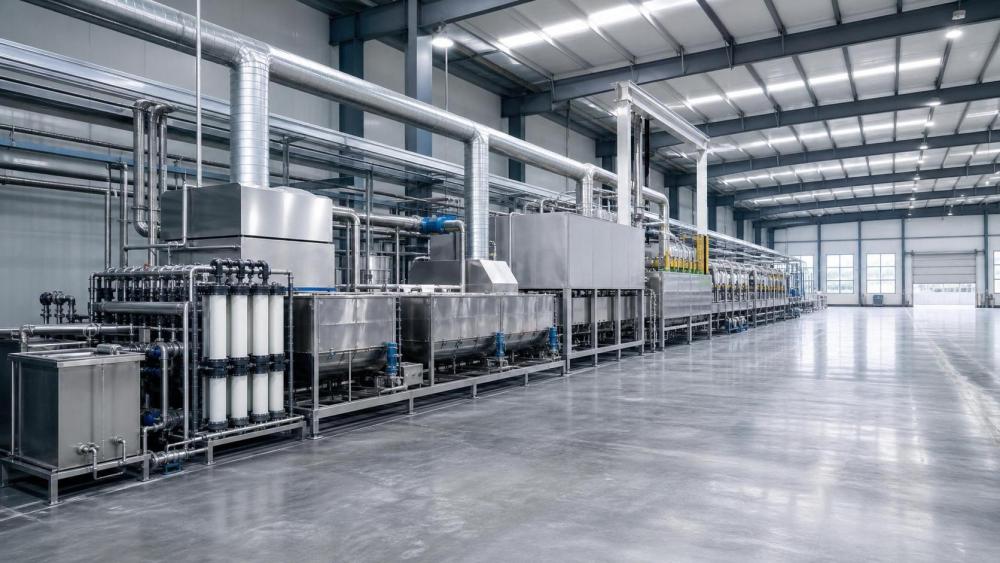
Surface treatment technology cost usually starts with equipment pricing, but that number is only the entry point.
In practice, approval decisions are shaped by installation scope, utility demand, production stability, and compliance obligations.
That is why two systems with similar throughput can produce very different total ownership profiles.
A plating line, pretreatment washer, blasting system, anodizing setup, or electrostatic coating process each carries different cost behavior.
The useful question is not only, “What does the line cost?”
It is also, “What must be funded, maintained, monitored, and replaced over the next five to ten years?”
Within advanced manufacturing, surface treatment sits beside cleaning, marking, batching, and vacuum support as a process-quality control point.
GIAS often frames these auxiliary systems as hidden performance drivers because they influence yield, traceability, appearance, and corrosion resistance.
So when reviewing surface treatment technology cost, it helps to treat the process as an operating asset, not a standalone purchase.
Which CapEx items usually make the biggest difference?
Capital expenditure often expands fastest outside the core machine frame.
This surprises teams that compare suppliers only on line price and nominal capacity.
The largest CapEx drivers commonly include pretreatment stages, tank materials, drying modules, conveyors, ventilation, wastewater handling, and controls integration.
Facility modifications can be equally important.
Floor loading, exhaust routing, chemical storage, fire protection, drainage, and power upgrades may add substantial cost before production even begins.
Automation level also changes the investment logic.
A manual or semi-automatic system may look cheaper upfront, yet require more labor, create more rework, and deliver less stable quality.
A more automated line may increase CapEx, but lower long-run variability and documentation risk.
A practical way to compare options is to separate fixed purchase items from site-dependent items.
If one proposal looks unusually low, the missing items are often found in utilities, environmental treatment, or software integration.
How much of surface treatment technology cost comes from energy and utilities?
Quite a lot, especially when the process uses heated baths, drying ovens, blowers, pumps, or air handling systems.
Energy use is not only a tariff issue.
It also reflects process design, insulation quality, line loading, recovery systems, and idle-time control.
For example, a system running below designed capacity may consume nearly the same baseline energy as a fuller line.
That makes cost per treated part much worse.
Water use and wastewater treatment should be reviewed in the same way.
Rinse stages, chemical replenishment, sludge disposal, and filter replacement can materially change operating cost.
More efficient process control may reduce chemistry losses, rework, and discharge treatment.
This is where broader auxiliary-system thinking becomes useful.
The same discipline used for vacuum stability, weighing accuracy, or ultrasonic cleaning precision also improves surface treatment economics.
- Ask for energy consumption at real production loads, not theoretical peak efficiency alone.
- Review startup, standby, and changeover consumption, which often erode expected savings.
- Check whether exhaust heat recovery or bath management controls are included.
- Model utility cost per acceptable part, not per machine hour.
That last metric gives a clearer financial view when reject rates vary between process options.
Where do maintenance and downtime usually hide?
Maintenance cost is rarely just spare parts.
It usually appears through bath contamination, nozzle clogging, conveyor wear, pump failure, sensor drift, corrosion, and unplanned cleaning shutdowns.
A lower-cost line can become expensive if maintenance intervals are short or difficult to execute.
The more useful maintenance question is whether the system is designed for predictable service windows.
Quick-access components, standardized consumables, remote diagnostics, and clear spare recommendations often reduce total disruption more than they reduce invoice price.
In actual operations, downtime can also trigger adjacent losses.
Upstream cleaning may continue, downstream coating may stop, and traceability schedules may break if product batches are delayed.
That ripple effect matters in export-facing production where documentation and delivery timing are tightly linked.
When reviewing surface treatment technology cost, it helps to request answers to a few practical questions.
- What consumables need replacement within the first year?
- Which components require shutdown to inspect or clean?
- How long is mean time to repair for pumps, burners, fans, or control modules?
- Can the supplier support local parts, remote troubleshooting, and preventive service planning?
These answers usually reveal whether a “cheaper” option remains cheaper after twelve months.
Is the cheapest process option ever the safest financial decision?
Sometimes, but not often.
The lowest initial price can make sense for simple parts, limited volumes, and low compliance exposure.
However, the decision becomes riskier when quality consistency affects corrosion claims, cosmetic acceptance, or regulated documentation.
Surface treatment technology cost should therefore be judged against failure cost.
If pretreatment is unstable, coatings may fail early.
If process monitoring is weak, audit preparation becomes harder.
If environmental handling is underspecified, future upgrades may be forced under tighter rules.
A more balanced comparison uses a short judgment table.
This comparison is often more valuable than a basic price ranking.
What should be confirmed before approving a surface treatment investment?
A sound approval case usually combines technical fit, operating assumptions, and risk visibility.
That means confirming not only process capability, but also the conditions required to sustain it.
In many factories, surface treatment does not operate alone.
It interacts with part cleaning, drying, coding, packaging, and quality verification.
So the strongest investment review asks how the line fits the wider process-support system.
That systems view is one reason intelligence platforms like GIAS are useful.
They connect surface treatment decisions with upstream cleanliness, downstream traceability, and operational consistency.
Before approval, it is worth validating five points:
- The process matches substrate, coating target, finish standard, and expected throughput.
- The CapEx budget includes site works, utilities, environmental handling, and integration.
- The operating model reflects energy, chemistry, water, labor, and downtime realities.
- The supplier can support maintenance, spare parts, and performance verification.
- The comparison method uses cost per acceptable part and not headline price alone.
If those points are documented clearly, surface treatment technology cost becomes easier to defend internally and easier to compare across proposals.
The next step is straightforward.
Build a side-by-side review using CapEx, utility demand, maintenance exposure, compliance needs, and expected yield stability.
That approach gives a more accurate view of return on capital than equipment price alone.