
Industrial Recipe Accuracy Cost: What Really Eats Profit
Industrial recipe accuracy cost rarely appears as a single line item. It hides inside scrap, rework, overfill, giveaway, downtime, and customer complaints.
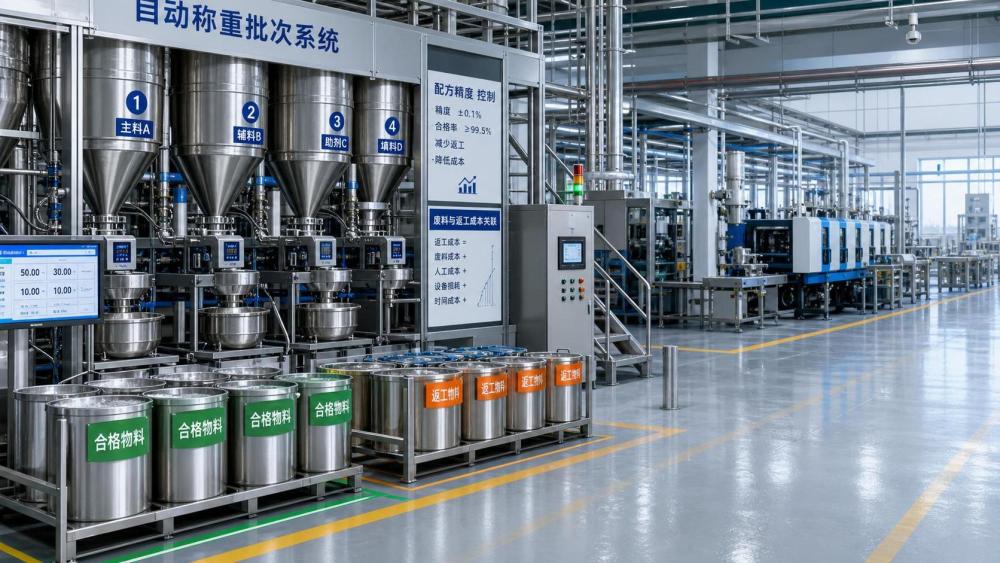
That makes it easy to underestimate. It also makes it dangerous for any factory trying to protect margin under tighter pricing pressure.
In actual operations, small dosing errors can create large financial consequences. A fraction of a percent off target may seem harmless, until it repeats across thousands of batches.
The industrial recipe accuracy cost becomes even more serious in regulated production. Food, pharmaceuticals, chemicals, and battery materials all depend on repeatable inputs and stable process control.
For purchasing and budget approval, the key issue is simple. Poor recipe accuracy does not stay in production. It flows directly into financial performance.
This is why weighing, batching, coding, vacuum stability, cleaning precision, and surface preparation deserve closer attention. They support the process, but they often decide the outcome.
Where Industrial Recipe Accuracy Cost Starts
Most losses begin before a defect is visible. The problem usually starts with ingredient feeding, material transfer, scale drift, operator adjustments, or poor calibration routines.
Once the recipe moves off target, several costs appear at the same time. Some are obvious. Others stay buried inside normal operating data.
- Raw material giveaway from overweight batches
- Scrap created by underweight or out-of-spec mixtures
- Rework labor and extra machine occupation
- Production interruptions during investigation and reset
- Compliance exposure when traceability records are incomplete
A useful way to view industrial recipe accuracy cost is through cost stacking. One dosing mistake does not create one loss. It often triggers five or six related losses.
From recent market shifts, this matters more than before. Material prices are less forgiving, customer audits are sharper, and quality failures travel faster across supply chains.
The Hidden Cost Drivers Behind Waste and Rework
Not every plant loses money in the same way. However, the most common cost drivers are surprisingly consistent across sectors.
1. Inaccurate weighing systems
A scale that drifts slowly can pass routine observation. Yet it keeps adding hidden industrial recipe accuracy cost through every shift and every formula.
2. Manual intervention during batching
Operators often correct short-term problems with manual additions. This helps output continue, but consistency usually suffers and recipe variance increases.
3. Weak material traceability
When a batch fails, poor coding or weak record linkage slows root-cause analysis. More material gets quarantined, and working capital remains tied up longer.
4. Environmental instability
Vacuum fluctuations, contamination, moisture, and temperature swings can change how materials behave. The recipe may be correct on paper, but wrong in process.
5. Poor upstream preparation
Surface residue, unclean vessels, or inconsistent pretreatment often create downstream instability. That raises industrial recipe accuracy cost even if the dosing system performs well.
Why This Matters in Financial Approval
Capital requests for weighing and batching upgrades can look modestly important. The issue is that standard ROI reviews often miss the full loss picture.
A better review asks how industrial recipe accuracy cost affects margin, inventory, compliance, and customer retention together. That gives a far more realistic investment case.
This also changes supplier evaluation. The lowest equipment price may not deliver the lowest industrial recipe accuracy cost over three to five years.
How to Evaluate Equipment Beyond Purchase Price
The smarter question is not, “What does the system cost?” It is, “What cost does the system remove?” That shift improves procurement quality immediately.
When reviewing industrial weighing, batching, coding, vacuum, or cleaning support systems, focus on measurable business outcomes.
- Check tolerance stability across real production speeds, not lab conditions.
- Review calibration frequency, maintenance demands, and sensor life.
- Confirm software can store recipe history and operator interventions.
- Ask how the system connects with traceability, coding, and ERP data.
- Measure likely savings in giveaway, scrap, downtime, and investigations.
A strong supplier should discuss process risk, not just machine features. That is often the clearest sign they understand industrial recipe accuracy cost in practical terms.
This is especially true in multi-line plants. One reliable platform can reduce training complexity, spare parts variation, and data fragmentation across sites.
A Broader View of Process-Support ROI
Industrial recipe accuracy cost does not belong only to the batching room. It is influenced by other auxiliary systems that stabilize the production environment.
For example, ultrasonic cleaning protects part surfaces before bonding or coating. Vacuum systems protect moisture-sensitive or contamination-sensitive production steps.
Laser marking and inkjet coding strengthen traceability when a quality event appears. Surface treatment and electrostatic coating improve consistency where adhesion and corrosion resistance matter.
These systems are easy to classify as secondary equipment. In reality, they reduce hidden cost exposure around yield, brand risk, and regulatory performance.
That broader view helps explain why industrial recipe accuracy cost should be assessed across the process chain, not inside one machine specification.
Practical Questions Before Budget Approval
Before approving a project, it helps to ask a short set of direct questions. These often reveal whether the current process is leaking value.
- How much material giveaway occurs per batch, shift, and year?
- What share of rework comes from mixing or dosing variation?
- How long does root-cause analysis take after a batch deviation?
- Which data are automatic, and which depend on manual records?
- What is the cost of one compliance hold or delayed shipment?
When those answers are quantified, industrial recipe accuracy cost becomes much easier to justify in financial terms. It moves from technical discussion to profit protection.
In many cases, the best decision is not a full line replacement. A targeted upgrade in sensors, controls, traceability, or process-support equipment may deliver faster returns.
Conclusion
Industrial recipe accuracy cost is a margin issue, not just an engineering issue. It shapes waste levels, rework rates, compliance confidence, and long-term supplier performance.
The most effective purchasing decisions look beyond upfront price. They connect equipment accuracy with batch reliability, traceability strength, and lower total process risk.
For manufacturers operating in precision-driven markets, that is where better approvals begin. The more clearly industrial recipe accuracy cost is measured, the easier it becomes to recover hidden profit.