
Why does industrial batching engineering price vary so much between projects?
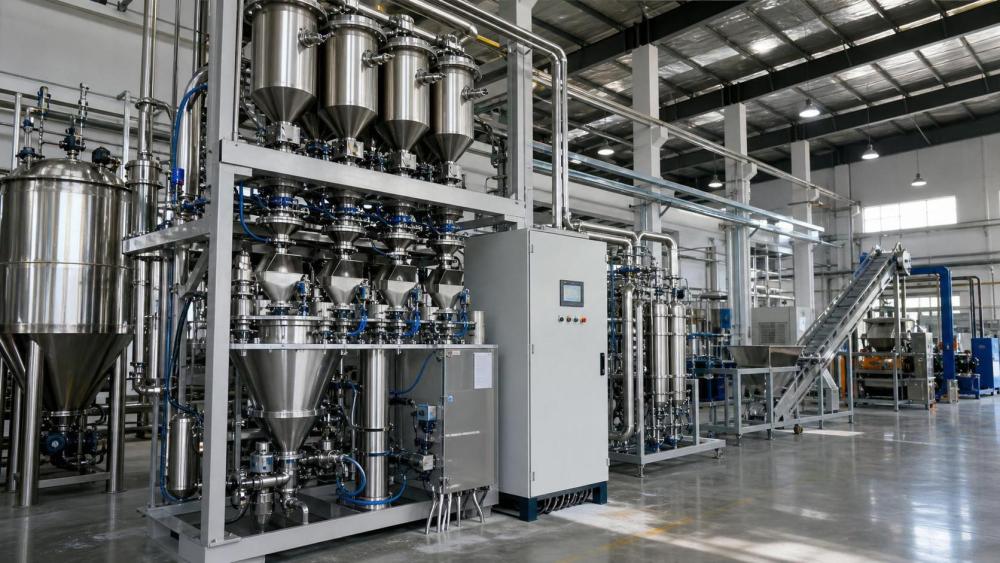
Industrial batching engineering price rarely depends on the dosing unit alone. The larger cost picture includes control logic, material flow, installation conditions, and validation requirements.
That is why two systems with similar throughput can show very different budgets. One may only meter powders into a simple mixer. Another may manage multiple liquids, traceability, alarms, and recipe security.
In practice, automated dosing systems sit in the same decision layer as other industrial auxiliary systems. Like vacuum support, coding equipment, or surface treatment lines, they influence consistency more than they attract attention.
For budgeting, the useful question is not only, “What is the machine price?” It is also, “What level of process control is being purchased, and what operational risk is being removed?”
This matters across food, chemicals, pharmaceuticals, and battery materials. When recipe accuracy directly affects yield, safety, and compliance, the industrial batching engineering price becomes a strategic cost, not just a line item.
What is usually included in the industrial batching engineering price?
A supplier quote may look straightforward, but scope can vary widely. Some quotes include only core equipment. Others include a near-complete project package.
A reliable comparison starts by separating equipment cost from engineering scope. That prevents low-price offers from appearing stronger than they really are.
This is where many approvals get delayed. A low initial number may exclude software integration, operator training, or performance verification. Those omissions return later as change orders.
GIAS often frames auxiliary equipment in this broader way. The real value is not the component itself, but how process-support systems stabilize quality, traceability, and repeatability across production.
Which technical factors push the price up fastest?
The fastest cost increases usually come from complexity, not size alone. A bigger tank is not always expensive. A harder process usually is.
Accuracy is one common driver. Tight dosing tolerance demands better load cells, more stable feeders, finer valve control, and longer calibration work.
Material behavior also changes the industrial batching engineering price. Free-flowing granules are easier to handle than sticky powders, abrasive minerals, or foaming liquids.
Then there is system architecture. A standalone skidded unit costs less than a line integrated with upstream conveying, barcode verification, ERP data transfer, and downstream packaging coordination.
- Multi-ingredient recipes increase valve counts, sensors, and control sequences.
- Hygienic or corrosion-resistant designs add material and fabrication cost.
- ATEX or hazardous-area requirements can reshape the full electrical design.
- Traceability functions add software layers, data retention, and user permissions.
More advanced facilities also expect compatibility with broader auxiliary infrastructure. A batching system may need to coordinate with vacuum transfer, coding systems, or cleaning processes that protect product integrity.
So, when reviewing price escalation, it helps to ask whether the added cost improves throughput, reduces loss, or lowers compliance exposure. If it does none of those, it may be unnecessary complexity.
How can you tell whether a quote is competitive or just incomplete?
A competitive quote is transparent. An incomplete quote is often vague in exactly the areas that create later cost.
One practical method is to compare offers by engineering depth, not just total amount. A detailed bid usually explains sequence control, performance assumptions, excluded works, and acceptance criteria.
The next table helps structure that review before approval moves forward.
When industrial batching engineering price looks unusually low, the hidden issue is often scope transfer. The supplier is not necessarily cheaper. The buyer is simply carrying more future responsibility.
A better comparison also reviews reference projects in related sectors. Food, chemical, and battery applications all use batching, but cleanliness, traceability, and dust risk change the economic picture.
Where do lifecycle costs outweigh the purchase price?
This is often the turning point in the discussion. A lower capital price can look attractive until operating losses become visible.
For example, poor dosing accuracy may create giveaway, off-spec batches, or rework. In high-value materials, that can exceed the initial equipment savings within months.
Maintenance access matters too. If cleaning takes too long, production hours disappear. If sensor replacement requires long stops, maintenance cost is no longer a secondary issue.
Energy is sometimes overlooked, especially when pneumatic conveying, vacuum transfer, or dust collection run continuously around the batching cell.
- Track recipe variance cost, not just machine uptime.
- Estimate cleaning labor per batch changeover.
- Review spare part lead times for critical weighing components.
- Check software support terms and update policies.
Platforms such as GIAS highlight this wider perspective across auxiliary systems. Whether the topic is laser traceability, ultrasonic cleaning, or dosing accuracy, the hidden economic impact usually appears in quality stability and operational continuity.
What is a sensible next step before approving budget?
The best next step is to turn the industrial batching engineering price into a structured review, not a simple quote comparison.
Start with the recipe, the materials, and the required accuracy. Then map site conditions, automation expectations, compliance demands, and ramp-up deadlines.
After that, request a scope matrix from each supplier. This makes hidden exclusions visible and shortens internal approval cycles.
If several industrial auxiliary systems will interact, review them together. Batching performance can depend on upstream cleaning, identification, transfer, or vacuum stability more than expected.
A well-judged industrial batching engineering price should support measurable outcomes: stable formulation, lower waste, easier audits, and predictable expansion. Those points make the budget easier to defend and the implementation easier to control.
Before moving forward, compare total scope, expected lifecycle cost, and process risk side by side. That usually reveals which proposal is truly economical, and which one only looks inexpensive at first glance.