
Why Validation Changes the Meaning of Automation in Pharma
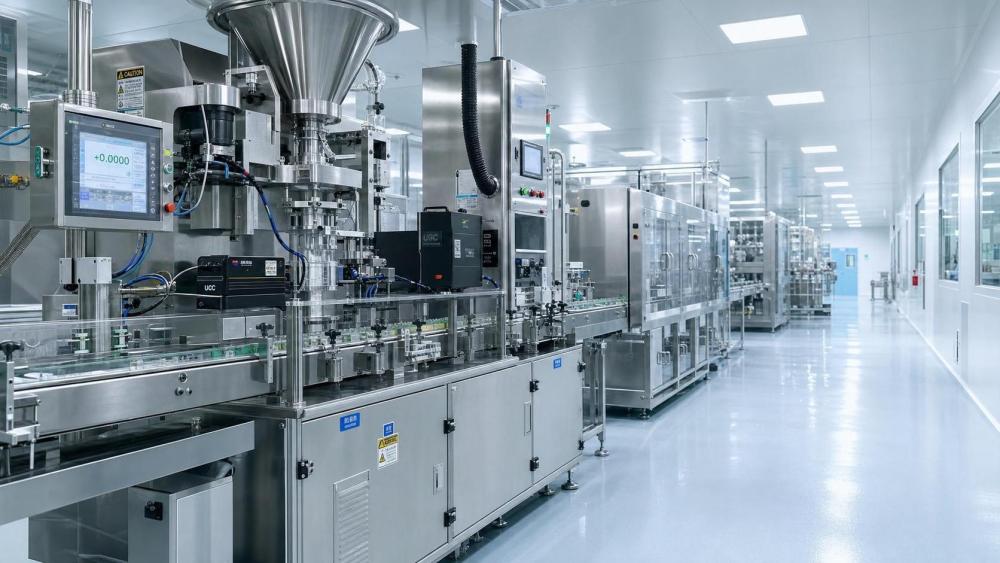
In pharmaceutical production, automation is rarely judged by speed alone.
Industrial automation systems pharmaceuticals facilities use must also preserve data integrity, batch consistency, and controlled traceability.
That is why validation matters.
It turns an automated function into documented evidence that a GMP workflow performs as intended under routine conditions.
This becomes especially important with auxiliary systems.
Weighing, coding, ultrasonic cleaning, vacuum support, and related process equipment often sit beside core production machines.
Yet failures there can still trigger deviations, rejected batches, labeling errors, or weak audit trails.
A practical reading of industrial automation systems pharmaceuticals projects shows that validation is never one-size-fits-all.
A coding line, a cleanroom washer, and a freeze-drying vacuum loop do not carry the same risk.
They need different evidence, different alarms, and different acceptance logic.
That application-driven view also aligns with how GIAS approaches industrial auxiliary systems.
The real question is not whether a subsystem is advanced.
The question is whether microscopic process control can be proven, repeated, and defended across GMP workflows.
Actual Validation Priorities Shift with the Workflow
Different pharmaceutical operations create different validation burdens because the failure modes are different.
An automated weigh-and-dispense station is sensitive to recipe accuracy and electronic records.
A laser marking or inkjet coding cell is more exposed to serialization errors and unreadable identification.
An ultrasonic cleaning process has to prove contaminant removal, repeatability, and cleaning boundary control.
Vacuum systems supporting freeze-drying or packaging must show stable process conditions, not just pump capacity on paper.
This is where industrial automation systems pharmaceuticals validation becomes more than protocol writing.
It becomes a decision about what evidence is meaningful in that exact production context.
In practice, more mature teams first map product-contact risk, record criticality, and operator interaction.
Only then do they define IQ, OQ, and PQ depth.
That order prevents overtesting low-risk functions while missing control gaps in high-impact steps.
Where the judgment criteria usually diverge
That difference is easy to miss when industrial automation systems pharmaceuticals selections are copied from another plant.
Weighing and Batching Demand Stronger Electronic Discipline
Automated weighing often looks straightforward until formulation variability enters the picture.
Small tolerances, active ingredient potency, and staged additions can make a minor control gap operationally serious.
For industrial automation systems pharmaceuticals environments using in dispensing, the core issue is not only scale precision.
It is whether the full sequence remains locked to approved instructions, user permissions, and complete batch records.
A common mistake is validating the instrument but not the workflow around it.
The result may be accurate weight values with weak control over material identity, hold steps, or override events.
In actual applications, better validation packages challenge the system with interrupted sessions, barcode mismatches, and out-of-tolerance conditions.
They also verify how data moves into manufacturing execution or quality systems.
That is often where hidden GMP risk appears.
What deserves attention before approval
- Calibration status must remain visible and linked to release logic.
- Recipe revisions should be version-controlled and impossible to load unofficially.
- Manual interventions need reason capture, time stamps, and reviewability.
- Network loss should not create silent data gaps or duplicate entries.
Coding, Marking, and Packaging Need Traceability You Can Audit
Another high-frequency area is product identification.
Here, industrial automation systems pharmaceuticals lines depend on are tightly linked to GMP and brand protection.
Laser marking and inkjet coding may look secondary beside filling or blistering equipment.
In reality, one unreadable code can break downstream aggregation, recall response, or release confidence.
Validation in this setting should test more than print quality.
It should prove synchronized data transfer, line clearance logic, reject station response, and code verification behavior at operating speed.
More demanding environments also need evidence that cleaning agents, abrasion, or storage conditions will not degrade code permanence.
This is one reason GIAS gives sustained attention to coding and marking technologies.
Traceability performance is usually shaped by small process-support details rather than headline machine specifications.
Cleaning and Vacuum Workflows Fail Differently from Packaging Systems
Cleaning and vacuum applications introduce another layer of validation logic.
Ultrasonic cleaning systems must show that validated cycles remove defined residues from actual component geometries.
A successful empty-basket test says very little about complex parts, blind holes, or tightly nested fixtures.
For industrial automation systems pharmaceuticals operations use for cleaning, load pattern and bath condition often matter as much as power settings.
Vacuum-supported workflows create a similar trap.
A pump may meet nameplate performance yet still behave poorly during moisture load changes, leak events, or extended cycles.
In freeze-drying, degassing, or controlled packaging, validation needs to capture dynamic conditions.
Steady-state acceptance alone is not enough.
That is where auxiliary equipment intelligence becomes useful.
The better decisions usually come from comparing contamination risks, pressure stability, maintenance intervals, and process interaction together.
Misjudgments Usually Start with the Wrong Validation Scope
Many avoidable problems come from treating similar applications as identical.
A legacy oral solid dose line and a high-control sterile support process do not justify the same validation shortcuts.
Industrial automation systems pharmaceuticals projects often underperform because scope is defined around hardware, not workflow risk.
Several patterns appear repeatedly.
- Focusing on supplier specifications while ignoring site utilities, room conditions, and cleaning routines.
- Testing normal operation only, without challenge conditions or operator deviations.
- Approving software functions without verifying role permissions and audit trail review steps.
- Looking at purchase cost while overlooking spare parts, recalibration, and downtime exposure.
These are not paperwork issues.
They change whether the process remains in control after handover.
A Practical Way to Match Validation Depth to GMP Risk
A more reliable approach starts by separating critical process effect from supporting convenience.
Then map each automation function to product quality, traceability, and record integrity.
For industrial automation systems pharmaceuticals teams assess, this usually creates a clearer validation path.
This framework also helps compare technologies covered across GIAS, from weighing and coding to vacuum and surface-sensitive support processes.
Before Final Approval, Confirm the Conditions Around the System
The strongest validation package still weakens if surrounding conditions are vague.
It is worth confirming utility quality, environmental limits, cleaning chemistry, operator access, maintenance windows, and software change control.
Those factors decide whether industrial automation systems pharmaceuticals sites install will remain compliant after launch.
A useful next step is to review each GMP workflow by application, not by equipment category alone.
List the process-support systems involved, define the risk each one can create, and match validation evidence to that risk.
Then compare implementation difficulty, maintenance burden, and data-handling demands before locking the final specification.
That sequence leads to better validation decisions than relying on generic automation claims.