
How to Evaluate a Lithium Battery Production Support Supplier for Capacity, Quality, and Ramp-Up Speed
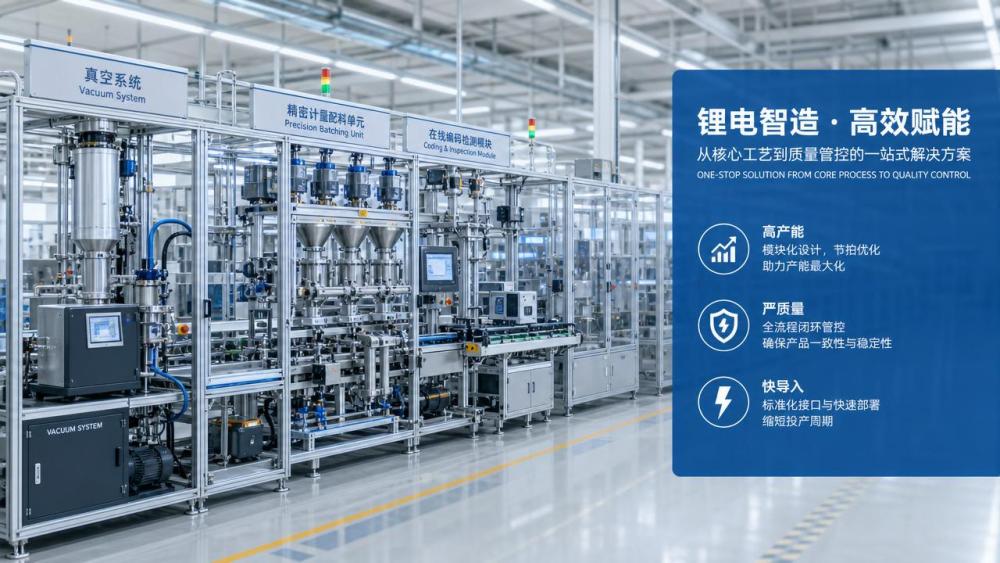
Choosing a lithium battery production support supplier is a strategic manufacturing decision.
A weak supplier can slow expansion, increase scrap, and create unstable output.
A strong supplier helps maintain throughput, traceability, and process consistency.
In lithium battery manufacturing, support systems often sit behind the main line.
Yet they directly influence cleanliness, dosing accuracy, coding reliability, vacuum stability, and coating performance.
That is why evaluating a lithium battery production support supplier requires more than comparing quotations.
You need to test real production capacity, quality control discipline, and ramp-up support.
The best decision usually comes from a structured supplier review.
Why the Right Supplier Matters in Battery Expansion
Battery projects move fast, but failure costs are unusually high.
Small process deviations can affect yield, safety, and downstream qualification.
This makes the lithium battery production support supplier part of operational risk management.
For example, poor vacuum performance can disrupt drying and degassing stability.
Weak batching accuracy can shift slurry quality and create variation across lots.
Inconsistent marking or coding can damage traceability during audits or recalls.
So, the supplier must support production goals, not just ship equipment on time.
From a procurement view, that means assessing long-term delivery performance and technical maturity together.
Start with Capacity, Not Catalog Claims
Many suppliers look capable on paper.
The real question is whether they can support your production scale without delays.
Ask how many systems they deliver each month by product type.
Check whether core parts are made in-house or sourced from multiple outside vendors.
A dependable lithium battery production support supplier should explain bottlenecks clearly.
That includes machining, assembly, software integration, testing, and spare parts readiness.
Key capacity checks
- Monthly output by equipment category
- Lead time under normal and peak demand
- Capacity reserve for urgent project changes
- Supplier dependence on single-source components
- Installation manpower across multiple sites
In practice, factory expansion rarely happens in a perfectly stable schedule.
A qualified lithium battery production support supplier should handle phased delivery and sudden volume changes.
Verify Quality Systems Behind the Equipment
Capacity alone is not enough.
Quality assurance determines whether systems perform consistently after installation.
A good lithium battery production support supplier should provide more than certificates.
You want to see process discipline, inspection records, calibration control, and documented acceptance standards.
This is especially important for weighing, batching, vacuum, marking, and surface treatment systems.
Each of these affects output stability at a very practical level.
What quality evidence should be requested
- Incoming inspection standards for critical parts
- Factory acceptance test records and sample reports
- Calibration routines for sensors, scales, and measuring devices
- Software validation and change-control procedures
- Corrective action history for common failures
Recent market shifts make this even more important.
As battery lines scale faster, repeatability matters more than one-time demonstration results.
That is a useful filter when comparing suppliers with similar pricing.
Assess Ramp-Up Speed as a Real Business Capability
Ramp-up speed is often underestimated during supplier selection.
However, delayed commissioning can push back customer qualification and revenue plans.
A lithium battery production support supplier must support startup under real factory conditions.
That means installation planning, process tuning, operator training, and fast fault response.
The more complex the line, the more valuable this becomes.
Questions that reveal ramp-up strength
- How long does installation usually take by system type?
- How many engineers are available for startup support?
- Can the supplier support night shifts or compressed launch schedules?
- What remote diagnostic tools are already in place?
- How quickly are replacement parts delivered during startup?
A strong lithium battery production support supplier does not wait for problems to appear.
They prepare commissioning checklists, escalation paths, and decision owners in advance.
That preparation shortens the path from equipment arrival to stable output.
Look Beyond Equipment to Process Understanding
The best suppliers understand the battery process, not only their own machine.
This is a clear advantage when solving line-level issues.
For instance, an ultrasonic cleaning supplier should understand contamination sensitivity upstream and downstream.
A weighing and batching supplier should understand how accuracy affects slurry consistency.
A vacuum systems supplier should understand moisture control, drying efficiency, and leak risk.
This broader process view often separates a vendor from a real lithium battery production support supplier.
Useful proof points
- Battery-related reference projects
- Case studies with measurable yield or uptime improvement
- Ability to discuss failure modes in your application
- Cross-functional support from engineering and service teams
This also improves communication during expansion.
Suppliers with process context usually identify risks faster and propose more practical fixes.
Use a Practical Evaluation Matrix
A decision matrix keeps supplier selection disciplined.
It also helps align procurement, engineering, quality, and operations.
When reviewing a lithium battery production support supplier, weighted scoring works well.
This structure makes supplier discussions more objective.
It also highlights trade-offs before they become expensive surprises.
Common Red Flags During Supplier Evaluation
Some warning signs appear early if you ask the right questions.
These are often stronger signals than polished presentations.
- Lead times change repeatedly without a clear reason
- Acceptance criteria are vague or undocumented
- Service coverage depends on one engineer only
- Battery references are generic and not verifiable
- Spare parts planning is reactive instead of planned
- Software changes are made without formal version control
If several of these appear together, slow down the decision.
The cheaper option may become the more expensive one after startup.
Final Selection Should Focus on Execution Confidence
A lithium battery production support supplier should be evaluated as an execution partner.
Capacity shows whether they can deliver.
Quality systems show whether they can deliver consistently.
Ramp-up support shows whether they can deliver on your timeline.
That combination matters far more than price alone.
In real projects, stable output and faster qualification create the strongest return.
Use site audits, reference checks, test data, and a weighted scorecard.
That approach helps identify the lithium battery production support supplier most ready for growth.
When the next expansion phase begins, that preparation turns supplier selection into production confidence.