
It usually starts with a line layout meeting that seems straightforward. The core machines are defined, floor space is roughly blocked out, and everyone wants a first-pass budget. Then a difficult question lands on the table: have you included the cleaning units, coding stations, vacuum infrastructure, weighing controls, dust extraction, curing support, surface preparation, and all the “small” systems that keep the line stable? In many projects, these items are added late, costed separately, or treated as utility details rather than production assets.
That is where budget drift often begins. A new production line can look affordable when only the primary equipment is counted, but the real number changes once auxiliary needs are mapped process by process. If you are trying to estimate industrial auxiliary systems cost, the challenge is not just collecting supplier quotes. The harder part is deciding which support systems are actually required, what level of performance they need, and which hidden interfaces will increase installation and operating costs after procurement has already started.
A common mistake is to group all auxiliary equipment into one loose budget line and move on. That approach feels efficient in early planning, but it creates problems later because auxiliary systems do not behave like generic accessories. An ultrasonic cleaning unit affects contamination control before assembly or coating. A laser marker or inkjet coder affects traceability, line speed synchronization, and consumable planning. Industrial weighing and batching influence recipe accuracy and rework risk. Vacuum pumps and vacuum systems shape packaging integrity, coating performance, drying stability, and process consistency. Surface treatment and electrostatic coating systems affect adhesion, finish quality, environmental controls, and downstream rejection rates.
When those functions are not broken down properly, the estimate becomes misleading in two directions at once. It may be too low because it ignores integration, exhaust, guarding, conveyors, software links, fixtures, spare parts, and commissioning. Or it may be too high because the specification is vague and every supplier prices in extra margin for uncertainty. Either way, the budget loses its value as a decision tool.
Start from the production sequence, not the equipment catalog
Many teams begin cost estimation by asking vendors for prices on named machine types. That is understandable, but it often locks the project into incomplete comparisons. A better starting point is the production sequence itself. Walk through the line from incoming material to finished output and note every point where the product must be cleaned, identified, weighed, dried, evacuated, coated, inspected, or protected. Those moments define the need for auxiliary systems more accurately than a shopping list does.
For example, if a component must be free of micron-level residue before welding, bonding, coating, or packaging, cleaning is not optional support equipment. It is a process requirement. If every unit needs permanent identification for traceability or anti-counterfeiting, marking and coding are not interchangeable afterthoughts. If the product recipe depends on precise dosing, batching belongs in the production logic itself rather than in a generic utilities bucket.
This process-first view helps because it forces three practical questions early: where is the auxiliary function needed, what happens if it is under-specified, and what systems around it must also be included? Once those are answered, cost categories become more realistic.
Where estimates usually go wrong
People rarely miss auxiliary equipment because they do not know it exists. More often, they miss cost because they estimate only the main unit and forget the surrounding conditions that allow it to work as intended.
Take vacuum as an example. A pump price alone does not represent the cost of a usable vacuum system. Pipework, receivers, valves, filtration, control logic, backup strategy, leak testing, noise treatment, and maintenance access may all affect the final investment. The same pattern appears in coating and surface treatment. The spray or treatment hardware may be visible in the line design, but pretreatment stages, curing support, recovery, ventilation, waste handling, and operator protection can shift the total sharply.
Marking and coding systems create another kind of error. Teams sometimes compare only machine purchase price, even though substrate type, code permanence, speed matching, vision verification, positioning, and data integration can change the specification. A lower upfront quote may require more fixtures, more manual intervention, or more frequent consumable replacement.
Cleaning systems are also easy to underestimate because the conversation stays focused on tank size or power rating. In reality, basket design, handling method, drying stage, chemical compatibility, water quality, filtration, drainage, and contamination limits often determine the useful cost range.
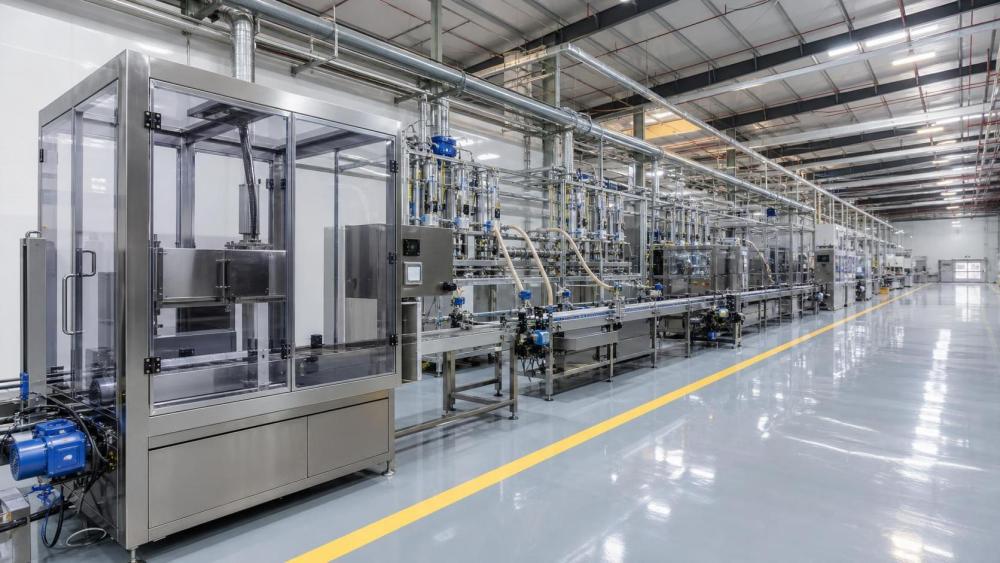
A more reliable way to build the estimate
When the line is still in planning, it helps to build the estimate in layers rather than trying to force one final number too early.
Layer 1: Functional need
List each auxiliary function tied to a process step. Avoid broad labels like “coding system” or “vacuum support” if they hide different operating requirements. Instead, define the purpose in plain engineering language: remove fine contamination before assembly, create permanent serial marking, maintain batch accuracy, support package evacuation, prepare a surface for coating adhesion, and so on.
Layer 2: Performance boundary
Set the minimum acceptable process condition. This does not require final design detail, but it does require discipline. For cleaning, that might mean contamination sensitivity and throughput method. For marking, it might mean permanence, readability, and substrate compatibility. For weighing and batching, it may be tolerance, recipe change frequency, and data recording needs. For vacuum, it could be required pressure stability and cycle demand. For coating or surface treatment, it often includes finish expectation, material compatibility, and environmental controls.
Layer 3: Integration scope
This is where many budgets improve. Ask what the auxiliary system must connect to physically and digitally. Does it need conveyors, robotic handling, enclosures, extraction, water treatment, compressed air conditioning, data exchange with MES or PLC logic, or separate operator stations? Does it interrupt the line if maintenance is needed? Is there a bypass mode? These questions do not just affect engineering convenience; they affect procurement cost directly.
Layer 4: Operating burden
Not every cost sits in the purchase order. Some systems bring recurring loads through consumables, cleaning media, nozzles, filters, chemicals, calibration routines, vacuum oil management, wear components, or more operator time. If you only compare capital price, the estimate may favor the wrong option for the actual production model.
Layer 5: Risk allowance
Early estimates should include uncertainty, but not as a random percentage applied to everything. It is more useful to place allowance where information is weakest: product sensitivity, contamination threshold, traceability requirements, line speed changes, or local environmental constraints. That makes the estimate easier to revise later without destabilizing the whole budget.
Choosing between simpler and more integrated options
Not every line needs the most advanced version of every auxiliary system. The decision becomes difficult when teams are caught between future-proofing and overspending. A practical way to think about it is to compare simplicity against process exposure.
If the line has low product variation, modest throughput, and limited compliance pressure, a simpler standalone auxiliary setup may be enough. This can apply to basic coding, small-batch weighing, or localized cleaning steps where manual loading and simple controls are acceptable.
But when the line depends on traceability, repeatable cleanliness, automated recipe control, vacuum stability across multiple stations, or finish consistency under tight quality expectations, fragmented equipment choices often create more cost later. In those cases, a more integrated approach may be easier to defend even if the initial quote is higher, because the estimate is less likely to omit necessary interfaces.
The key is not to treat integration as a luxury feature. Sometimes it is just the honest recognition of how the line has to run. If a system must communicate with other equipment, maintain consistent parameters, or support audit-ready process records, then those needs belong in the estimate from the beginning.
Questions worth asking before requesting quotes
Supplier pricing gets better when your internal questions are better. Before sending RFQs, clarify the process exposure around each auxiliary function.
Ask whether the product is sensitive to residue, static, moisture, marking contrast, batch deviation, vacuum fluctuation, or coating thickness variation. Ask whether the system will run continuously or in intermittent cycles. Ask who will load, inspect, clean, calibrate, and maintain it. Ask whether expansion is likely. Ask what failure mode is most expensive: contamination, unreadable code, wrong recipe, package leak, poor adhesion, or surface defect.
These are not academic details. They shape the specification level that suppliers will price against. When they are missing, quotes become hard to compare because each vendor is silently filling in the blanks differently.
Using external information without turning it into guesswork
During the research phase, many teams read technical portals, application notes, and equipment comparisons to understand available process routes. That is useful, especially in areas like ultrasonic cleaning, laser marking, industrial batching, vacuum systems, and electrostatic coating where the same product family may support very different operating conditions. The value of this research is not that it gives you a ready-made budget number. Its value is that it helps narrow the right specification questions before procurement starts.
If you use outside information well, you begin to separate process essentials from optional features. You also become better at spotting when a quote excludes support items that should have been included. This is especially important in auxiliary systems because the technical boundary between machine scope and plant scope is often blurry.
When the budget still feels uncertain
Sometimes the estimate remains unstable even after a structured review. Usually that happens for one of three reasons: the product itself is still changing, the line speed target is not fixed, or the quality requirement is stated broadly but not translated into measurable process conditions.
When that happens, resist the urge to force a false precision into the budget. It is better to develop a bounded estimate with clear assumptions than a single number that hides major unknowns. Separate confirmed needs from provisional ones. Note where the auxiliary function is mandatory and where the technology choice is still open. If needed, classify equipment into immediate, likely, and conditional scope. That keeps the project moving without pretending that uncertainty has disappeared.
It also helps to revisit the estimate whenever one core assumption changes. A shift in material, product geometry, line takt time, packaging format, or finish expectation can ripple directly into cleaning, coding, vacuum, dosing, and coating requirements. The auxiliary budget should not be static while the process definition is still moving.
Getting to a number you can defend
A defensible estimate for industrial auxiliary systems cost is usually not the one with the most detail on day one. It is the one that shows clear reasoning. It links each support system to a process need, identifies the operating boundary, includes major integration elements, and distinguishes between known scope and assumptions.
That level of discipline matters because auxiliary systems sit in the places where production lines often succeed or fail quietly. They influence cleanliness, identification, batching accuracy, vacuum stability, coating quality, and the consistency that customers or auditors eventually notice. If you budget them as leftovers, surprises are likely. If you cost them as process-critical elements, procurement decisions become easier to compare and much easier to explain later.
For most new lines, the best next step is simple: map the process, mark every supporting function, and estimate each one as part of line performance rather than background infrastructure. That shift alone usually makes the budget more realistic, even before the first formal quote arrives.