
In automated manufacturing, even short interruptions can trigger missed deadlines, quality deviations, and rising operating costs. That is why maintenance free design for production lines is becoming a practical priority for project managers and engineering leaders. By reducing service frequency, simplifying system integration, and improving long-term reliability, this approach helps manufacturers lower downtime risks while supporting more stable, efficient, and scalable production performance.
The idea sounds straightforward, but in real projects it is often misunderstood. Maintenance-free does not mean a line will never need attention. It means critical components and auxiliary systems are designed to avoid routine adjustment, frequent lubrication, contamination-related intervention, or wear-prone manual servicing under normal operating conditions. For the people responsible for launch timing, ramp-up stability, and output targets, that distinction matters.
Downtime rarely starts with the main machine alone
When a production line stops, the first assumption often points to the central machine: the press, the robot cell, the filling line, the packaging unit. Yet many unplanned stops come from supporting equipment that receives less design attention during early project phases. A coding unit that needs constant cleaning, a vacuum system with unstable seals, a weighing module that drifts and requires repeated recalibration, or a surface treatment stage that builds residue faster than expected can all slow an automated line long before a major mechanical failure appears.
This is one reason industrial auxiliary systems deserve more attention in line design reviews. Platforms such as Global General Industrial Auxiliary Systems (GIAS) focus specifically on these process-support technologies across advanced manufacturing, from ultrasonic cleaning and welding to laser marking, batching, vacuum systems, and electrostatic coating. That perspective is useful because downtime risk is often distributed across the line, not concentrated in one machine.
A project can look robust on paper and still suffer from weak maintenance assumptions. If a line depends on frequent consumable replacement, operator adjustments, hard-to-access filters, or contamination-sensitive subsystems, the actual uptime profile may diverge sharply from the original plan.
What maintenance-free design really changes
For engineering teams, maintenance-free design is less about a marketing label and more about removing predictable causes of interruption. In practice, that usually shows up in a few ways:
- Fewer wear points that require scheduled manual service
- Sealed or self-contained components that reduce contamination risk
- Simpler assemblies with fewer alignment-sensitive parts
- Materials and surface choices that resist buildup, corrosion, or chemical attack
- Control architectures that detect deviation early, before a stop occurs
The benefit is not only reduced labor. It also affects scheduling discipline. A line that demands frequent attention creates hidden instability: maintenance windows get deferred, minor issues accumulate, and teams end up troubleshooting during production rather than between shifts. Maintenance-free design reduces that friction.
This is particularly relevant in high-mix or compliance-sensitive industries, where traceability, cleaning quality, dosing accuracy, or coating consistency are closely tied to final product acceptance. Auxiliary equipment may not define the factory layout, but it often defines whether output stays within spec.
Where project managers should look first
Not every subsystem offers the same return from maintenance-free thinking. The best candidates are usually the ones that combine high cycle frequency, difficult access, contamination exposure, or quality-critical function.
Take ultrasonic cleaning. In precision manufacturing, cleaning performance can affect downstream bonding, welding, coating, or inspection. If the system design allows residues to accumulate quickly or requires frequent manual intervention to maintain bath condition and process consistency, the line may not stop immediately, but reject rates can creep up. A better design focus is not just tank capacity or power rating, but drainability, access for validation, material compatibility, and how the unit behaves over long operating periods.
The same logic applies to laser marking and inkjet coding. These systems support traceability and anti-counterfeiting, but they can also become micro-stoppage generators if optics, nozzles, ventilation paths, or substrate handling are not chosen well. A maintenance-light design in this area tends to rely on stable mounting, controlled contamination, and process settings that do not sit at the edge of failure.
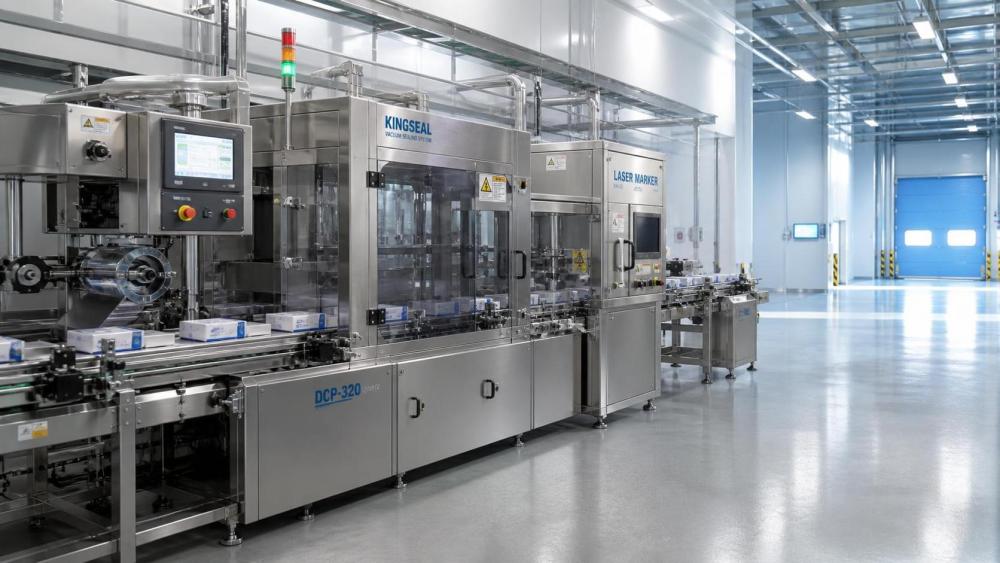
Vacuum systems are another common blind spot. In packaging, semiconductor processing, coating, freeze-drying, or degassing, vacuum instability may not begin as a dramatic breakdown. It may start as slower cycle time, incomplete evacuation, seal degradation, or rising heat load. Project teams sometimes focus on nominal pump capacity and underweight service access, leak path control, filtration strategy, and actual duty cycle. Those details determine whether the system remains stable without frequent intervention.
For weighing and batching, maintenance-free design often has more to do with environmental isolation and mechanical stability than with the scale itself. Vibration, dust, humidity, or product buildup can create recurring adjustment needs. A design that protects metering accuracy from the surrounding process can reduce both stoppages and recipe deviations.
Why simpler service often beats higher specification
One of the more expensive mistakes in automated line projects is assuming that the highest-performance component automatically carries the lowest risk. In reality, a slightly less aggressive specification with better contamination tolerance, fewer manual touchpoints, and easier replacement logic may support uptime far better.
That tradeoff is common in surface treatment and electrostatic coating lines. A technically advanced process setup may promise excellent finish quality, but if it depends on frequent nozzle cleaning, difficult powder recovery access, or delicate parameter tuning, the downtime burden can outweigh the theoretical gain. The stronger design is often the one that holds acceptable process consistency over time with fewer interventions.
Project managers usually do not need every subsystem to be maintenance-free in the strictest sense. They need the line to remain predictable. Predictability matters more than impressive brochure language. If a supplier cannot explain what routine intervention has been removed, what still requires service, and how access is handled under actual operating conditions, the maintenance claim should be examined carefully.
Questions worth asking before equipment approval
A good review process usually gets more value from practical questions than from generic reliability claims. Before locking in an automated line design, it helps to ask:
- Which components still require scheduled intervention, and at what interval under expected duty conditions?
- What failure modes are most likely to cause a line stop versus a quality deviation?
- Can service tasks be completed without disturbing alignment, calibration, or validated process settings?
- How sensitive is the subsystem to dust, chemical residue, humidity, vibration, or operator variability?
- Are critical spares standardized, or will replacement depend on long lead-time parts?
- What process data is available to warn of drift before the line goes down?
These are not procurement formalities. They shape commissioning risk, staffing requirements, spare-part planning, and the true cost of ownership. They also help separate genuine maintenance-free design from equipment that simply shifts service work downstream.
Integration matters as much as component design
Even well-designed equipment can become maintenance-heavy after poor integration. Hose routing that traps residue, cable layouts that complicate access, cramped installation around pumps or dosing modules, and control interfaces that hide alarm history all turn manageable systems into recurring downtime risks.
That is where cross-process understanding becomes valuable. GIAS is useful in this context not because it pushes one equipment category, but because it organizes knowledge across the auxiliary systems that influence line stability: cleaning precision, identification, batching accuracy, vacuum reliability, coating performance, and compliance-related process control. For project leaders comparing options, that broader view often reveals dependencies that a single-machine discussion misses.
A line may, for example, meet its target cycle time in factory acceptance testing and still struggle after installation because the local environment changes the maintenance profile. Cooling water quality, airborne contamination, local utility stability, shift skill levels, and sanitation requirements can all alter how “maintenance-free” a design really is. This usually needs to be judged against the site, not only the equipment brochure.
What a realistic decision framework looks like
For most projects, the right decision is not to chase zero maintenance. It is to reduce avoidable intervention on the functions that are hardest to stop, hardest to access, or most likely to create quality escapes.
A useful way to evaluate maintenance free design for production lines is to score each auxiliary subsystem against four practical criteria: impact on line stoppage, impact on product quality, frequency of required service, and difficulty of recovery after intervention. Systems that score high across those factors deserve closer design scrutiny even if they seem secondary in the overall layout.
That approach tends to produce better decisions than focusing only on purchase price or nominal machine specification. It also helps when comparing suppliers that use similar language but very different engineering assumptions.
In the end, maintenance-free design is not about eliminating the maintenance team. It is about designing automated production lines so that routine service does not quietly become a production risk. For project managers, that means looking past the headline machine, challenging vague reliability claims, and testing whether auxiliary systems can hold process stability with minimal intervention. If those answers are still unclear, the next step is usually not a faster purchasing decision, but a deeper review of operating conditions, access constraints, spare strategy, and validation requirements before the line is finalized.