
Food safety problems often begin as control problems. A sauce that drifts a few degrees during holding, a dry blend that receives the wrong minor ingredient, or a package code that cannot be read after sealing may still look acceptable when it leaves the line. The difficulty appears later, when texture changes across batches, shelf-life behavior becomes uncertain, or a traceability review exposes missing production records. In industrial process control food processing environments, consistency depends on keeping each critical variable inside a defined operating window and proving that it stayed there.
That control window is rarely limited to one machine. It usually extends across receiving, storage, weighing, mixing, thermal treatment, transfer, filling, packaging, and clean-down. A stable process does not come from one final inspection result. It comes from linked measurements: load cells confirming actual ingredient mass, temperature probes showing product core response rather than jacket temperature alone, vacuum sensors indicating seal conditions, and coding systems preserving batch identity through handling and distribution. When these measurements are connected to alarms, interlocks, and records, variation becomes visible before it becomes product loss.
Where inconsistency enters the line
In many food plants, the largest deviations come from ordinary transitions rather than dramatic equipment failure. Raw materials arrive with natural moisture differences, bulk powders bridge in hoppers, pumps shear sensitive emulsions, and heat exchangers behave differently after partial fouling. Even utilities contribute. Compressed air with oil or water carryover can affect actuated valves and packaging equipment. Steam pressure fluctuation can shift cooking response. Cooling water temperature may alter product setting or crystallization.
Industrial process control reduces these shifts by treating the line as a sequence of measured conditions instead of a sequence of manual assumptions. If ingredient addition is confirmed by actual weight rather than scoop count or timer-based feed duration, recipe drift becomes easier to stop. If transfer lines are instrumented to confirm flow, pressure, and valve position, an operator does not need to infer whether the product reached the intended vessel. If the system records hold time only after the target product temperature is achieved, not merely when a cooker cycle starts, thermal exposure is represented more accurately.
Common misjudgments often come from reading the wrong variable. Jacket temperature is sometimes mistaken for product temperature. Pump speed is treated as proof of flow, even when a line is partially blocked. A stable filler cycle is assumed to mean stable net content, although viscosity or head pressure has changed. Process control works when measurements are chosen to reflect the product condition that actually matters to safety, composition, or release quality.
Batching accuracy affects more than recipe cost
Ingredient control is one of the clearest points where process discipline influences both safety and consistency. In dry mix, beverage, dairy, bakery, prepared meal, and seasoning lines, small ingredients may control pH, water activity, allergen status, curing behavior, preservation, or flavor balance. An overfeed or underfeed is not simply a formulation issue. It can affect microbial stability, declaration accuracy, rework handling, and line clearance decisions.
Weighing and batching systems should therefore be evaluated beyond nominal scale capacity. Resolution, vibration resistance, feed rate control, hopper geometry, and cleanability all matter. Fast coarse feed with poorly tuned dribble feed can overshoot repeatedly. Powder that sticks to vessel walls creates hidden inventory and delayed release into the next batch. If the equipment is installed near forklifts, mezzanines, or conveyors that transmit vibration, apparent weight can fluctuate enough to trigger false corrections. Load cells also need the correct mounting conditions; pipe strain, misaligned supports, or cable tension can distort readings even when the instrument itself is functioning.
For liquid additions, mass flow measurement may be preferable where density or temperature changes make volumetric assumptions unreliable. For minor ingredients, enclosed transfer and barcode-linked dispensing can reduce mix-up risk when containers are visually similar. In facilities managing allergen segregation, recipe authorization should be tied to both line status and material identity, so an approved batch cannot start with the wrong tote or hand-add container present at the station.
Records from these systems become especially valuable during deviation review. If a batch is questioned, a time-stamped ingredient curve can show whether the issue came from a late addition, an interrupted feed, or a correction that was applied after mixing had already progressed too far.
Temperature control must follow product behavior, not panel settings
Thermal processes are often described by setpoints, but safety depends on what the product experiences. In kettles, retorts, ovens, fryers, pasteurizers, and cooling tunnels, the difference between displayed equipment temperature and actual product response can be significant. Viscous materials may heat unevenly. Particulates can shield colder zones. Line speed changes may alter dwell time without obvious indication at the control panel.
Better control starts with sensor placement. A probe mounted where flow is strongest may miss slower zones where underprocessing occurs. A single sensor at vessel wall level may read hot while the product center remains below target. For continuous systems, inlet and outlet measurements should be interpreted together with residence time, not as isolated numbers. Alarm limits also need to reflect process risk. A broad alarm deadband may reduce nuisance trips, but it can also hide gradual drift that matters to lethality or texture.
Heating is only half of the issue. Cooling stages affect both shelf-life and physical quality. Cooked grains, dairy products, fillings, and ready meals may be microbiologically vulnerable if the product remains in the warm zone longer than intended. At the same time, aggressive cooling can damage structure, promote condensation before packaging, or change fill behavior. Control logic should therefore connect temperature trend, agitation state, and transfer readiness rather than treating cooling as a simple countdown step.
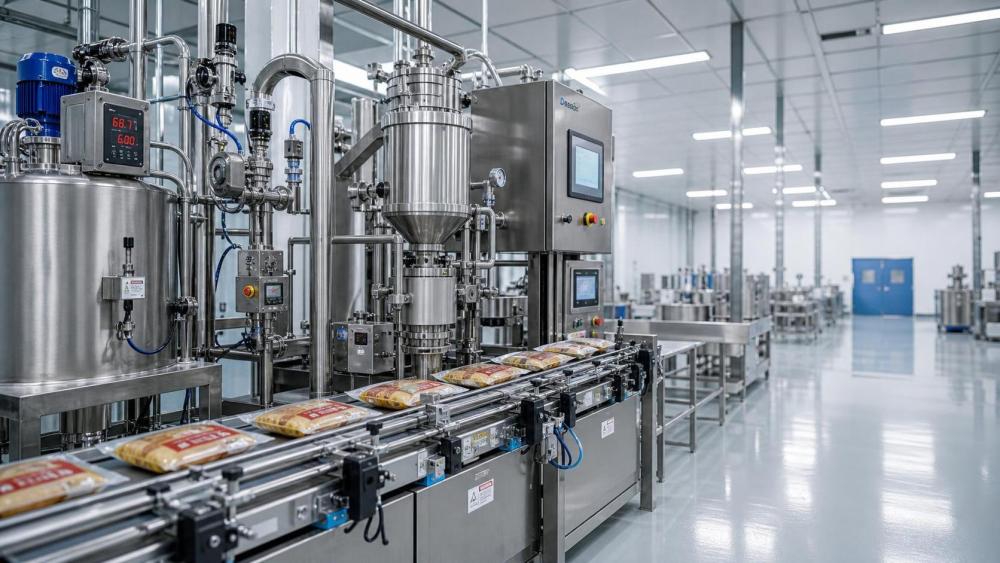
Where freeze-drying, vacuum concentration, or vacuum packaging is used, pressure stability becomes part of thermal control as well. Vacuum level influences boiling behavior, moisture removal, seal integrity, and package headspace. A pump may still be running while effective vacuum deteriorates because of leakage, condensate issues, worn seals, or fouled filters. Pressure should be monitored close to the process, not only at the pump skid, especially when pipe length and product vapor load are significant.
Traceability fails when identification is treated as a late-stage add-on
A controlled food process needs product identity to move with the product. Batch numbers, lot codes, date marks, and line identifiers are not administrative extras. They are process variables tied to release status, hold decisions, and recall scope. If coding is added at the end without upstream verification, the plant may have accurate production data but no reliable way to connect it to the physical goods already palletized.
Marking and coding systems should be matched to the packaging material, line speed, condensation exposure, abrasion risk, and expected readability after transport. Ink behavior on flexible film differs from behavior on coated cartons or rigid plastic. Laser marking may perform well on some surfaces and poorly on others if the contrast layer is inconsistent. Code verification should account for print position and legibility after sealing, because a code that was technically applied may still be hidden in a fold, distorted by heat, or lost under frost.
Traceability becomes stronger when code generation is linked to active recipe, shift, line, and batch status. That reduces the chance of manual code entry errors during changeover. It also matters during rework. If rework is permitted under defined conditions, the added material needs its own identity in the record, otherwise the finished batch history becomes incomplete even when all ingredients were physically correct.
Cleaning control is part of product control
Food plants often separate sanitation from production in discussion, while the process itself does not. Residues left in transfer lines, dead legs, nozzles, or fill heads can alter both hygiene risk and product composition in the next run. Industrial process control supports sanitation by confirming concentration, temperature, conductivity, flow coverage, and cycle completion rather than relying on elapsed time alone.
Clean-in-place systems need more than a valid recipe. Return conductivity may indicate detergent presence, but it does not prove mechanical action reached a shadowed area. Flow that is adequate for one circuit may be too low for another with different elevation or line diameter. If a conductivity sensor is installed where dilution lingers, rinse completion may be falsely accepted. After maintenance, improperly reassembled gaskets, spray devices, or valve seats can change wash effectiveness even though the cleaning program remains unchanged.
For components that require offline cleaning, including precision nozzles, filters, and small product-contact parts, controlled ultrasonic cleaning may be used where fine residues are difficult to remove manually. The value is not the cleaning method by itself, but repeatable exposure time, bath condition, and post-clean handling that prevent cleaned parts from becoming recontaminated before assembly.
Packaging and final handling still need process discipline
Many product complaints originate after the cooking or mixing stage has already been completed correctly. Seals fail because jaw temperature drifted or film tension changed. Modified atmosphere packaging loses effectiveness because residual oxygen was not monitored during a film roll change. Net content variation grows when product temperature alters viscosity at the filler. Even pallet stability can affect traceability if labels tear or barcode placement is inconsistent.
Final handling should therefore be included in the same control logic as upstream production. Seal verification, package vacuum or gas checks where relevant, weigh control, code verification, and reject confirmation all need a recorded response path. A rejected pack that is not physically removed is not a controlled reject. Likewise, a metal detector or X-ray event that is logged but not reconciled with downstream count creates a record gap that becomes serious during investigation.
Installation and maintenance decisions shape control reliability
Instrumentation quality is often judged by specification sheet accuracy, but field conditions determine whether that accuracy survives daily production. Sensors installed where washdown enters connectors, impulse lines that trap condensate, poorly routed signal cables near variable frequency drives, or unsupported piping stressing a flowmeter can create unstable readings that look like process noise. In hygienic areas, the mechanical design of mounts, cable glands, and enclosures matters because poorly detailed installations can introduce both sanitation concerns and calibration drift.
Maintenance should focus on failure patterns that degrade trust gradually. A drifting temperature probe, a sticky control valve, a vacuum leak that appears only during warm operation, or a worn printhead can all remain in service while pushing the line toward inconsistent output. Preventive work is more effective when it follows actual process symptoms in the trend data instead of generic intervals alone. Repeated manual overrides, frequent operator edits to setpoints, and chronic alarm shelving usually indicate that the process or instrument needs attention.
Spare parts strategy also affects control performance. Replacing a failed sensor with a slightly different range, wetted material, connector type, or response time may restore operation while changing process behavior. In food environments, compatibility with cleaning chemicals, temperature cycles, and product contact requirements should be reviewed before substitutions are released.
Control discipline reduces release uncertainty
When process data is complete, product review becomes less dependent on inference. A release decision can consider whether the batch stayed within defined mass, time, temperature, pressure, and identification conditions, whether deviations were corrected early enough to matter, and whether packaging controls remained effective through the run. That does not remove the need for laboratory checks or sensory evaluation, but it changes their role. Instead of trying to discover hidden process variation after the fact, testing can be used to confirm a process that was already kept under control.
In food processing, consistency and safety improve when measurement points reflect real product risk, when alarms lead to action instead of noise, and when auxiliary systems such as weighing, coding, vacuum, and cleaning controls are treated as part of the production process rather than support equipment sitting at the edge of it.