
Evaluating Dry PU/PVC Coating Line Capabilities for High-Yield Artificial Leather Manufacturing in 2026
Why Dry PU/PVC Coating Line Performance Matters for 2026 Artificial Leather Output Targets
Project managers overseeing artificial leather production lines face a narrowing margin between theoretical capacity and actual yield. In 2026, the pressure isn’t just to meet volume targets—it’s to sustain them across shifting material formulations, tighter environmental compliance windows, and volatile raw material supply chains. Dry-type PU/PVC coating lines sit at the center of this challenge: they’re not auxiliary equipment but throughput determinants. A line rated for 1,200 mm/min on paper may deliver only 850 mm/min in continuous operation if tension control drifts by ±3%, oven zones lack thermal uniformity across width, or web tracking tolerances exceed ±1.2 mm over 24 hours. These aren’t hypothetical variances—they’re measurable parameters that directly impact scrap rate, rework frequency, and first-pass yield per shift.
Key Operational Parameters That Define Real-World Capability
Three interdependent subsystems govern dry coating line performance: web handling, coating application, and thermal processing. Each requires verification—not just specification sheet review—during procurement evaluation.
Web handling starts with the stenter frame’s structural rigidity. Lines built with welded steel frames (not bolted assemblies) maintain dimensional stability under thermal expansion and mechanical load. A 0.05 mm/m deviation in rail flatness translates to cumulative misalignment across 30 m of drying zone, causing edge wrinkling or coating thickness variation >±8% at 1.8 m web width. Tension control must operate across speed ranges—not just at nominal rate. If closed-loop dancer arms respond slower than 120 ms to load change, web slippage occurs during acceleration, resulting in streaking or delamination at seam transitions.
Coating application hinges on doctor blade geometry and backing roll hardness. PU formulations vary in viscosity (3,500–7,200 cP at 25°C), and PVC plastisols shift rheology with temperature. A fixed-angle blade works only within a narrow viscosity band; adjustable-angle systems allow recalibration without hardware replacement. Backing roll Shore A hardness must match substrate elongation—too soft, and it deforms under nip pressure; too hard, and it transmits vibration into the wet film.
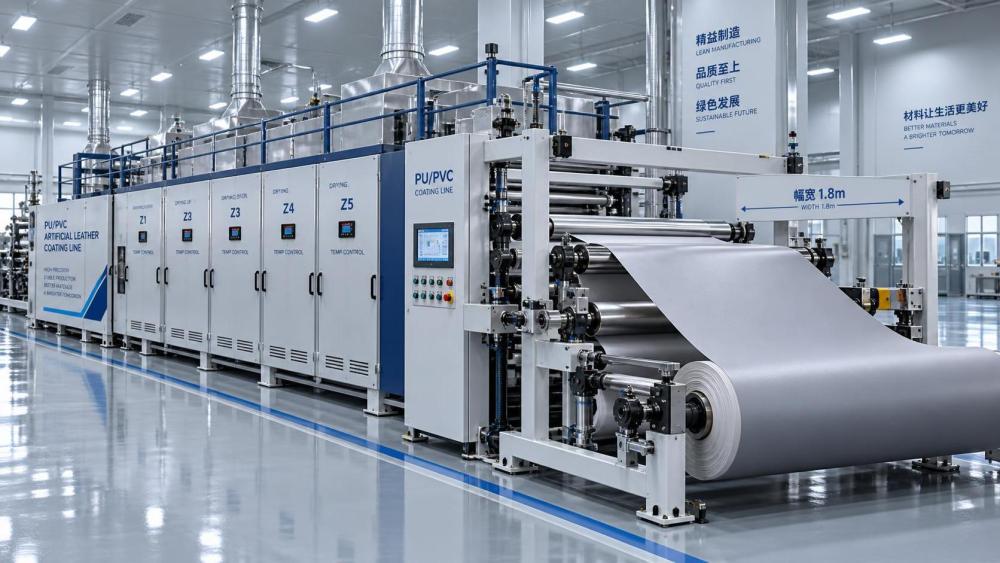
Thermal processing demands zonal independence. A single-zone oven cannot accommodate the staged solvent evaporation profile required for high-solids PU (e.g., 35% solids). Zone 1 must evaporate carrier solvents at lower temperatures (90–110°C), Zone 2 drive off residual moisture (120–135°C), and Zone 3 cure crosslinkers (145–160°C). Temperature variance across the belt width must stay within ±2.5°C to prevent differential shrinkage—a common cause of post-coating curl or dimensional instability in finished rolls.
Process Checks That Reveal Hidden Limitations
Standard factory acceptance tests often miss real-world stress points. Project managers should require these three process checks before final sign-off:
- 24-hour thermal soak test: Run at 95% of rated speed with full-width polyester scrim substrate for one full shift. Monitor oven zone temperatures every 30 minutes using calibrated thermocouples placed at center, quarter, and edge positions. Record maximum deviation per zone.
- Viscosity ramp test: Feed three consecutive batches differing in PU viscosity by ±15% (e.g., 4,800 → 5,520 → 6,348 cP). Measure coating weight consistency (gravimetric method) at entry and exit of drying zone. Acceptable variation: ≤±4.5 g/m² across all batches.
- Edge tracking stability test: Introduce controlled lateral offset (±2 mm) at unwind station and verify automatic correction time and overshoot amplitude. System must return to centerline within 1.8 seconds with ≤0.3 mm overshoot.
These tests expose design compromises masked by peak-performance claims—such as insufficient heater watt density, undersized exhaust fans, or inadequate servo motor torque for rapid tension recovery.
Material-Specific Implications for PU vs. PVC Operation
PU and PVC demand different thermal profiles and mechanical responses. PVC plastisols require longer dwell time at elevated temperatures (≥150°C) to fuse particles, making heat transfer efficiency critical. Lines with forced convection ovens outperform radiant-only designs when processing thick PVC films (>0.35 mm), reducing surface blistering risk. PU coatings, conversely, are sensitive to rapid heating—thermal shock causes microcracking in the top layer before full crosslinking. A line with gradual temperature ramping (≤8°C/min) and precise exhaust humidity control (<35% RH) minimizes this defect.
Substrate compatibility also dictates line configuration. Nonwoven backings stretch differently than knits or wovens under tension. Stenter frames must allow independent adjustment of pin bar spacing and chain tension—features often omitted from entry-level models. Without this, dimensional stability suffers, leading to inconsistent coating coverage at selvages.
Supply Chain and Service Considerations Beyond Technical Specs
Delivery lead time for dry coating lines has stretched beyond 28 weeks for custom configurations. Projects scheduled for Q2 2026 commissioning must place orders by late Q4 2025—assuming no component shortages in stainless steel rollers or PLC controllers. Spare parts availability matters more than headline pricing: if critical components like ceramic coating blades or high-temp bearing assemblies require 12-week air freight, unplanned downtime multiplies cost per meter of output.
Service support must be verified—not assumed. Request evidence of on-site technician certifications for specific line models, not generic “automation” credentials. Verify whether firmware updates are provided free for the first 24 months, and whether remote diagnostics require proprietary software licenses that expire annually.artificial leather coating line
Validation Protocol for Procurement Teams
Procurement documents should mandate third-party witnessed testing—not vendor-conducted demonstrations. Specify ASTM D3776 for coating weight measurement, ISO 10012 for measurement system analysis of thickness gauges, and ISO 5725 for repeatability of oven temperature readings. Require documentation of calibration certificates traceable to NIST or equivalent national metrology institute for all test instruments used during FAT.
Reject proposals where coating width is listed as “up to 2,200 mm” without stating minimum stable operating width. A line capable of 2,200 mm at 600 m/min may only hold ±5% coating weight consistency above 1,600 mm. Define minimum acceptable consistency at your target production width—not the maximum possible.
Final Selection Criteria for 2026 Deployment
The right dry PU/PVC coating line isn’t defined by its highest published speed or widest coating width. It’s defined by its ability to maintain coating weight consistency ±3.2 g/m², dimensional stability ±0.15% lengthwise, and surface defect rate <0.18/m² across planned operating shifts—without requiring operator intervention every 90 minutes. That capability emerges from mechanical precision, thermal control granularity, and validated response to real material variability—not brochure metrics. Project managers who prioritize verifiable process behavior over headline numbers reduce yield volatility, avoid costly retrofitting, and secure predictable output through 2026 and beyond.